<TEI xmlns="http://www.tei-c.org/ns/1.0" xml:id="M0012518">
    <teiHeader>
        <fileDesc>
            <titleStmt>
                <title type="main">Heft IX (1879)</title>
                <author><persName ref="http://d-nb.info/gnd/118578537">
                        <surname>Marx</surname>
                        <forename>Karl</forename>
                    </persName></author>
                <editor><persName ref="http://d-nb.info/gnd/1159394350">
                        <forename>Timm</forename>
                        <surname>Graßmann</surname>
                    </persName></editor>
            </titleStmt><editionStmt><p/></editionStmt>
            
            <publicationStmt><publisher><ref target="https://www.bbaw.de">Berlin-Brandenburgische Akademie der Wissenschaften</ref></publisher><pubPlace ref="https://www.geonames.org/2950159">Berlin</pubPlace><availability><licence target="https://creativecommons.org/licenses/by-sa/4.0/">Creative Commons Attribution-ShareAlike 4.0 International (CC BY-SA 4.0)</licence></availability><idno type="URLWeb">https://megadigital.bbaw.de/</idno><idno type="URLXML">https://megadigital.bbaw.de/.xml</idno></publicationStmt>
            <seriesStmt> 
                <title>Exzerpte und Notizen</title>
                <biblScope unit="section" n="IV"/>
                <biblScope unit="volume" n="25"/>
                <biblScope unit="chapter" n="15" select="main" prev="M0012517" next="M0012519"/> 
            </seriesStmt>
            <notesStmt><relatedItem type="introduction">
                <bibl><ref target="https://megadigital.bbaw.de/M7770300"/></bibl>
            </relatedItem>
                <relatedItem type="cover_image"><ref target="https://digilib.bbaw.de/digitallibrary/servlet/Scaler/IIIF/silo10!mega!exzerptstart!15_Heft_IX_IISG_B_151.jpg/full/!190,400/0/default.jpg"/></relatedItem></notesStmt>
            <sourceDesc>
                <msDesc><msIdentifier>
                    <institution>IISH (International Institute of Social History)</institution>
                    <repository>ARCH00860</repository>
                    <collection>Karl Marx and Friedrich Engels Papers</collection>
                    <idno>
                        <idno type="shelfmark">B 151 [B 137]</idno>
                        <idno type="uri">https://search.iisg.amsterdam/Record/ARCH00860/ArchiveContentList#ARCH00860</idno>
                        <idno type="URLCatalogue">https://search.iisg.amsterdam/Record/ARCH00860/ArchiveContentList#B_151</idno>
                        <idno type="URLImages">https://access.iisg.amsterdam/universalviewer/#?manifest=https://hdl.handle.net/10622/ARCH00860.B_151?locatt=view:manifest</idno>
                    </idno>
                </msIdentifier>
                    <physDesc>
                        <p><list>
                            <item>H Originalhandschrift: IISG, Marx-Engels-Nachlass, Sign.
                                B 151/B 137.</item>
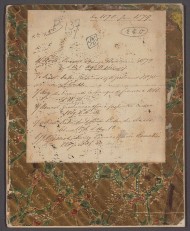
                            <item>Beschreibstoff: Notizheft mit kartoniertem Umschlag, Außenseiten marmorartig und mit schrägen hell- und dunkelbraunen Streifen gemustertem Papier bezogen, Innenseiten mit weißem Papier beklebt. Format: 202 × 161 mm. Auf Vorderdeckel von Engels Etikett im Format 139 × 126 mm aufgeklebt. Keine Vorsatzblätter. Darin eingebunden 20 Blatt (= 40 Seiten) mittelstarkes, glattes, weißes Papier, unliniert. Wasserzeichen: A PIRIE &amp; SONS sowie helle Streifen im Abstand von 26 mm.</item>
                            <item>Zustand: Gut erhalten, Papier leicht vergilbt. Ecken und Kanten des Umschlags leicht abgestoßen, vom Hinterdeckel links oben ein dreieckiges Stück abgerissen, dadurch auf der Innenseite geringer Textverluste.</item>
                            <item>Schreiber: Marx, Engels (nur Etikett).</item>
                            <item>Schreibmaterial: Schwarze Tinte, leicht bräunlich verfärbt. Auf Etikett auch eine Bleistifteintragung.</item>
                            <item>Beschriftung: Vorderdeckel beidseitig und Innenseite des Hinterdeckels (teilweise) sowie alle 40 Seiten. Lateinische und deutsche Schrift..</item>
                            <item>Paginierung: Marx paginierte 1–40 und Innenseite des Hinterdeckels 41 mit Tinte (später von fremder Hand mit Bleistift nachgezogen).</item>
                            <item>Vermerke fremder Hand: Archivstempel IISG, Sign. B 137; Fotosign. Eb 0 – Eb 41 (mit Bleistift).</item>
                        </list>                            
                        </p>
                    </physDesc>
                </msDesc>
            </sourceDesc>
        </fileDesc>
        <profileDesc><textClass><keywords><term>excerpts</term></keywords></textClass>
            <creation>
                <persName ref="https://megadigital.bbaw.de/M0001374 http://d-nb.info/gnd/118578537">Marx, Karl (1818–1883)</persName>
                <placeName/>
                <date from="1879-01-01" to="1879-02-28"/>
            </creation>
            <langUsage>
                <language ident="de">German</language>
            </langUsage>
            <abstract><p>41 Seiten</p>
                <p>Exzerpte von wahrscheinlich Januar 1879 aus:</p>                
                <p>– Pietro Rota: Principj di scienza bancaria (1873)</p>
                <p>– Otto von Diest-Daber: Geldmacht und Socialismus (1875)</p>
                <p>– Otto von Diest-Daber: Der sittliche Boden im Staatsleben (1876)</p>
                <p>– Joseph-Louis Rey: Des erreurs de la Banque de France et des crises financières
                    (1866)</p>
                <p>– Victor Bonnet: Questions économiques et financières a propos des crises (1859)</p>
                <p>– John P. Gassiot: Monetary Panics and their Remedy (1867)</p>
                <p/>
            </abstract>
        </profileDesc>       
    </teiHeader>
    <text><body>
            <pb n="[Umschlag]"/>
            <div n="1">
                <head type="toc" resp="editor">
                    <supplied reason="editorialOutline">Inhaltsverzeichnis von
                    Engels</supplied></head>
                <table rend="frame" xml:id="Table1">
                    <head>Dec. 1878 – Jan. 1879.</head>
                    <row>
                        <cell>1) Rota, Princ. di Scienza Bancaria.
                            1873.</cell>
                        <cell>S. 1 bis 5. Heft II (Schluss).</cell>
                    </row>
                    <row>
                        <cell>2) v. Diest-Daber. Geldmacht
                            &amp; Sozialismus 1875.</cell>
                        <cell>S. 5–11.</cell>
                    </row>
                    <row>
                        <cell>3) Rey, des Erreurs de la Banque de France &amp;c 1866.</cell>
                        <cell>S. 13–16.</cell>
                    </row>
                    <row>
                        <cell>4) Bonnet, Questions éc. &amp;
                            fin. à propos des crises. 1859. </cell>
                        <cell>S. 16–36.</cell>
                    </row>
                    <row>
                        <cell>5) v. Diest-Daber, der
                            sittliche Boden des Staatslebens. 1876.</cell>
                        <cell>S. 11–13.</cell>
                    </row>
                    <row>
                        <cell>6) J. P. Gassiot, Money Panics
                            &amp; their Remedies. 1867.</cell>
                        <cell>S. 36–40. <ref xml:id="c64bd9d6-a118-4c93-8bd9-d6a1186c93b8" corresp="#b0dcd28a-60c1-469c-9cd2-8a60c1569c4f" type="editorialNote">Heft I</ref><note xml:id="b0dcd28a-60c1-469c-9cd2-8a60c1569c4f" corresp="#c64bd9d6-a118-4c93-8bd9-d6a1186c93b8" type="editorial">Mit Bleistift
                            geschrieben.</note></cell>
                    </row>
                </table>
            </div>
            <pb n="[0]"/>
            <div n="1">
                <head type="toc" resp="editor">
                    <supplied reason="editorialOutline">Inhaltsverzeichnis und bibliographische
                        Notizen</supplied></head>
                <p>1) <hi rendition="#u">Pietro Rota.</hi>
                    <hi rendition="#u">Principj di Scienza Bancaria (Milano 1873 2<hi rendition="#sup">nd</hi> ed.)</hi>
                    <hi rendition="#u">Schluss.</hi> (p. 1–5)</p>
                <p>2) <hi rendition="#u">v. Diest-Daber.</hi>
                    <hi rendition="#u">Geldmacht u. Socialismus</hi>
                    <hi rendition="#u">2<hi rendition="#sup">t</hi> Aufl. Berlin 1875</hi>
                    (5–11)</p>
                <p>3) <hi rendition="#u">Rey</hi>, J. L. <hi rendition="#u">Des Erreurs de la Banque
                        de France et des Crises financières que ces Erreurs provoquent.</hi>
                    Marseille 1866 (13–16)</p>
                <p>4) <hi rendition="#u">V. Bonnet:</hi>
                    <hi rendition="#u">Questions économiques et financières à propos des
                        crises.</hi>
                    <hi rendition="#u">Paris</hi> 1859 (p. 16–36)</p>
                <p>5) <hi rendition="#u">v. Diest-Daber:</hi>
                    <hi rendition="#u">Der sittliche Boden im Staatsleben.</hi>
                    <hi rendition="#u">2 Aufl. Berlin 1876.</hi> (11–13)</p>
                <p>6) <hi rendition="#u">John P. Gassiot:</hi>
                    <hi rendition="#u">„Monetary Panics and their Remedy“</hi>
                    <hi rendition="#u">London 1867</hi> (p. 36–40)</p>
                <lb/>
                <lb/>
                <lb/>
                <p>Gegen <persName ref="https://megadigital.bbaw.de/M8663371 https://d-nb.info/gnd/124436269">Rorarius</persName> ⦗von protestantischer
                    Seite⦘: „Murium in Campegianis hortis degentium, adversus N. Bestii …, Vicarii
                    Pontificii edictum, oratio pro se ipsis, patrocinante H. R. ⦗Hieronymus
                    Rorarius⦘ etc<supplied cert="high">“</supplied> Augustae Rheticae, 1663. 4°;
                    dies im <hi rendition="#u">brit. Museum</hi>: 1080.l.38. unter <hi rendition="#u">Rorarius (Hieronymus)</hi></p>
                <lb/>
                <p><hi rendition="#u">Hieronymi Rorarii:</hi>
                    <hi rendition="#u">ExLegati Pontificii: „Quod Animalia bruta ratione utantur
                        melius homine.<supplied cert="high">“</supplied> Libri duo. <choice>
                            <sic>Parisis</sic>
                            <corr cert="high">Parisiis</corr>
                        </choice> 1648</hi>, ed. Gabriel Naudé (Naudaeus) In d<ex>er</ex> Schrift
                    lässt <hi rendition="#u"><persName ref="https://megadigital.bbaw.de/M8663371 https://d-nb.info/gnd/124436269">Rorarius</persName>
                            d<ex>as</ex> Thema</hi> – ein Gespräch mit ihm selbst – durchführen von
                        <persName ref="https://megadigital.bbaw.de/M2169880">Bernardus Clesius</persName>, <hi rendition="#u">Cardinalis Tridentinus</hi> ⦗also Exlegat Pontificus (Horarius) u. sein
                    Freund d<ex>er</ex>
                    <hi rendition="#u">Cardinal</hi>. Praedarwiniten quant à la raison des animaux⦘
                    ⦗Of course the thing was meant against the <hi rendition="#u">doctrine of
                            <persName ref="https://megadigital.bbaw.de/M0010831 http://d-nb.info/gnd/118524844">Descartes</persName> that animals are mere
                        machines</hi>.⦘</p>
                <p>Andre Ausgabe mit Zusätzen im 18<hi rendition="#sup">t</hi> Jahrhundert
                    zu Helmstadt v. deutschem Professor.<supplied cert="high">⦘</supplied></p>
            </div>
            <pb n="1"/>
            <div n="1" xml:id="nnwg_5tg_tvb">
                <note type="excerpt_source" resp="editor" corresp="#nnwg_5tg_tvb"><bibl><persName ref="https://megadigital.bbaw.de/M6377082">Pietro Rota</persName>:
                        Principj di Scienza Bancaria. 2. ed., notevolmente accresciuta e migliorata.
                        Milano 1873.</bibl></note>
                <head type="toc"><persName ref="https://megadigital.bbaw.de/M6377082">Pietro Rota</persName>. Principj di
                    Scienza Bancaria 2 ed. Milano. 1873 (<ref xml:id="a154e883-7c96-4793-94e8-837c96479375" corresp="#b0d4c3a9-522d-4749-94c3-a9522d874968" type="editorialNote">Schluss</ref><note xml:id="b0d4c3a9-522d-4749-94c3-a9522d874968" corresp="#a154e883-7c96-4793-94e8-837c96479375" type="editorial">Marx beendet hier die
                                in <ref target="https://megadigital.bbaw.de/M0012516/nfzj_rpx_pvb">Heft VIII</ref> begonnenen Auszüge aus Rotas „Principj di Scienza Bancaria“.</note>)</head>
                <div n="2">
                    <head type="toc">C<ex>ap</ex>. XI Istituto di Credito Reale.</head>
                    <p>1) <hi rendition="#u">D<ex>ie</ex> Bedürfnisse d<ex>er</ex> Agricultur</hi>.
                        In <hi rendition="#u">Italien</hi> producirt im <hi rendition="#u">Durchschnitt</hi> von <hi rendition="#u">hectare Land</hi> – <hi rendition="#u">10 ettolitri di frumento</hi>, <hi rendition="#u">40</hi>
                        in <hi rendition="#u">England</hi>, <hi rendition="#u">31</hi> in <hi rendition="#u">Würtemberg</hi>, <hi rendition="#u">23</hi> in Holland,
                            <hi rendition="#u">20</hi> in Sachsen, <hi rendition="#u">19</hi> in
                        Preussen u. Belgien. (317, N<ex>ote</ex> 1) Nella <hi rendition="#u">industria agricola moderna scompare quasi il vantaggio di una naturale
                            fertilità</hi> e domina <hi rendition="#u">la fertilità artificiale</hi>,
                        <hi rendition="#u">opera dell’uomo</hi>. (318)</p>
                    <p>2) <hi rendition="#u">Crédit foncier</hi>. Bei d<ex>en</ex> Alten galt <hi rendition="#u">Realcredit</hi> mehr als <hi rendition="#u">Personalcredit</hi>; so Axiom d<ex>es</ex> röm. Rechts: <ref xml:id="d8235540-425d-4ed6-a355-40425d9ed663" corresp="#f61a0d93-8bcc-4993-9a0d-938bccf99312" type="editorialNote"><hi rendition="#u">»plus est cautionis in re quam
                                    in persona«</hi></ref><note xml:id="f61a0d93-8bcc-4993-9a0d-938bccf99312" corresp="#d8235540-425d-4ed6-a355-40425d9ed663" type="editorial">„Eine
                                Sicherheitsleistung in Sachen ist mehr (wert) als die in einer
                                Person“ bzw. „Es gibt mehr Sicherheit bei einer Sache als bei einem
                                Menschen“</note>; u. unter d<ex>en</ex> Sachen scheint <hi rendition="#u">»la terra«</hi> beste Garantie zu bieten. Ein
                        Grundeigenthum gleichsam una proprietà pubblica, jeder kann Werth davon
                        schätzen, kann v. einer Hand in andre nicht übergehn ohne öffentlichen Act.
                        Und dennoch: Für Grundeigenthümer schwer Capital zu finden, u. wann, haben’s
                        theurer zu zahlen als Industrielle u. Kaufleut. <hi rendition="#u">Hauptgrund:</hi>
                        <hi rendition="#u">Agricultur verlangt Credit auf lange Verfalltermine</hi>;
                        in <hi rendition="#u">Ameliorationen</hi>
                        <choice>
                            <sic>angewandt</sic>
                            <corr cert="high">angewandtes</corr>
                        </choice> Capital kehrt nur zurück nach langem lapsus v. Zeit, auch nicht
                            <hi rendition="#u">ganz auf einmal</hi>, sondern <hi rendition="#u">brockenweis</hi>, indem d<ex>as</ex> angewandte Capital vom Boden
                        restituirt wird unter <hi rendition="#u">Form v. Vermehrung di rendita
                            annua</hi>. Proprietär kann zu solchem Zweck (Melioration) daher kein
                        Capital pumpen, wenn’s ihm nicht gemacht auf <hi rendition="#u">langterminigen</hi> Credit. Ausserdem in vielen Ländern, wenn terra als
                        Garantie angeboten, schwierig l’accertamento della proprietà, imbrogliato
                        assai il regime ipotecario etc. (319)</p>
                    <p><hi rendition="#u">Istitutio di credito fondiario</hi>, angeblicher Zweck:
                        Capital zu verschaffen f. migliorie alla proprietà fondiaria; ist <hi rendition="#u">intermediario</hi> zwischen Capitalist u.
                        Grundeigenthümer; Vehikel des credito fondiario – ist <hi rendition="#u">cartella fondiaria</hi>; d<ex>as</ex> Institut d<ex>es</ex> credit
                        foncier substituirt sich vis-à-vis dem Eigenthümer den Capitalisten, u.
                        vis-à-vis dem Capitalisten, substituirt’s sich den Eigenthümer; d<ex>as</ex>
                        Institut nimmt <hi rendition="#u">Hypothek auf Güter d<ex>es</ex>
                            Eigenthümers</hi>, consignirt ihm dafür <hi rendition="#u">Kapital</hi>,
                        nicht in Geld, sondern in <hi rendition="#u">cartelle fondiarie</hi>, i. e.
                            <hi rendition="#u">titoli di credito</hi>, worin das Institut <hi rendition="#u">si professa debitore di una determinata <choice>
                                <sic>summa</sic>
                                <corr cert="high">somma</corr>
                            </choice></hi>. Eigenthümer <ref xml:id="c52744ae-0f01-4b79-a744-ae0f016b79fc" corresp="#f52723ee-de8d-448a-a723-eede8d848a65" type="editorialNote">»verkoft« diese
                                Papiercher</ref><note xml:id="f52723ee-de8d-448a-a723-eede8d848a65" corresp="#c52744ae-0f01-4b79-a744-ae0f016b79fc" type="editorial">verkauft diese
                                Papiere</note>, findet leicht Käufer dafür u. so das ihm
                        nöthige Capital. Durch d<ex>en</ex> Verkauf der Papiercher contrahirt er
                        keine Obligation; seine Obligationen nur gegen d<ex>as</ex> Institut, dem er
                        zu zahlen <hi rendition="#u">Zins d<ex>es</ex> ihm geliehnen Capitals</hi>
                        u. <hi rendition="#u">Restitution des letztern selbst in vorher bestimmter
                            Epoche</hi>. Verkauf der Papiercher leicht, weil sehr sichres placement;
                        im Masse wie d<ex>ie</ex> Hypotheken extinct ⦗durch Zahlung seitens
                            d<ex>er</ex> Grundeigner⦘ <hi rendition="#u">entzieht das Institut die
                            Papiercher dem Handel</hi>. So macht d<ex>er</ex> Capitalist <hi rendition="#u">loan auf Grundeigenthum ohne durch lange Verfallstermine
                            sein Capital zu immobilisiren</hi>; denn da die Papiercher <hi rendition="#u">al portatore</hi>
                        <hi rendition="#u">kann er sie wieder verkofe</hi>, <hi rendition="#u">wenn
                            er sein Geld wieder haben will für andres Geschäft</hi>. Zweierlei
                        Urspung dieser Sorte Institute, <ref xml:id="af9cbc60-716f-432a-9cbc-60716f032ae1" corresp="#fd71c74c-795c-4132-b1c7-4c795c5132ee" type="editorialNote"><hi rendition="#u">Teutonisch</hi></ref><note xml:id="fd71c74c-795c-4132-b1c7-4c795c5132ee" corresp="#af9cbc60-716f-432a-9cbc-60716f032ae1" type="editorial">Bei Rota, S.
                                321: tedesco</note><hi rendition="#u"> u. French</hi>.</p>
                    <p>Des <hi rendition="#u">Teutonischen Ursprungs Credito Fondiario</hi>. (<hi rendition="#u">Deutscher typ</hi> – die proprietarî selbst; <hi rendition="#u">fzs. typ<ex>us</ex></hi> dagegen <hi rendition="#u">creation der Capitalisten</hi>)</p>
                    <p>Nachdem <hi rendition="#u">7jähriger Krieg</hi> beendet, d<ex>er</ex> Friede
                            <hi rendition="#u">1763</hi>; während d<ex>es</ex> Kriegs verlangten
                            d<ex>ie</ex>
                        <hi rendition="#u">Gläubiger</hi> nicht <hi rendition="#u">Zahlung v.
                                d<ex>en</ex>
                            <ref xml:id="dd2b0134-22de-4e9c-ab01-3422defe9c12" corresp="#e58b3899-dfc1-410e-8b38-99dfc1d10e8f" type="editorialNote">runirte Landeigenthümer</ref><note xml:id="e58b3899-dfc1-410e-8b38-99dfc1d10e8f" corresp="#dd2b0134-22de-4e9c-ab01-3422defe9c12" type="editorial">runierten
                            Landeigentümern</note></hi>, weil in Circulation befindliches Geld
                            <hi rendition="#u">alterata</hi> e <hi rendition="#u">mancante di
                            peso</hi>, so dass d<ex>ie</ex> Gläubiger bei Zahlung an sie oft
                        »schmerzliche Verlust«; aber nachdem <hi rendition="#u"><persName ref="https://megadigital.bbaw.de/M0011012 http://d-nb.info/gnd/118535749">Fried. II</persName></hi>
                        <choice>
                            <sic>brachte</sic>
                            <corr type="deleted"/>
                        </choice> Geldcirculation wieder in Ordnung gebracht, wollten d<ex>ie</ex>
                        Gläubiger – Zahlung v. d<ex>en</ex>
                        <ref xml:id="c0011367-91d1-4ec8-8113-6791d18ec88d" corresp="#cf2119f5-5e6c-4105-a119-f55e6c2105ae" type="editorialNote">Landlümmeln</ref><note xml:id="cf2119f5-5e6c-4105-a119-f55e6c2105ae" corresp="#c0011367-91d1-4ec8-8113-6791d18ec88d" type="editorial">Bei
                                Rota, S. 322: proprietarî</note>. Nun <hi rendition="#u">Edict
                            von
                            Fried. II</hi>
                        erlaubend <hi rendition="#u">den ruinirten Krautjunkern d<ex>er</ex>
                            Östlichen Provinzen Zahlung ihrer Schulden für 3 Jahre
                            aufzuschieben</hi>; dies half nicht viel; <hi rendition="#u">1767</hi>
                        Vorschlag
                        von <persName ref="https://megadigital.bbaw.de/M2818182"><hi rendition="#u"><choice>
                                    <sic>Volfang</sic>
                                    <corr>Wolfgang</corr>
                                </choice> Büring</hi></persName>, negoziante di Berlino: er wolle
                        wohlfeil d<ex>en</ex> Grundbesitzern Capital verschaffen; nähmlich
                            d<ex>ie</ex>
                        <hi rendition="#u">propriétaires bésogneaux</hi> (creditbedürftig) sollten
                        sich vereinigen in eine Gesellschaft; sie sollten <hi rendition="#u">verhypotheciren selber Gesellschaft ihre fondi</hi> u. d<ex>ie</ex>
                        <hi rendition="#u">Gesellschaft sollte ihnen cediren</hi>, zu <hi rendition="#sup">1</hi>/<hi rendition="#sub">3</hi> od. <hi rendition="#sup">1</hi>/<hi rendition="#sub">2</hi> des Werths des
                        fondo, <hi rendition="#u">negotiable »Pfandbriefe«</hi> (»lettere di
                        pegno«); <ref xml:id="db4dab4d-1801-40bd-8dab-4d180120bd65" corresp="#aac44815-a6ac-43f9-8448-15a6ac23f931" type="editorialNote">d<ex>as</ex> Kunststück, dem Gesindel
                                Credit zu verschaffen, bestand also bei Büring darin, d<ex>ie</ex>
                                <hi rendition="#u">Collectivgarantie der Burschen ihrer
                                    individuellen Garantie zu substituiren</hi></ref><note xml:id="aac44815-a6ac-43f9-8448-15a6ac23f931" corresp="#db4dab4d-1801-40bd-8dab-4d180120bd65" type="editorial">Zusammenfassung von Marx in eigenen
                                Worten.</note>. D<ex>ie</ex> so gebildeten
                        Bodencreditgesellschaften benamst: <hi rendition="#u">„Landschaftliche
                            Creditvereine“</hi>, sind gegründet u. dirigirt von d<ex>en</ex> Eignern
                        selbst. <hi rendition="#u">Erste die v. Schlesien</hi>, <hi rendition="#u">gegründet <choice>
                                <sic>1670</sic>
                                <corr>1760</corr>
                            </choice></hi>; <hi rendition="#u"><persName ref="https://megadigital.bbaw.de/M0011012 http://d-nb.info/gnd/118535749">Fd II</persName></hi> concurrirte bei deren Bildung, lieh ihr <hi rendition="#u"><choice>
                                <sic>200,000</sic>
                                <corr>300,000</corr>
                            </choice> Th. zu 2%</hi>
                        <ref xml:id="cb7fbbe8-5d6e-4cb2-bfbb-e85d6ebcb265" corresp="#c3b78ec4-a9f2-45c2-b78e-c4a9f285c285" type="editorialNote">(!)</ref><note xml:id="c3b78ec4-a9f2-45c2-b78e-c4a9f285c285" corresp="#cb7fbbe8-5d6e-4cb2-bfbb-e85d6ebcb265" type="editorial">Zusatz von
                                Marx.</note>; folgten nach d<ex>em</ex> schlesischen Vorgang
                            d<ex>ie</ex>
                        <hi rendition="#u">»landschaftliche«</hi> Gesellschaft für <hi rendition="#u">Pommern</hi> (1781), <hi rendition="#u">Brandenburg</hi>
                        (1782), <hi rendition="#u">Westpreussen</hi> (1787), <hi rendition="#u">Ostpreussen</hi> (1787). Einige dieser Gesellschaften waren <hi rendition="#u">obligatorisch</hi>; in Ostpreussen jeder Grundeigenthümer
                        verpflichtet in d<ex>ie</ex> società einzutreten. <hi rendition="#u">Sui
                            primordi</hi> konnten nicht verhypothecirt werden der Gesellschaft, also
                        auch keinen Credit v. ihr erhalten ausser die <hi rendition="#u">Rittergüter</hi>. Heutzutag nicht mehr<ref xml:id="d23bb6c8-3f97-459d-bbb6-c83f97659dd4" corresp="#b230d13c-3ed3-42ab-b0d1-3c3ed312ab41" type="editorialNote">?</ref><note xml:id="b230d13c-3ed3-42ab-b0d1-3c3ed312ab41" corresp="#d23bb6c8-3f97-459d-bbb6-c83f97659dd4" type="editorial">Zusatz von
                            Marx.</note> Dies preussische System completirt durch <hi rendition="#u">Einführung d<ex>es</ex> amortissement</hi>. D<ex>er</ex>
                        Eigenthümer kann nämlich jährlich <hi rendition="#u">zur Zinszahlung zufügen
                            einen Theil d<ex>es</ex> Capitals</hi>; la parte del capitale versato
                        wird ihm angerechnet (calcolato) negli interessi, u. indem er so für gewisse
                        Reihe <pb n="2"/> von Jahren bestimmte Summe zahlt, findet er sich mit poco
                        sacrifizio interamente liberato del debito suo. Dies System d<ex>es</ex>
                        Amortissement zuerst practicirt v. d<ex>er</ex>
                        <hi rendition="#u">Società territoriale von Lüneburg</hi>, <hi rendition="#u">1790</hi>, u. v. d<ex>er</ex> Territorialgesellschaft von
                        Posen, 1821. D<ex>ie</ex> »Pfandbriefe« wurden acceptirt v. Capitalisten;
                        dienten aber namentlich zur <hi rendition="#u">Placirung v<ex>on</ex>
                            Pupillengeldern</hi>
                        u. <hi rendition="#u">frommer Gesellschaften-Gelder</hi>. Selbst <hi rendition="#u">1807–15</hi> hielten diese Pfandbriefe assai bene ihre
                        Werthe – zwischen 70–80%; <hi rendition="#u">nur einmal, 1812, fielen die
                            der <ref xml:id="ec4effeb-b095-4b5d-8eff-ebb095ab5d74" corresp="#d786b85a-d7d2-4de8-86b8-5ad7d22de830" type="editorialNote">Schlesischen Gesellschaft</ref><note xml:id="d786b85a-d7d2-4de8-86b8-5ad7d22de830" corresp="#ec4effeb-b095-4b5d-8eff-ebb095ab5d74" type="editorial">Bei Rota, S. 324: della Società della
                                    Prussia occidentale. – Von der Schlesischen Gesellschaft war
                                    kurz vorher die Rede.</note> auf 33%, stiegen auf 91% in
                            1815</hi>. Seit 1815 d<ex>ie</ex> Pfandbriefe stets about <hi rendition="#u">pari</hi>, ohne viel drüber zu steigen; <hi rendition="#u">höchster Curs derer d<ex>er</ex> Schles.
                            Gesellschaft</hi> 107% (in J<ex>ahren</ex> 1829, 1830, 1835, 1836, 1837,
                        1838). <hi rendition="#u">Mit Ausnahme v. grossen politischen u. socialen
                            Ereignissen</hi> – ⦗nämlich considering, dass sonst d<ex>ie</ex> Natur
                        dieser Pfandbriefe nicht wechselbar, dass d<ex>ie</ex>
                        <hi rendition="#u">Sicherheit</hi>, <hi rendition="#u">die sie bieten</hi>,
                            <hi rendition="#u">nicht</hi> abnehmen kann, also auch nicht das in sie
                        gesetzte Vertrauen⦘ – die alle fortune erschüttern u. alle Institutionen
                        treffen, – kann einzige Ursache in <hi rendition="#u">Werthschwankung dieser
                            Papiercher sein Steigen od. Fallen d<ex>es</ex> Zinsfusses</hi>. Da <hi rendition="#u">fixirt d<ex>er</ex> Zins</hi> gegeben dalle cartelle,
                        also nicht folgend den Oscillationen der currenten Zinstaxe, so werden
                            d<ex>ie</ex> Pfandbriefe in Epoche grosser Nachfrage nach Capital im
                        Curs fallen, dahingegen aber in Epoche grossen Capitalüberflusses einen
                        ihren Nominalwerth überschiessenden Realwerth erreichen. Im Ganzen <hi rendition="#u">sind es wenigst variable Werthtitel</hi>, also gut für
                        den, der bescheidnes u. sichres placement für eignes Capital sucht. <hi rendition="#u">1805</hi> in Circulation f. 53,811,000 Th. in
                        Pfandbriefen, <hi rendition="#u">1848</hi> gestiegen auf 85,291,000 Th. Nach
                        einem Artikel v. <hi rendition="#u"><persName ref="https://megadigital.bbaw.de/M0009139 http://d-nb.info/gnd/118600400">Richter</persName></hi>
                        <hi rendition="#u">1862</hi> in Circulation für <hi rendition="#u">Th 150,246,000</hi>. Nach einem <hi rendition="#u">Report des fzs. gvt.
                            publicirt 1851</hi>, d<ex>ie</ex>
                        <hi rendition="#u">Pfandbriefe in allen deutschen Staaten</hi>, <hi rendition="#u">Gallicien</hi> eingeschlossen, <ref xml:id="b3d74a0f-8be0-47e3-974a-0f8be0a7e3d8" corresp="#c5583f47-38b4-44a2-983f-4738b4d4a2d7" type="editorialNote">hatte</ref><note xml:id="c5583f47-38b4-44a2-983f-4738b4d4a2d7" corresp="#b3d74a0f-8be0-47e3-974a-0f8be0a7e3d8" type="editorial">hatten</note>
                        <hi rendition="#u">damals erreicht Summe v. 540,423,158 fcs</hi>.</p>
                    <milestone unit="section" rendition="#hr"/>
                    <lb/>
                    <p><hi rendition="#u">Französischer typus</hi> ⦗existirt in Deutschland unter
                            d<ex>em</ex> Namen: <hi rendition="#u">»Hypothekenbanken«</hi>.⦘</p>
                    <p>Bedürfniss gefühlt seit lange; <hi rendition="#u">1834</hi> u. <hi rendition="#u">1837</hi> sprangen in <hi rendition="#u">Frankreich</hi>
                        auf <hi rendition="#u">kleine Crédit foncier Institute</hi>, wenig Erfolg,
                        presto si tolsero <choice>
                            <sic>del</sic>
                            <corr>dal</corr>
                        </choice> campo; <hi rendition="#u">1848</hi> die Frage d<ex>er</ex>
                        <hi rendition="#u">Istituti di credito fondiario</hi> lang debattirt in <hi rendition="#u">Assemblée nationale</hi>, schliesslich <hi rendition="#u">1851 Decret</hi>, festsetzend d<ex>ie</ex>
                        <hi rendition="#u">Normen</hi>, wonach diese Institute sich zu reguliren
                        hätten. Sprangen in d<ex>em</ex> Jahr auf <hi rendition="#u">Istituti di
                            credito fondiario</hi> zu <hi rendition="#u">Nevers, Marseilles,
                            Paris</hi>; aber d<ex>as</ex>
                        <hi rendition="#u">imperialist<ex>ische</ex></hi> gvt., <hi rendition="#u">centralizzatore par excellence</hi>, ertheilte <hi rendition="#u">exclusives Privileg f. d<ex>ie</ex> Operation des credito
                            fondiario</hi> d<ex>er</ex>
                        <hi rendition="#u">Societé de Crédit foncier zu Paris</hi>, die d<ex>en</ex>
                        Namen annahm: <hi rendition="#u">„<orgName ref="https://megadigital.bbaw.de/M0003240 https://d-nb.info/gnd/74551-0">Crédit Foncier de
                                France</orgName>“</hi>; sie erhielt Erlaubniss d<ex>ie</ex>
                        <hi rendition="#u">2 kleinen Institute v. Nevers u. Marseilles</hi>
                        <ref xml:id="ab9abae4-1283-4f3b-9aba-e412832f3b05" corresp="#c36a2769-699a-45dc-aa27-69699a15dcc4" type="editorialNote">anzukofen</ref><note xml:id="c36a2769-699a-45dc-aa27-69699a15dcc4" corresp="#ab9abae4-1283-4f3b-9aba-e412832f3b05" type="editorial">anzukaufen</note>; unterschriebnes Capital v. 90 Mil. <ref xml:id="bbabc49a-9ce8-4fcb-abc4-9a9ce8afcb26" corresp="#a5d01379-7189-4aa7-9013-7971890aa712" type="editorialNote">fcs</ref><note xml:id="a5d01379-7189-4aa7-9013-7971890aa712" corresp="#bbabc49a-9ce8-4fcb-abc4-9a9ce8afcb26" type="editorial">Bei Rota in
                                den Geldangaben stets: di lire, L. oder lire.</note>; macht
                        die loans in »denari«; zur Verschaffung d<ex>er</ex> Capitalien für diese
                        loans emittirt <hi rendition="#u">lettres de gage</hi> u. <hi rendition="#u">obbligazioni</hi> dette <hi rendition="#u">comunali</hi>; hatte am <hi rendition="#u">30 Juni 1871 in Circulation</hi> f. <hi rendition="#u">Pfandbriefe</hi> u. <hi rendition="#u">obbligazioni comunali an
                            1280 Mil. fcs</hi>. D<ex>ie</ex> Klagen gegen d<ex>ie</ex> Verwaltung
                            d<ex>es</ex> Credit foncier begründet, weil es seinen Ursprung von
                        Privilegien u. Centralisation hat; da es privilegirtes Institut, hat die
                        Regierung ihre Hand im Spiel, u. ernennt dessen <hi rendition="#u">Administratoren</hi>; diese, ernannt von Regierung, stellen zur
                        Disposition der letzteren die Capitalien des Instituts u. helfen ihr damit
                        in opere politiche, wie ultimamente ersichtlich dal valido concorso, den
                            d<ex>er</ex> Credit foncier <hi rendition="#u">lieh für d<ex>ie</ex>
                            Befestigungswerke v. Paris</hi> u. f. d<ex>ie</ex>
                        <hi rendition="#u">travaux publics con tanto scialaquio ordinate von Präfect
                                <persName ref="https://megadigital.bbaw.de/M0007245 http://d-nb.info/gnd/118773453">Haussmann</persName></hi>; da dies Institut
                        eine centralisirte Bank, so natürlich, dass d<ex>er</ex>
                        <hi rendition="#u">grössere Theil ihrer imprestiti gemacht an Paris</hi> u.
                            <hi rendition="#u">im Departement der Seine</hi>. Ueber <hi rendition="#u">15,762 imprestiti ipotecarî</hi> gemacht v. d<ex>em</ex>
                        Institut seit seinem Ursprung <hi rendition="#u">bis Ende 1868</hi> für
                        Summe v. <hi rendition="#u">fcs 936,000,000</hi>; davon hatte gehabt <hi rendition="#u">Departement der Seine 9214 für Summe von 674,400,000
                            fcs</hi> u. d<ex>er</ex>
                        <hi rendition="#u">Rest v. Frankreich 6548 für Summe von 261,600,000
                            fcs</hi>. Die <hi rendition="#u">loans auf Häuser</hi> waren mehr
                        begünstigt als die auf <hi rendition="#u">Ländereien</hi> (fondi); sopra <hi rendition="#u">1726 prestiti</hi>, concessi in 1868, waren <hi rendition="#u">1177 auf Hypothek von Häusern</hi>, f. Werth von
                        71,265,00 fcs, <hi rendition="#u">537 auf ipoteca di fondi</hi> für Werth
                        von 17,534,000 fcs u. 12 misti für 2 milioni fcs. (326, 27)</p>
                    <p>D<ex>as</ex> System der <hi rendition="#u">associazioni</hi> dei <hi rendition="#u">proprietarî</hi>
                        <ref xml:id="adf0cac6-1cff-4517-b0ca-c61cffa517dc" corresp="#bac9c7de-b1ef-4f54-89c7-deb1ef1f54b4" type="editorialNote">(deutscher typus)</ref><note xml:id="bac9c7de-b1ef-4f54-89c7-deb1ef1f54b4" corresp="#adf0cac6-1cff-4517-b0ca-c61cffa517dc" type="editorial">Zusatz von Marx.</note> kann nicht gut
                        gelingen, wo <pb n="3"/> Grundeigenthum sehr getheilt, wie in Italien u.
                        Frankreich. (327) Die Institute <hi rendition="#u">fzs. typus</hi> –
                        Hypothekenbanken, Crédit foncier – immer faul quando godano di privilegio
                        esclusivo. (l. c.)</p>
                    <p><hi rendition="#u">Vor 1859</hi> war es <hi rendition="#u">in Italien viel
                            leichter als heutzutag Credit zu finden für Agricultur</hi>; u. zwar
                        weil: »il prestito all’agricoltura« war »l’unico impiego possibile ai
                        risparmi«. Den <hi rendition="#u">Staatsschuldscheinen</hi> d<ex>en</ex>
                        verhassten »governi cattivi e stranieri« kehrte man d<ex>ie</ex> Schulter,
                            <hi rendition="#u">Handelsgesellschaften</hi> existirten wenige u. <hi rendition="#u">ihre Actionaire</hi> waren fast alle Fremde; seit <hi rendition="#u">1859</hi> grosses <ref xml:id="bcea7e98-99f1-4f14-aa7e-9899f1af1483" corresp="#f5666785-2fea-479a-a667-852fea979aa3" type="editorialNote">changement de
                                décoration</ref><note xml:id="f5666785-2fea-479a-a667-852fea979aa3" corresp="#bcea7e98-99f1-4f14-aa7e-9899f1af1483" type="editorial">Bei Rota, S. 328: le
                                cose mutarono d’aspetto</note>; sehr viele Capitalien <hi rendition="#u">suchten Anwendung in den national loans</hi>; mit polit<ex>ischem</ex> Wiedererwachen
                        <ref xml:id="ba766c4d-bb2a-43d8-b66c-4dbb2a03d847" corresp="#c1d794c2-502d-49b8-9794-c2502d19b89b" type="editorialNote">allgemeines Wiedererwachen</ref><note xml:id="c1d794c2-502d-49b8-9794-c2502d19b89b" corresp="#ba766c4d-bb2a-43d8-b66c-4dbb2a03d847" type="editorial">Bei Rota, S. 328: risveglio
                            industriale</note>
                        <ref xml:id="b7e8bad4-b88f-41ca-a8ba-d4b88fe1caef" corresp="#b257aebe-212c-4d80-97ae-be212cad8031" type="editorialNote">⦗i. e. Schwindel⦘</ref><note xml:id="b257aebe-212c-4d80-97ae-be212cad8031" corresp="#b7e8bad4-b88f-41ca-a8ba-d4b88fe1caef" type="editorial">Bemerkung von Marx.</note>
                        Eisenbahngesellschaften, Credit- industrielle etc
                        Unternehmungsgesellschaften. Neue commercielle activity; Zinsfuss steigt;
                        Agricultur, verlassen vom Kapital für mehr lockende Bissen, senti danno.
                        (327, 28)</p>
                    <p>In d<ex>er</ex> That: In Italien <hi rendition="#u">wählten d<ex>ie</ex>
                            Sparkassen</hi> immer mit Vorliebe dies »genere d’impiego« ⦗i. e. in
                        prestiti alla proprietà fondiaria⦘; namentlich zu erwähnen die v. <hi rendition="#u">Bologna</hi>, u. die v. <hi rendition="#u">Mailand</hi>,
                        welche letztere Ende 1862 introduceva il prestito ad ammortamento. Ein
                        wahres Credit Foncier Institut, welches begann seine Operationen <hi rendition="#u">Ende d<ex>es</ex> 17. Jhdts</hi>, ist il <hi rendition="#u">„<orgName ref="https://megadigital.bbaw.de/M0785762">Monte dei Paschi</orgName>“ di
                            Siena</hi>. (328) ⦗<hi rendition="#u">Sieh Relazione della Commissione
                            d’Inchiesta, v<ex>ol</ex>. I</hi>, p. 81 sqq.⦘</p>
                    <p>Indess d<ex>ie</ex> Prestiti seitens d<ex>er</ex>
                        <hi rendition="#u">Casse
                            di Risparmio</hi>, dal <orgName ref="https://megadigital.bbaw.de/M0785762"><hi rendition="#u">Monte dei Paschi</hi></orgName> u. <hi rendition="#u">ähnlicher Institute</hi> nicht genügend für d<ex>ie</ex> dringenden
                        Bedürfnisse d<ex>er</ex> Agricultur. <hi rendition="#u">Gesetz (italien.)
                                v<ex>om</ex> 14 Juni 1866</hi>, gab Ursprung d<ex>er</ex>
                        <hi rendition="#u">eigentlichen Credits fonciers in Italien</hi>. Durch dies
                        Gesetz wurden le <hi rendition="#u">operazioni di credito fondiario</hi>
                        affidate alla <hi rendition="#u">Cassa di Risparmio</hi> di <hi rendition="#u">Milano</hi>, alla <hi rendition="#u">Cassa di</hi>
                        risparmio di <hi rendition="#u">Bologna</hi>, alle <hi rendition="#u">Opere
                            Pie di S. Paolo di Torino</hi>, al <hi rendition="#u"><orgName ref="https://megadigital.bbaw.de/M6398580">banco di Napoli</orgName></hi>, u. al <hi rendition="#u">Monte dei Paschi di Siena</hi> ⦗<hi rendition="#u">1870</hi> kam hinzu il <hi rendition="#u">Banco
                            di Sicilia</hi>; <hi rendition="#u">1872</hi>
                            d<ex>ie</ex> Cassa di Risparmio di Cagliari; 1872 erstreckte sich
                            d<ex>as</ex> Gesetz über d<ex>en</ex> Credit foncier auch auf
                            d<ex>ie</ex> venetianischen Provinzen⦘, v. d<ex>en</ex>
                        <hi rendition="#u">territorialen Grenzen</hi> bestimmt, innerhalb deren
                        diese Institute <ref xml:id="a901593a-f86d-4acb-8159-3af86d2acbbe" corresp="#d3078734-235c-4734-8787-34235ce734e1" type="editorialNote">zu agire</ref><note xml:id="d3078734-235c-4734-8787-34235ce734e1" corresp="#a901593a-f86d-4acb-8159-3af86d2acbbe" type="editorial">zu agieren hatten</note>; sie erhielten
                        exclusives Privileg für d<ex>ie</ex> Operationen de credit foncier, oder
                        vielmehr festgesetzt, dass <hi rendition="#u">keine Gesellschaft, Institut,
                            Privater</hi> ähnliche Operationen machen dürfe <hi rendition="#u">se
                            non autorizzato per legge</hi>. (see <hi rendition="#u">Art. 23</hi>
                        obigen Gesetzes) D<ex>ie</ex> Institute mussten assigniren ein <hi rendition="#u">Capital in garanzia der neuen Operationen</hi>, <hi rendition="#u">u. dies
                            Capital so stabilito</hi>:</p>
                    <p><hi rendition="#u">Banco di Napoli</hi> – l<ex>ire</ex> 8 Milion<ex>i</ex>,
                            <hi rendition="#u">Monte dei Paschi</hi> 1 Mill. l<ex>ire</ex>, <hi rendition="#u">Cassa di Risparmio di Bologna</hi> 1 Mill. l<ex>ire</ex>,
                        die <hi rendition="#u">v. Mailand</hi> 4 Mil. l<ex>ire</ex>, <hi rendition="#u">Opere pie di S. Paolo</hi> 1,500,000 l<ex>ire</ex>.
                        (p. 330) Nach d<ex>em</ex> Gesetz dürfen die <hi rendition="#u">Institute</hi>: <hi rendition="#u">loan auf Hypothek</hi> u. <hi rendition="#u">Emission von cartelle fondiarie</hi>; loan <ref xml:id="caaffd19-dd55-4f17-affd-19dd55df1736" corresp="#d29f137b-faeb-4eb2-9f13-7bfaebdeb212" type="editorialNote">nicht &gt; <hi rendition="#sup">1</hi>/<hi rendition="#sub">2</hi></ref><note xml:id="d29f137b-faeb-4eb2-9f13-7bfaebdeb212" corresp="#caaffd19-dd55-4f17-affd-19dd55df1736" type="editorial">nicht
                                mehr als die Hälfte</note> d<ex>es</ex> Werths des stabile
                        ipotecato u. ist reimbursable mit Ammortisation; d<ex>as</ex> loan gemacht
                        in cartelle fondiarie zinstragend zu 5%; d<ex>er</ex> Loanempfänger zahlt
                            d<ex>em</ex> Institut <hi rendition="#u">5% Zins</hi> auf d<ex>ie</ex>
                        erhaltne Anleihe, <hi rendition="#u">0.45%</hi> per <hi rendition="#u">diritti</hi> di <hi rendition="#u">commissione</hi> u. <hi rendition="#u">0.15%</hi> a <hi rendition="#u">titolo d’abbonamento per
                            le tasse di registro e di bollo</hi>. Alles zusammen muss der Pumper
                        zahlen eine <hi rendition="#u">annualità</hi> von <hi rendition="#u">6.06%</hi> l<ex>ire</ex> se vuole estinguere il suo debito in 50 anni,
                        o di <hi rendition="#u">lire 13.42%</hi> se lo vuole estinguere in
                        10 anni.</p>
                    <p>Die istituti di credito fondiario eröffnen auch <hi rendition="#u">conto
                            corrente con ipoteca</hi>. D<ex>er</ex>
                        <hi rendition="#u">proprietär</hi> in diesem Fall erhält die <hi rendition="#u">Vorschüsse</hi> in Baribus u. muss zahlen <hi rendition="#u">einen Zins</hi>, <hi rendition="#u">che viene stabilito
                            di volta in volta all’apertura di ciascun conto</hi>, ma deve essere
                        dell’uno per cento più alto di quello che fruttano in realtà le cartelle
                        fondiarie; endlich erlaubt d<ex>en</ex> Instituten: <hi rendition="#u">Vorschüsse zu machen auf deposito di cartelle fondiarie</hi>; solcher
                        Vorschuss darf gehn bis <hi rendition="#sup">4</hi>/<hi rendition="#sub">5</hi> del <hi rendition="#u">corso delle cartelle</hi>, <hi rendition="#u">Zins muss sein 1% höher allo sconto della <orgName ref="https://megadigital.bbaw.de/M7477238">Banca Nazionale</orgName></hi>. <hi rendition="#u">Jeder andre Vorschuss auf Deposit ist verboten</hi> d<ex>en</ex>
                        Instituten di credito fondiario. (331) Capitalisten u. bankers begünstigen
                        till now by no means le cartelle fondiarie.</p>
                    <p>Der <hi rendition="#u">mehr oder weniger hohe Cours der cartelle
                            fondiarie</hi>, macht dass Grundeigner mehr od. weniger belastet; er
                        zahlt wirklich <hi rendition="#u">nur 5%</hi> wann die <hi rendition="#u">cartelle al pari</hi> sind u. <hi rendition="#u">paga interesse più
                            grave sul capitale realmente incassato più le cartelle si discostano dal
                            pari</hi>. Nach einer Publication d<ex>es</ex>
                        <persName ref="https://megadigital.bbaw.de/M1023885 https://d-nb.info/gnd/11935649X"><hi rendition="#u">Luigi
                                    Luzzatti</hi></persName>
                        <pb n="4"/> zeigt folgende Tabelle die <hi rendition="#u">Zinsrate reell
                            bezahlt für d<ex>ie</ex> prestiti</hi>, in relazione al corso delle
                        cartelle dei diversi istituti italiani:</p>
                    <table rend="frame" xml:id="Table2">
                        <row role="label">
                            <cell>Institute.</cell>
                            <cell>Börsenpreis d<ex>er</ex> Cartelle am 30 Juni 1871. </cell>
                            <cell>Zins d<ex>es</ex> loans des credito fondiario ausschliesslich
                                    d<ex>er</ex> Quote f. amortissement</cell>
                            <cell>Saggio dei prestiti gemacht mit ancient method d<ex>es</ex>
                                credito ipotecario</cell>
                        </row>
                        <row>
                            <cell>Turin</cell>
                            <cell><hi rendition="#c">421</hi></cell>
                            <cell><hi rendition="#c">6.65</hi></cell>
                            <cell><hi rendition="#c">7</hi></cell>
                        </row>
                        <row>
                            <cell>Mailand</cell>
                            <cell><hi rendition="#c">453.75</hi></cell>
                            <cell><hi rendition="#c">6.20</hi></cell>
                            <cell><hi rendition="#c">5.50</hi></cell>
                        </row>
                        <row>
                            <cell>Bologna</cell>
                            <cell><hi rendition="#c">376.45</hi></cell>
                            <cell><hi rendition="#c">7.44</hi></cell>
                            <cell><hi rendition="#c">6</hi></cell>
                        </row>
                        <row>
                            <cell>Siena</cell>
                            <cell><hi rendition="#c"><choice>
                                        <sic>383</sic>
                                        <corr cert="high">385</corr>
                                    </choice>.</hi></cell>
                            <cell><hi rendition="#c">7.27</hi></cell>
                            <cell><hi rendition="#c">6</hi></cell>
                        </row>
                        <row>
                            <cell>Napoli</cell>
                            <cell><hi rendition="#c">386</hi></cell>
                            <cell><hi rendition="#c">7.25</hi></cell>
                            <cell><hi rendition="#c">10</hi></cell>
                        </row>
                    </table>
                    <p>Ende <hi rendition="#u">1872 war Börsenpreis d<ex>er</ex> cartelle</hi>
                            d<ex>er</ex> verschiednen Institute:</p>
                    <table rend="frame" xml:id="Table3" cols="8">
                        <row>
                            <cell>Mailand</cell>
                            <cell>=</cell>
                            <cell>495.50</cell>
                            <cell/>
                            <cell>Bologna</cell>
                            <cell>=</cell>
                            <cell>425.</cell>
                            <cell/>
                        </row>
                        <row>
                            <cell>Turin</cell>
                            <cell>=</cell>
                            <cell>447.</cell>
                            <cell/>
                            <cell>Palermo</cell>
                            <cell>=</cell>
                            <cell>423.</cell>
                            <cell/>
                        </row>
                        <row>
                            <cell>Siena</cell>
                            <cell>=</cell>
                            <cell>430.</cell>
                            <cell/>
                            <cell>Napoli</cell>
                            <cell>=</cell>
                            <cell>414. </cell>
                            <cell>(p. 332)</cell>
                        </row>
                    </table>
                    <p>Man sieht dass d<ex>as</ex>
                        <hi rendition="#u">loan des credito fondiario theurer kommt dem
                            proprietario</hi> als kam d<ex>as</ex>
                        <hi rendition="#u">prestito ipotecario</hi> mit d<ex>em</ex> alten System,
                        except zu Turin u. zu Neaple. Zu hoffen, dass d<ex>er</ex> Curs dieser
                        »cartelle« sich mit d<ex>er</ex> Zeit verbessern u. <hi rendition="#u">al
                            pari</hi> steigen wird. Dann wird credito fondiario wirklich nützlich
                        sein dem <hi rendition="#u">proprietario</hi>. (333) Wie in Frankreich,
                        diese Institute haben ihre <hi rendition="#u">Sitze in grossen Städten</hi>,
                        u. haben <hi rendition="#u">auf d<ex>em</ex> Land</hi> u. in den
                            v<ex>om</ex> Centrum abgelegneren Städten keine Filialen, die mit
                        Vollmacht u. Mitteln versehn wären Operationen zu machen; kleine Städte u.
                        Landschaft haben wenig Nutzen v. diesen Instituten, deren Operationen fast
                        ausschliesslich <hi rendition="#u">Hypotheken auf d<ex>ie</ex> Häuser in
                                d<ex>en</ex> grossen Städten</hi>, wo sie ihren Sitz haben, u. in
                        loans auf <hi rendition="#u">terre</hi>, poste in una breve zona circostante
                        alla città (<choice>
                            <sic>433</sic>
                            <corr cert="high">333</corr>
                        </choice>)</p>
                    <p>Nach d<ex>en</ex> comptes rendus d<ex>er</ex> Operationen d<ex>es</ex>
                        <hi rendition="#u">Ist<ex>ituto</ex> di credit<ex>o</ex> fondiario</hi>
                        della <hi rendition="#u">Cassa di Risparmio di Milano fino al 31 Dec.
                            1871</hi>: in 4 Jahren seiner Existenz machte es <hi rendition="#u">207</hi> loans für l<ex>ire</ex>
                        <choice>
                            <sic>13,430,500</sic>
                            <corr>13,429,500</corr>
                        </choice>; diese loans, nach d<ex>er</ex>
                        <hi rendition="#u">ubicazione degli stabili ipotecati</hi> classificirt
                        so:</p>
                    <table rend="frame" xml:id="Table4" cols="4">
                        <row>
                            <cell>Auf Häuser d<ex>er</ex> Stadt e CC. SS.</cell>
                            <cell>v. Milano</cell>
                            <cell rend="end" rendition="#right">N. 85</cell>
                            <cell rend="end" rendition="#right"> per l<ex>ira</ex> 6,470,000</cell>
                        </row>
                        <row>
                            <cell>Sopra terr. della provincia</cell>
                            <cell>di Milano</cell>
                            <cell rend="end" rendition="#right">〃 38</cell>
                            <cell rend="end" rendition="#right">   〃   〃 2,094,000</cell>
                        </row>
                        <row>
                            <cell/>
                            <cell>di Bergamo</cell>
                            <cell rend="end" rendition="#right">4</cell>
                            <cell rend="end" rendition="#right"><choice>
                                    <sic>102,500</sic>
                                    <corr>122,500</corr>
                                </choice></cell>
                        </row>
                        <row>
                            <cell rend="end italic"/>
                            <cell>A riportarsi</cell>
                            <cell rend="end italic" rendition="#right">N. 127</cell>
                            <cell rend="end" rendition="#right"> l<ex>ira</ex> 8,686,500</cell>
                        </row>
                        <row>
                            <cell/>
                            <cell cols="3">⦗nämlich d<ex>ie</ex> eben erwähnte Summe 8,686,500
                                l.⦘</cell>
                        </row>
                        <row>
                            <cell>Sopra terr. della provincia</cell>
                            <cell>di Brescia</cell>
                            <cell rend="end" rendition="#right">〃20</cell>
                            <cell rend="end" rendition="#right">684,000</cell>
                        </row>
                        <row>
                            <cell/>
                            <cell>〃Como</cell>
                            <cell rend="end" rendition="#right">4</cell>
                            <cell rend="end" rendition="#right">114,000</cell>
                        </row>
                        <row>
                            <cell/>
                            <cell>〃Cremona</cell>
                            <cell rend="end" rendition="#right">31</cell>
                            <cell rend="end" rendition="#right">1,815,000</cell>
                        </row>
                        <row>
                            <cell/>
                            <cell>〃Mantova</cell>
                            <cell rend="end" rendition="#right">15</cell>
                            <cell rend="end" rendition="#right">514,000</cell>
                        </row>
                        <row>
                            <cell/>
                            <cell>〃Novara</cell>
                            <cell rend="end" rendition="#right">2</cell>
                            <cell rend="end" rendition="#right">135,000</cell>
                        </row>
                        <row>
                            <cell/>
                            <cell>〃Pavia</cell>
                            <cell rend="end" rendition="#right">8</cell>
                            <cell rend="end" rendition="#right">1,481,000</cell>
                        </row>
                        <row>
                            <cell/>
                            <cell/>
                            <cell rend="end" rendition="#right">N. 207</cell>
                            <cell rend="end" rendition="#right">L. <choice>
                                    <sic>13,430,500</sic>
                                    <corr>13,429,500</corr>
                                </choice></cell>
                        </row>
                    </table>
                    <p>Verschiedne Verbesserung v<ex>om</ex> Minister d<ex>er</ex> Agricultur
                        vorgeschlagen, werden Gesetz werden; davon wichtigst: <hi rendition="#u">agenzie locali</hi>.</p>
                    <table rend="frame" xml:id="Table5" cols="6">
                        <head>Bilanzen d<ex>er</ex> Istitute (italien.) di credito fondiario</head>
                        <row role="label">
                            <cell/>
                            <cell/>
                            <cell rend="center">Am 31 Dec. 1870</cell>
                            <cell rend="center">Am 31 Dec. 1871</cell>
                            <cell rend="center">Am 31 Decbr 1872</cell>
                            <cell/>
                        </row>
                        <row>
                            <cell rend="justify">Cartelle fond.</cell>
                            <cell>Numero</cell>
                            <cell rend="end" rendition="#right"><choice>
                                    <sic>72,083</sic>
                                    <corr>72,038</corr>
                                </choice></cell>
                            <cell rend="end" rendition="#right">101,504</cell>
                            <cell rend="end" rendition="#right">140,789</cell>
                            <cell/>
                        </row>
                        <row>
                            <cell> </cell>
                            <cell>Importo</cell>
                            <cell rend="end" rendition="#right">36,019,000</cell>
                            <cell rend="end" rendition="#right">51,752,000</cell>
                            <cell rend="end" rendition="#right"><choice>
                                    <sic>70,394,5000</sic>
                                    <corr>70,394,500</corr>
                                </choice></cell>
                            <cell/>
                        </row>
                        <row>
                            <cell cols="2">Conti correnti ipotecarî</cell>
                            <cell rend="end" rendition="#right"><choice>
                                    <sic>11,014</sic>
                                    <corr>14,014</corr>
                                </choice></cell>
                            <cell rend="end" rendition="#right">92,593</cell>
                            <cell rend="end" rendition="#right">98,097</cell>
                            <cell/>
                        </row>
                        <row>
                            <cell cols="2">Vorschüsse auf cartelle</cell>
                            <cell rend="end" rendition="#right">122,900</cell>
                            <cell rend="end" rendition="#right">377,856</cell>
                            <cell rend="end" rendition="#right">100,800.</cell>
                            <cell>(p. 334)</cell>
                        </row>
                    </table>
                    <pb n="5"/>
                    <p>3)
                        <hi rendition="#u">Il Credito Mobiliare</hi></p>
                    <p>Aeltestes Institut d<ex>er</ex> Art, – dem nachgebildet die v. <hi rendition="#u">Deutschland, Spanien, Oestreich, Italien</hi> – ist <hi rendition="#u">d<ex>as</ex>
                            <orgName ref="https://megadigital.bbaw.de/M0012509 1026378">Pariser</orgName></hi>, gestiftet <ref xml:id="f05aa900-87b3-4230-9aa9-0087b3a23001" corresp="#f5a12ccc-82fe-4438-a12c-cc82fe643819" type="editorialNote">v. die <hi rendition="#u"><persName ref="https://megadigital.bbaw.de/M0008825 https://d-nb.info/gnd/118592696">Gebrieder</persName></hi></ref><note xml:id="f5a12ccc-82fe-4438-a12c-cc82fe643819" corresp="#f05aa900-87b3-4230-9aa9-0087b3a23001" type="editorial">von den Gebrüdern</note><hi rendition="#u">
                                    <persName ref="https://megadigital.bbaw.de/M0008826 https://d-nb.info/gnd/118592688">Pereire</persName></hi>, <hi rendition="#u">1852</hi>.</p>
                    <p>Sieh <hi rendition="#u">„Relazione della Commissione d’inchiesta sul corso
                            forzoso. V<ex>ol</ex>. 1. p. 69–70“</hi>.</p>
                </div>
                <div n="2">
                    <head type="toc">ch. XII) Il governo e le banche di emissione. </head>
                    <p>⦗Sieh <hi rendition="#u">Rossi:
                            Rapporto präsentirt 1840</hi> der <hi rendition="#u">fzs. Pairskammer
                            über d<ex>as</ex> Project d<ex>er</ex> Verlängerung d<ex>es</ex>
                            Privilegiums d<ex>er</ex>
                            <orgName ref="https://megadigital.bbaw.de/M0012235 https://d-nb.info/gnd/8538-8">Bank v. Fkch</orgName></hi>.⦘ ⦗sieh dazu: <hi rendition="#u">Wolowski:</hi>
                        <hi rendition="#u">„La Question des Banques“</hi>, p. 184. <hi rendition="#u">Paris, 1864</hi>⦘ D<ex>ie</ex>
                        <hi rendition="#u">U. St.</hi>, obgleich sie mehr als 1000 Emissionsbanken
                        haben, haben in Verhältniss zu Bevölkerung und Territorium <hi rendition="#u">geringere Papiercirculation als Frankreich, England,
                            Oestreich, Deutschland</hi>. D<ex>ie</ex>
                        <hi rendition="#u">Nationalbank v. Belgien</hi> hat eine Circulation
                        immensely höher <ref xml:id="da95c520-6b6a-41bf-95c5-206b6ab1bf27" corresp="#cf92bb4b-0c08-4216-92bb-4b0c08f216fa" type="editorialNote">der welcher</ref><note xml:id="cf92bb4b-0c08-4216-92bb-4b0c08f216fa" corresp="#da95c520-6b6a-41bf-95c5-206b6ab1bf27" type="editorial">die welche</note> d<ex>ie</ex>
                        4 Emissionsbanken hatten die vor 1851 existirten; nämlich letztere nie mehr
                        als 53 Mil. fcs, dagegen d<ex>ie</ex>
                        <orgName ref="https://megadigital.bbaw.de/M0367254">Nationalbank v. Belgien</orgName> Circulation v.
                            320 M<ex>ill</ex>. fcs. <hi rendition="#u">Schweiz</hi> mit 20 banks hat
                        Minimalcirculation, keine 20 Mil. fcs. (350)</p>
                    <p>Die <hi rendition="#u">Banken che crea l’aggiotaggio sono peste
                            dell’ordinamento economico</hi> e creatrici di sciagure (p. 352)</p>
                    <p>Seit <hi rendition="#u">1866</hi>, durch cours forcé, d<ex>ie</ex>
                        <hi rendition="#u">Banknoten</hi> stiegen herab v. Betrag v. 20 lire, auf
                        10, 5, 2, schliesslich 1 lira; in America minimum 5$ etc.</p>
                    <milestone unit="section" rendition="#hr"/>
                    <lb/>
                </div>
            </div>
            <div n="1" xml:id="nocn_q1n_tvb">
                <note type="excerpt_source" resp="editor" corresp="#nocn_q1n_tvb"><bibl><persName ref="https://megadigital.bbaw.de/M8839582 https://d-nb.info/gnd/116104546">Otto von
                        Diest-Daber</persName>: Geldmacht und Socialismus. Einzelne Schlagschatten auf die
                        innere Politik des Fürsten Bismarck mit Original-Correspondenzen desselben.
                        2. verb. und mit einem Vorwort verm. Aufl. Berlin 1875.</bibl></note>
                <head type="toc"><persName ref="https://megadigital.bbaw.de/M8839582 https://d-nb.info/gnd/116104546">Otto v. Diest-Daber</persName>.
                    Geldmacht u. Socialismus. Einzelne Schlagschatten auf die innere Politik des
                    Fürsten Bismarck mit Original Correspondenz desselben. 2<hi rendition="#sup">t
                    </hi>verbesserte u. mit einem Vorwort vermehrte Auflage. Berlin. 1875.</head>
                <p><hi rendition="#u">Motto: »Eine feste Burg ist unser Gott.«</hi></p>
                <p>⦗D<ex>ie</ex> Briefe d<ex>es</ex> Bismarck veröffentlichte Diest-Daber nach
                    vorheriger Anfrage bei Bismarck, der durch Nicht-Protest Erlaubniss
                        gab.<supplied cert="high">⦘</supplied> In seiner
                    Vorrede,
                        <hi rendition="#u">v<ex>om</ex> 12 Nov. 1874</hi> citirt Diest-Daber <hi rendition="#u">N. 247 d<ex>er</ex>
                        Volkszeitung</hi>
                    ⦗also pro a<ex>nno</ex> 1874<supplied cert="high">⦘</supplied>, wo es u. a.
                    heisst, d<ex>as</ex> Interessanteste an d<ex>er</ex> Schrift seien 2 Briefe v.
                    Bismarck „aus welchen ganz unzweifelhaft hervorgeht, wie <hi rendition="#u">äusserst wenig</hi> es mit der <hi rendition="#u">liberalen Wandelung</hi>
                    des leitenden Staatsmannes zu sagen hat, von welcher die nach Tausenden
                    zählenden Nationalliberalen vom landläufigen Philisterschlage so viel zu
                    erzählen wissen etc.“ In N. 492 nennt d<ex>ie</ex>
                    <hi rendition="#u">Neue Stettiner Zeitung</hi> den Diest-D<ex>aber</ex> einen
                        <hi rendition="#u">„pommerschen Dickkopf“</hi>. <hi rendition="#u">Germania</hi>
                    fragt <hi rendition="#u">den D<ex>iest</ex> D<ex>aber</ex></hi>, warum er
                    14 Jahre über Dinge geschwiegen? <hi rendition="#u">D<ex>iest</ex>
                            D<ex>aber</ex></hi> Vorrede (p. XIII) antwortet, es wäre ihm
                    »selbstverständlich persönlich eine befriedigende Genugthuung gewesen, <hi rendition="#u">gleich d<ex>ie</ex> Verhältnisse klar zu legen</hi> u.
                    insbesondre den Bewohnern des 9 Jahre hindurch in Ehren verwalteten
                    Kreises
                    eine Aufklärung über unser Scheiden zu gewähren«, auch hätte er »im
                        J<ex>ahr</ex> 1860 dem Präsidenten d<ex>es</ex>
                    Herrenhauses
                        d<ex>ie</ex> ganze Angelegenheit bereits übergeben«, liess sich aber »in
                    Folge eines uns durch seinen <ref xml:id="f0fa0b4a-b33a-4191-ba0b-4ab33af19143" corresp="#aacca858-89f9-48b5-8ca8-5889f978b549" type="editorialNote">⦗des
                            Präsidenten⦘</ref><note xml:id="aacca858-89f9-48b5-8ca8-5889f978b549" corresp="#f0fa0b4a-b33a-4191-ba0b-4ab33af19143" type="editorial">Zusatz von
                        Marx.</note> Mund von hoher Stelle ausgesprochenen Ersuchens zu dem an
                    u. für sich nicht leichten <hi rendition="#u">loyalen Opfer des Schweigens
                        einstweilen</hi>« sich bewegen u. »dies Opfer in einem grossen Theile auch
                    jetzt noch bethätigt« von ihm. (l. c.) Diest-Daber l. c. sagt die »Germania«
                        <ref xml:id="d8169366-989b-4ce6-9693-66989b2ce623" corresp="#b5595657-6458-4cd6-9956-5764582cd656" type="editorialNote">⦗in Kritik d<ex>er</ex> 1<hi rendition="#sup">st</hi> Aufl. seiner Schrift⦘</ref><note xml:id="b5595657-6458-4cd6-9956-5764582cd656" corresp="#d8169366-989b-4ce6-9693-66989b2ce623" type="editorial">Zusatz von Marx.</note> citirte von <ref xml:id="ed11c19f-f931-4656-91c1-9ff93166566a" corresp="#e14908d7-651f-4f5f-8908-d7651fbf5fa5" type="editorialNote"><hi rendition="#u">Wilhelm d<ex>em</ex> Schönen</hi></ref><note xml:id="e14908d7-651f-4f5f-8908-d7651fbf5fa5" corresp="#ed11c19f-f931-4656-91c1-9ff93166566a" type="editorial">Wilhelm I. – Bei Diest-Daber, S. XIII: Seine
                            Majestät der König</note> im <hi rendition="#u">Herbst 1862</hi>
                    öffentlich Geredetes, wo es u. a. heisst: „Ich hoffe, dass d<ex>ie</ex>
                    <hi rendition="#u">conservativen Grundsätze</hi>, welche ich als d<ex>ie</ex>
                    Grundlagen in Meinem
                    Programm
                    vom Jahre 1858 ausgesprochen habe … wieder mehr u. mehr zur Geltung kommen
                    werden. Die <hi rendition="#u">Verfassung</hi>,
                    welche Ich von meinem hochseligen <persName ref="https://megadigital.bbaw.de/M0006834 http://d-nb.info/gnd/118535994">Bruder</persName> übernommen u. <hi rendition="#u">beschworen</hi> habe, bildet die Grundlage d<ex>es</ex>
                    Staates; Ich werde aber nie zugeben, dass Wege betreten werden, die eben so
                    wenig in d<ex>er</ex> Verfassung begründet, <pb n="6"/> als mit den Rechten der
                    Krone veträglich sind … Durch d<ex>ie</ex> Parteiagitationen aber stehen noch
                    andere <hi rendition="#u">höhere Güter</hi> auf dem Spiele, denn der <hi rendition="#u">religiöse Sinn</hi> des Volkes wird irre geleitet; das darf
                    nicht geschehen, u. ich werde an meinem Theile dahin wirken, dass d<ex>er</ex>
                    Glaube im Volke bewahrt bleibe. Wir müssen alle wach sein u. bleiben, damit es
                    wieder besser werde; <hi rendition="#u">denn viele Erscheinungen sind wieder
                        wie</hi> im Jahre 1848 … ich werde jedem unberechtigten Andringen mit
                    Festigkeit widerstehen. Gott wolle mir mit dazu Kraft verleihen. Vertrauen Sie
                    mit mir: <hi rendition="#u">Gott hat Preussen noch nie verlassen</hi>. Ja, <hi rendition="#u">ohne Gott</hi>, können wir freilich Alle nichts; von Ihm muss
                    uns die Hülfe kommen. Aber <hi rendition="#u">auch vor Gott will man sich jetzt
                        nicht mehr beugen</hi> und nur auf d<ex>ie</ex> eigene Kraft vertrauen. Das
                    ist d<ex>er</ex> Grund so vielen Uebels.“ D<ex>iest</ex> D<ex>aber</ex> citirt
                    auch <hi rendition="#u">Wage
                        N. 42</hi>.</p>
                <p><ref xml:id="f3d40ffc-e646-425c-940f-fce646225c52" corresp="#b3c19f36-b1cc-4ed1-819f-36b1ccfed111" type="editorialNote">Nach <hi rendition="#u">Diest</hi> soll d<ex>ie</ex>
                            <hi rendition="#u">Regierung</hi></ref><note xml:id="b3c19f36-b1cc-4ed1-819f-36b1ccfed111" corresp="#f3d40ffc-e646-425c-940f-fce646225c52" type="editorial">Zusatz von Marx.</note> »einerseits der gewerbetreibenden
                    Arbeiter-Bevölkerung <hi rendition="#u">durch starke Organisation ihres
                        ständischen Haushaltes ein warmes Interesse … widmen</hi>, also auch Alles
                    energisch … bekämpfen, was <hi rendition="#uu">mit Recht</hi>
                    <hi rendition="#u">Grund zur Unzufriedenheit giebt</hi>, andrerseits aber auch
                        <hi rendition="#uu">Zucht</hi>
                    <ref xml:id="e7c425a2-b773-4654-8425-a2b7732654ce" corresp="#d119f363-68a3-431e-99f3-6368a3831e3e" type="editorialNote">⦗dies verdammt fett gedruckt⦘</ref><note xml:id="d119f363-68a3-431e-99f3-6368a3831e3e" corresp="#e7c425a2-b773-4654-8425-a2b7732654ce" type="editorial">Bemerkung von Marx.</note> durch
                        d<ex>ie</ex> Gesetzgebung u. Exekutive … <hi rendition="#u">üben</hi>«
                    (p. 2) Dagegen entrolle sich leider »ein Bild vor uns, wie die <hi rendition="#uu">Zuchtlosigkeit</hi> im Lande schnelle Fortschritte macht.«
                    (2)</p>
                <p><hi rendition="#u">»Die Macht des Geldes«</hi> wirkt »entsittlichend auch in
                    unserem Vaterlande, <hi rendition="#u">untergräbt d<ex>ie</ex> Gleichheit vor
                        dem Gesetze</hi>, <hi rendition="#u">depravirt den Beamtenstand</hi>«, sie <hi rendition="#u">»mehr
                        u. mehr auffrisst alle Kreise der Gesellschaft, auch die
                        Volksvertretungen«</hi> … »Der <hi rendition="#u">Geldhydra</hi>, aus
                    welcher der Socialismus mit hervorgegangen, ist <hi rendition="#u">rücksichtslos
                        auf d<ex>en</ex> Kopf zu treten</hi>.« (2) <ref xml:id="c8df38be-bb64-4d0e-9f38-bebb64dd0e17" corresp="#efb8d114-5adf-470c-b8d1-145adff70c0e" type="editorialNote">⦗Dies
                                <hi rendition="#u">aus Einleitung</hi>, geschrieben <hi rendition="#u">August 1874</hi>⦘</ref><note xml:id="efb8d114-5adf-470c-b8d1-145adff70c0e" corresp="#c8df38be-bb64-4d0e-9f38-bebb64dd0e17" type="editorial">Zusatz von Marx.</note></p>
                <p>»Der Geschichte gehört es bereits an u. kann daher dreist ausgesprochen werden,
                    dass Fürst <hi rendition="#u">Bismarck es war</hi>, <hi rendition="#u">der einer
                        starken Strömung von hoher Stelle entgegen im J. 1866</hi>, es durchzusetzen
                    wusste, dass die alten <hi rendition="#u">hohenzollernschen Stammlande</hi>
                    <hi rendition="#u">(Ansbach u. Baireuth)</hi> bei Bayern verblieben u. <hi rendition="#u">Oesterreich kein Dorf genommen</hi> wurde.« (9, 10)</p>
                <p>Heisst <hi rendition="#u">p. 10, Note</hi>: »Eingedenk der Zurückhaltung, die wir
                    uns auferlegten, erinnern wir uns an d<ex>ie</ex>
                    <hi rendition="#u">Adelsgeschichte eines Berliner Banquiers</hi> u. eines <hi rendition="#u">Hamburger Zeitungsgründers</hi>, an d<ex>ie</ex>
                    <hi rendition="#u">Veranlassung</hi>, <hi rendition="#u">aus welcher der
                        Unterstaatssecretair <persName ref="https://megadigital.bbaw.de/Thile">von Thile</persName> das
                        auswärtige Amt plötzlich verliess</hi>, an die <hi rendition="#u">Art</hi>,
                        <hi rendition="#u">wie in wenigen Tagen die
                        Central-Boden-Credit-Gesellschaft</hi>,
                    ferner der <hi rendition="#u">Hannoversche
                        Provinzialfonds</hi>,
                    der <hi rendition="#u">Entwurf zum
                        Civilehe-Gesetz</hi>,
                        <hi rendition="#u">d<ex>as</ex>
                        Militärgesetz
                        zu Stande kamen</hi> etc<supplied cert="high">.</supplied> Dass d<ex>as</ex>
                    <hi rendition="#u">Königthum</hi> in d<ex>er</ex> jetzigen Zeitströmung <hi rendition="#u">Schaden leidet</hi>, dürfte keinem Zweifel unterliegen. <hi rendition="#u">Aufgabe d<ex>es</ex> leitenden Staatsmanns</hi> wird es mit
                    sein, einen <hi rendition="#u">starken Damm</hi> dagegen aufrichten <hi rendition="#u">zu helfen</hi>, wozu eine modificirte Richtung der neueren
                    Gesetzgebung wesentlich mitzuwirken haben würde … <hi rendition="#u">Markiren
                        wollen wir hier nur noch die Intimität, die zwischen gewissen Finanzgrössen
                        u. einigen hohen Staatsmännern besteht.</hi>«</p>
                <p>»Fast gleichzeitig mit d<ex>em</ex> Beginn der grossen
                    Erfolge
                    in d<ex>er</ex>
                    <hi rendition="#u">auswärtigen Politik im Jahre 1866</hi>« tritt ein
                        »d<ex>ie</ex>
                    <hi rendition="#u">Wendung</hi> in d<ex>er</ex>
                    <hi rendition="#u">innern Politik des Grafen Bismarck</hi> u. <hi rendition="#u">nach u. nach ein Aufgeben der Position</hi> … welche er bis dahin
                    vertheidigt hatte«. (<choice>
                        <sic>11</sic>
                        <corr>10</corr>
                    </choice>) Er debütirte nämlich mit:</p>
                <p>1) <hi rendition="#u">Indemnität-Nachsuchung</hi>.
                    Die »<hi rendition="#u">gewählte Form</hi> einer <hi rendition="#u">Königlichen
                        Vorlage</hi>« für d<ex>as</ex> Indemnitätsgesetz war der Situation nicht
                    angemessen.</p>
                <p>2) <hi rendition="#u">D<ex>as</ex> allgemeine gleiche Stimmrecht</hi> (Art. 20
                    der Reichsverfassung); <ref xml:id="d3a61cbd-7283-4d22-a61c-bd72832d22a9" corresp="#a53df4df-8f22-4c1a-bdf4-df8f22cc1a03" type="editorialNote">dies dem D<ex>iest</ex>
                                D<ex>aber</ex> „Widerhaarige“ – giebt er jedoch zu, war</ref><note xml:id="a53df4df-8f22-4c1a-bdf4-df8f22cc1a03" corresp="#d3a61cbd-7283-4d22-a61c-bd72832d22a9" type="editorial">Zusatz von Marx.</note> »durch <hi rendition="#u">frühere Erklärungen der Pr. Regierung</hi>, vgl. d<ex>ie</ex>
                    <hi rendition="#u">Erklärung d<ex>es</ex> Vertreters Preussens in d<ex>er</ex>
                        Bundesversammlung v<ex>om</ex> 22 Jan. 1863</hi>, <hi rendition="#u">Bericht
                            d<ex>es</ex> Gesammtministeriums an d<ex>en</ex> König v<ex>om</ex>
                        15 Sept. 1863</hi>; d<ex>en</ex>
                    <hi rendition="#u">dringlichen Antrag d<ex>er</ex> Pr. Reg<ex>ierung</ex> bei
                            d<ex>em</ex> Bundestag v<ex>om</ex> 9 April 1864</hi>; d<ex>ie</ex>
                    Circulardepesche v<ex>om</ex> 10 Juni 1864 … in einer Weise präjudizirt, dass
                    ein freier Entschluss nach einer andern Richtung hin kaum mehr möglich
                        erschien.<supplied cert="high">«</supplied> (12)</p>
                <p>3) <hi rendition="#u">Gewerbe-
                        und Coalitionsfreiheit</hi>, <hi rendition="#u">sowie <ref xml:id="d1899459-70e1-489c-8994-5970e1289cea" corresp="#b7777ef5-8e21-4913-b77e-f58e2129131d" type="editorialNote">4)</ref><note xml:id="b7777ef5-8e21-4913-b77e-f58e2129131d" corresp="#d1899459-70e1-489c-8994-5970e1289cea" type="editorial">Zusatz von Marx. – Bei
                                Diest-Daber, S. 10, wurde die Freizügigkeit unter 3)
                                aufgeführt.</note> Freizügigkeitsgesetze</hi>. Eine <hi rendition="#u">Petition an Reichstag</hi>, von d<ex>en</ex>
                    <hi rendition="#u">Baugewerken zu Kiel</hi> besagt u. a.: „Die grosse Masse <hi rendition="#u">der gewerblichen Hülfsarbeiter nach Beseitigung der früheren
                        Ordnung von allem Einfluss der Arbeitgeber emancipirt</hi>« ist »der <hi rendition="#u">Herrschaft social-demokratischer Führer anheimgefallen</hi> …
                    Unfähig zu selbsständigem Urtheil über die socialen Fragen der Gegenwart,
                    ungewohnt selbst über die Bedingungen des Lebens und der Arbeit zu bestimmen,
                    sind d<ex>ie</ex> Arbeiter Werkzeuge von Männern geworden, welche unter der
                    Vorspiegelung <pb n="7"/> der Erlangung günstiger Lohn- u. Arbeitsbedingungen
                        <hi rendition="#u">auf d<ex>ie</ex>
                        <choice>
                            <sic>Untergrabungen</sic>
                            <corr cert="high">Untergrabung</corr>
                        </choice> aller staatlichen u. gesellschaftlichen Ordnung hinarbeiten</hi>.“
                        (18<supplied cert="high">, 19</supplied>)</p>
                <p><ref xml:id="b2cd85e7-8870-4b5f-8d85-e788707b5f2c" corresp="#b677c595-02b8-4cec-b7c5-9502b82cec64" type="editorialNote">D<ex>iest</ex> D<ex>aber</ex> macht darauf aufmerksam:
                            u. zwar</ref><note xml:id="b677c595-02b8-4cec-b7c5-9502b82cec64" corresp="#b2cd85e7-8870-4b5f-8d85-e788707b5f2c" type="editorial">Zusatz von Marx.</note>
                    <hi rendition="#u">»was wenig bekannt sein dürfte«</hi> – in d<ex>er</ex>
                    <hi rendition="#u">Provinz Preussen</hi> besteht, abweichend v. d<ex>en</ex>
                    übrigen Provinzen d<ex>es</ex> Königreichs, <hi rendition="#u">eine besondre
                        Verordnung</hi>, <hi rendition="#u">nach welcher auch Tagelöhner u.
                        Häusler
                        zwangsweise zurückgeführt</hi> werden können; heisst nämlich in <hi rendition="#u">Allerhöchste Ordre vom 8. August 1837</hi>: „dass bei <hi rendition="#u">Streitigkeiten zwischen d<ex>en</ex> Dienstherrschaften u.
                            d<ex>en</ex>
                        Instleuten
                        in der Provinz Preussen</hi>, über den An- u. Abzug u. über d<ex>ie</ex>
                    Erfüllung contractmässig übernommener Verpflichtungen während d<ex>es</ex>
                    bestehenden Dienstverhältnisses <hi rendition="#u">die Polizeibehörde</hi> auf
                    dieselbe Weise, wie es für d<ex>ie</ex> eigentlichen
                    Gesindesachen
                    gesetzlich vorgeschrieben ist, die <hi rendition="#u">vorläufigen Bestimmungen
                        erlasse</hi> u. mit Vorbehalt des beiden <choice>
                        <sic>Theiles</sic>
                        <corr cert="high">Theilen</corr>
                    </choice> dagegen zustehenden Antrages <hi rendition="#u">auf gerichtliche
                        Entscheidung zur Ausführung bringe</hi>.“ <supplied cert="high">»</supplied>D<ex>er</ex> §108 d<ex>er</ex> Gewerbeordnung enthält ein
                    analoges Princip, legt jedoch d<ex>ie</ex> Entscheidung in d<ex>ie</ex> Hand
                        d<ex>er</ex>
                    <hi rendition="#u">Gemeindebehörden</hi>« <ref xml:id="b28f4e44-4df5-4e5c-8f4e-444df52e5cc9" corresp="#c231d919-802d-4e48-b1d9-19802d8e48f4" type="editorialNote">u.
                                d<ex>em</ex> D<ex>iest</ex> D<ex>aber</ex> gefällt besser
                                d<ex>ie</ex> Kgl. Pr<ex>eußische</ex> Polizei</ref><note xml:id="c231d919-802d-4e48-b1d9-19802d8e48f4" corresp="#b28f4e44-4df5-4e5c-8f4e-444df52e5cc9" type="editorial">Zusammenfassende Bemerkung von Marx. – Bei
                            Diest-Daber, S. 22: „Dagegen würde es sich empfehlen und es hätte
                            hiermit schon vorgegangen werden können, der Polizeibehörde der [sic]
                            vorläufige administrative Entscheidung auf dem kürzesten Wege zu
                            übertragen, ohne den Weg Rechtens in höherer Instanz dabei
                            auszuschließen.“</note>. (<supplied cert="high">21,</supplied>
                    22)</p>
                <p>4) <hi rendition="#u">Gesetz über d<ex>en</ex> Hannover’schen
                        Provinzial-Fonds</hi>: <hi rendition="#u">Finanzlage d<ex>es</ex> Pr. Staats
                        nicht glänzend im Febr. 1868</hi>, trotz d<ex>er</ex> rosigen Darstellung
                        d<ex>es</ex> Finanzministeriums; d<ex>as</ex>
                    <hi rendition="#u">kurz vorhergegangene Depossedirten Gesetz</hi> hatte bereits
                    sehr bedeutende Summe beansprucht; grosser Theil d<ex>er</ex> conservativen
                    Fraktion glaubte Widerstand leisten zu müssen, gab den aber sofort auf, als
                    bekannt wurde, dass <hi rendition="#u">ein Versprechen Seiner Maj<ex>estät</ex>
                            d<ex>es</ex> Königs vorliege</hi> u. überdies <hi rendition="#u">Bismarck erklärte aus d<ex>er</ex> Zustimmung d<ex>es</ex> Landtags eine
                        Cabinetsfrage</hi> machen zu wollen. Letzteres verlautete dito aus sichrer
                    Quelle <hi rendition="#u">bei d<ex>er</ex> Vorlage d<ex>es</ex> Gesetzentwurfs
                        über d<ex>en</ex> Hannöverschen Provinzialfonds</hi>, der wiederum <hi rendition="#u">ein Capital von ca. 15 Mill. Th.</hi> beanspruchte, dessen
                        <hi rendition="#u">Zinsen zur Verwendung für Provinzialzwecke für
                            d<ex>ie</ex> Provinz Hannover</hi>, <hi rendition="#u">vorzugsweise zu
                        Wegebauten</hi> etc bestimmt werden sollten. <hi rendition="#u">19 Jan.
                        1868</hi> lud Bismarck 2 Glieder d<ex>es</ex> Abgeordnetenhauses (einer ein
                    Conservativer, andrer keiner Fraction angehörig) schriftlich zu einer
                    Besprechung dieser Provinzialfonds-Frage zu sich ein. Erörterung dauerte über
                        <supplied cert="high">eine</supplied> Stunde <ref xml:id="ebebd07a-02c5-436b-abd0-7a02c5236b85" corresp="#d4278382-4de5-4e36-a783-824de54e366c" type="editorialNote">(sieh
                            näher p. 32, 33)</ref><note xml:id="d4278382-4de5-4e36-a783-824de54e366c" corresp="#ebebd07a-02c5-436b-abd0-7a02c5236b85" type="editorial">Bemerkung von
                            Marx.</note>, Bismarck erklärte, in dieser Sache, <hi rendition="#u">habe der König keine Zusage od. Versprechen</hi> gemacht,
                    vielmehr der ihm nachgereisten Deputation auf d<ex>er</ex>
                    <hi rendition="#u">Insel Mainau</hi> die Antwort gegeben: „Er könne <hi rendition="#u">kein</hi> Versprechen geben, müsse vielmehr erst seinen
                    Landtag fragen<supplied cert="high">“</supplied> (33) 6 Februar 1868 erklärt
                    Bismarck d<ex>as</ex> Gegentheil im Abgeordneten Hause. „Es ist also ⦗seitens
                        d<ex>es</ex> pr. Ministeriums⦘ <hi rendition="#u">eine Zusage mit
                        Ermächtigung d<ex>es</ex> Königs</hi> gegeben.“ (34) Unter d<ex>em</ex>
                    Eindruck, <hi rendition="#u">dass</hi> eine Kgl. Zusage gegeben worden sei, ging
                    mit 197 gegen 192 Stimmen der Antrag durch »der Provinz ⦗Hannover⦘ zu eigener
                    Verwaltung den Betrag v. jährlich 500,000 Th. aus den Staatshaushalts-Einnahmen
                        <hi rendition="#u">eigenthümlich</hi> zu überweisen u. diese Summe fortan
                    auf d<ex>as</ex> Ordinarium d<ex>es</ex> Etats zu setzen« ⦗Bismarck hatte auch
                    erwähnt in Sitzung d<ex>es</ex> Abgeordnetenh<ex>auses</ex>
                    <hi rendition="#u">v<ex>om</ex> 6 Feb. ’68</hi>: „D<ex>er</ex>
                    <hi rendition="#u">Hannoversche Provinziallandtag</hi> hat den Ihnen bekannten
                    Antrag einstimmig gestellt.“⦘</p>
                <p><ref xml:id="a637c63a-76de-4d7d-b7c6-3a76de9d7d2b" corresp="#a7978ce9-6471-493c-978c-e96471893c07" type="editorialNote">⦗Abend 6 Febr. Hoffest bei Schön-Wilhelm, scheint<choice>
                                <sic>,</sic>
                                <corr type="deleted"/>
                            </choice> allerlei Unangenehmes stattgefunden zu haben. Sieh diese
                            Vorgänge weiter, die <hi rendition="#u">Bismarck’s Bruch mit u. Aufbruch
                                    d<ex>er</ex> pr. conservativen Partei veranlassten</hi> p.
                            35–37⦘</ref><note xml:id="a7978ce9-6471-493c-978c-e96471893c07" corresp="#a637c63a-76de-4d7d-b7c6-3a76de9d7d2b" type="editorial">Zusammenfassend von Marx in
                            eigenen Worten.</note></p>
                <p>5) <hi rendition="#u">D<ex>as</ex> Actiengesetz</hi> u. die <hi rendition="#u">Wucherfreiheit</hi>.</p>
                <p>»Wenn der <hi rendition="#u">bekannte Artikel d<ex>es</ex>
                        Handelsgesetzbuchs</hi>
                    einerseits anordnet, dass <hi rendition="#u">Actien nur al pari</hi> begeben
                    werden dürften, gleichzeitig aber d<ex>ie</ex>
                    <hi rendition="#u">Wuchergesetze</hi> aufgehoben wurden« so entstand dadurch ein
                    mitunter unlösbares »Räthsel … Denn es war zeitweis unmöglich 4–5%ige Papiere
                        <hi rendition="#u">derartiger Unternehmungen al pari an d<ex>er</ex> Börse
                        unterzubringen</hi>. Hieraus entstanden d<ex>ie</ex> bekannten <hi rendition="#u">General-Entreprisen</hi> u. d<ex>ie</ex> Umgehung
                        d<ex>es</ex> Gesetzes durch künstliches Hochschrauben der Anschläge, zu
                    welchen d<ex>ie</ex> Aufsichtsbehörde selbst d<ex>en</ex> Rath ertheilte.«
                    »Interessant in dieser Beziehung« ein <hi rendition="#u">Gutachten d<ex>es</ex>
                        Handels- u Finanzministeriums aus J. 1868</hi>, steht in d<ex>en</ex> Acten
                        d<ex>er</ex>
                    <hi rendition="#u">Untersuchungscommission über das Eisenbahnwesen</hi> u.
                        d<ex>ie</ex> Schlussworte lauten: „Selbstverständlich wollen aber sowohl
                        d<ex>ie</ex>
                    <hi rendition="#u">Bauunternehmer</hi>, wie d<ex>ie</ex>
                    <hi rendition="#u">Finanzmänner</hi>, <hi rendition="#u">bei ihrer Betheiligung
                        auch verdienen</hi> u. zwar in d<ex>em</ex>
                    <hi rendition="#u">Verhältniss d<ex>er</ex> Grösse des Risikos</hi>, <hi rendition="#u">welches durch d<ex>ie</ex> Coursverluste bedingt ist</hi>, u.
                    des <hi rendition="#u">Geldaufwandes</hi>, <hi rendition="#u">den die
                        Vorbereitung erfordert</hi>. Es geht daher nicht allein die <hi rendition="#u">Differenz d<ex>es</ex> Durchschnitts-Courses</hi>, zu <hi rendition="#u">welchem</hi> d<ex>ie</ex>
                    <hi rendition="#u">Aktien auf den Markt kommen</hi>, <hi rendition="#u">gegen
                        den Nominalbetrag</hi>, sondern eben so <hi rendition="#u">auch der
                        Gesammtbetrag</hi> desjenigen Gewinnstes, <pb n="8"/> welcher <hi rendition="#u">dem Bauunternehmer u. den Finanzleuten zufällt</hi> für <hi rendition="#u">das Unternehmen verloren</hi>. Um nun <hi rendition="#u">bei
                        einem so erheblichen Kapitalverlust</hi> das <hi rendition="#u">Unternehmen</hi> gleichwohl vollständig <hi rendition="#u">mit den
                        vorhandnen Mitteln</hi> zur Ausführung zu bringen, wird einerseits <hi rendition="#u">das Anlagecapital möglichst hoch veranschlagt</hi>, <hi rendition="#u">andrerseits möglichst billig gebaut</hi>“ (38) Die <hi rendition="#u">deutsche Landeszeitung</hi> (24 Juli, N. 170) fügte hinzu mit
                    Bezug auf <hi rendition="#u">Ansichten einer Minderheit in d<ex>er</ex>
                        Commission</hi>, denen d<ex>er</ex>
                    <hi rendition="#u">Berichterstatter d<ex>er</ex> Commission</hi> glaubte auch
                    Ausdruck geben zu müssen u. wo es u. a. heisst: „Grade die bestehenden
                    gesetzlichen Beschränkungen seien Schuld, mit ihrer Beseitigung sei alles
                    erreicht. <hi rendition="#u">Freier Eisenbahnbau</hi>, <hi rendition="#u">freie
                        Agiotage in d<ex>en</ex> Geldoperationen</hi> und – Niemand werde von
                    Gesetzesumgehungen reden hören. D<ex>ie</ex> vorgekommnen Unregelmässigkeiten
                    seien ganz <hi rendition="#u">natürliche Folgen</hi> der Geldlage u. der
                    Situation der Unternehmung. Eine Actiengesellschaft für Eisenbahn dürfe nur dem
                        <hi rendition="#u">Actiengesetz
                        von 1870</hi> unterliegen, <hi rendition="#u">dann werde sie auch ihren
                        Culturzweck erfüllen</hi>. Alle diese Uebel seien nur zu beseitigen, wenn
                        <hi rendition="#u">der Grund</hi> derselben aufgehoben werde und dieser
                    liege in den bestehenden <hi rendition="#u">gesetzlichen Bestimmungen</hi> der
                        <hi rendition="#u">Vollzahlung</hi> u. d. g. Dem <hi rendition="#u">gesunden</hi> Sinne d<ex>es</ex> Publicums müsse man selbst d<ex>ie</ex>
                    Beurtheilung d<ex>er</ex> Gefahr und d<ex>ie</ex>
                    <hi rendition="#u">Wahrung d<ex>es</ex> eignen Interesses überlassen</hi>.“ <ref xml:id="efc4a9eb-e755-4f15-84a9-ebe755af15e8" corresp="#d6f7e635-6705-4341-b7e6-3567059341b1" type="editorialNote">Dazu d<ex>ie</ex>
                            <hi rendition="#u">„Landeszeitung“</hi>:</ref><note xml:id="d6f7e635-6705-4341-b7e6-3567059341b1" corresp="#efc4a9eb-e755-4f15-84a9-ebe755af15e8" type="editorial">Zusatz von Marx.</note> „hinter dieser Art
                    der <hi rendition="#u">Freiheit der straflosen Börsensimulation</hi> rangirt
                    sofort die zu proklamirende Freiheit des straflosen Diebstahls und Raubens.
                    Dasselbe Publicum kann sich ja auch <supplied cert="high">zur</supplied> Wahrung
                    des eigenen Interesses vorsehen, <hi rendition="#u">dass es nicht bestohlen
                        wird</hi>.“ (39)</p>
                <p>Im übrigen, <ref xml:id="d857faa6-127b-4372-97fa-a6127b1372c5" corresp="#d02fbd17-a67d-458f-afbd-17a67d558f97" type="editorialNote">sagt D<ex>iest</ex>
                            D<ex>aber</ex></ref><note xml:id="d02fbd17-a67d-458f-afbd-17a67d558f97" corresp="#d857faa6-127b-4372-97fa-a6127b1372c5" type="editorial">Zusatz von
                        Marx.</note>, wundere man sich nicht darüber, welche Verhältnisse im
                        <hi rendition="#u">Handelsministerium</hi> gross gezogen worden sind, wenn
                    ein <hi rendition="#u">pr. Handelsminister fast 2 Jahrzehnte hindurch</hi>
                    <ref xml:id="bbe74e56-111a-4db2-a74e-56111abdb28f" corresp="#f79ddcf4-e238-4a33-9ddc-f4e238ba33c5" type="editorialNote">⦗<persName ref="https://megadigital.bbaw.de/M0007330 http://d-nb.info/gnd/1161445986">v. d<ex>er</ex>
                                Heydt</persName>?⦘</ref><note xml:id="f79ddcf4-e238-4a33-9ddc-f4e238ba33c5" corresp="#bbe74e56-111a-4db2-a74e-56111abdb28f" type="editorial">Zusatz von
                            Marx. Gemeint ist in der Tat August Freiherr von der
                    Heydt.</note>, was früher geleugnet wurde, gleichzeitig <hi rendition="#u">stiller
                        Theilhaber
                        eines grossen Rheinischen Banquiers- u. Handelshauses war</hi>, od. wie’s
                    heisst <hi rendition="#u">in d<ex>em</ex> Ministeriumrescript v. 1859 (6
                        Febr.)</hi>: „beim Antritt seines gegenwärtigen Amtes mit seinen damaligen
                    Socien in der fraglichen Handlung einen Vertrag geschlossen habe, durch welchen
                        <hi rendition="#u">derselbe seine Capitalien unter gewissen Bedingungen</hi>
                    in <hi rendition="#u">d<ex>em</ex> Geschäfte beliess</hi>“ (40) Ausserdem trat
                        d<ex>er</ex> älteste
                    Sohn
                        d<ex>es</ex> Handelsministers als Associé in d<ex>as</ex> Geschäft ein u.
                    letzterer blieb also auch hierdurch indirecter <ref xml:id="eec54530-9a97-4f6c-8545-309a977f6c44" corresp="#d5d538bc-1f88-4f1b-9538-bc1f882f1b9d" type="editorialNote">Theilnehmer</ref><note xml:id="d5d538bc-1f88-4f1b-9538-bc1f882f1b9d" corresp="#eec54530-9a97-4f6c-8545-309a977f6c44" type="editorial">Bei Diest-Daber,
                            S. 41: Theilhaber</note>. (41) D<ex>er</ex>
                    <hi rendition="#u">Handelsminister wirkt bei Feststellung der Höhe d<ex>er</ex>
                        Dividenden u. Reservefonds d<ex>er</ex> Eisenbahnen</hi> etc mit u. <hi rendition="#u">erfährt dieselben einige Zeit früher als d<ex>as</ex>
                        Publicum u. d<ex>ie</ex> Börse</hi>. (l. c.) Wie autokratisch dieser <ref xml:id="a50f7dd4-8743-4655-8f7d-d487434655d1" corresp="#c41c8e9c-dcea-4f92-9c8e-9cdcea3f92b5" type="editorialNote">„Heide“</ref><note xml:id="c41c8e9c-dcea-4f92-9c8e-9cdcea3f92b5" corresp="#a50f7dd4-8743-4655-8f7d-d487434655d1" type="editorial">Ausdruck von
                            Marx. Bei Diest-Daber, S. 41: jener Handelsminister</note> in <hi rendition="#u">Concessionirung</hi> u. <hi rendition="#u">Verwaltung
                            d<ex>er</ex> Eisenbahnen schon in d<ex>en</ex> 50<hi rendition="#sup">er</hi> Jahren</hi> eingriff, sagten Abg<ex>eordnete</ex>
                    <hi rendition="#u"><persName ref="https://megadigital.bbaw.de/M9511881 https://d-nb.info/gnd/116589469">Kühne</persName>, <persName ref="https://megadigital.bbaw.de/Reichenheim">Reichenheim</persName>, <persName ref="https://megadigital.bbaw.de/M0008370 https://d-nb.info/gnd/117041483">Milde</persName></hi> in Sitzung d<ex>es</ex> Abgeordnetenhauses
                        v<ex>om</ex> 19 <hi rendition="#u">März 1859</hi>, ganz positiv: „dass der
                    Art <hi rendition="#u">der Ausführung des Gesetzes über das Eisenbahnwesen</hi>
                    durch den <hi rendition="#u">Handelsminister</hi> in oberster Instanz gegenüber
                    das Publicum <hi rendition="#u">recht-</hi> u.<choice>
                        <sic>-</sic>
                        <corr type="deleted"/>
                    </choice>
                    <hi rendition="#u">schutzlos</hi> sei. Denn während man nach d<ex>em</ex> Gesetz
                        v<ex>om</ex>
                    <hi rendition="#u">3 Nov. 1838</hi> vom Minister <hi rendition="#u">an den
                        König</hi> habe appelliren können, stehe jetzt <hi rendition="#u">die
                        oberste Instanz dem Handelsminister</hi> zu, der zugleich in vielen Fällen
                        <hi rendition="#u">Partei</hi> sei.“ (41)</p>
                <p>6) <hi rendition="#u">Die Steuergesetzgebung</hi>.</p>
                <p>7) <hi rendition="#u">Die Kreisordnung als Anfang der
                        Verwaltungsorganisation</hi>.</p>
                <p>8) <hi rendition="#u">Schulaufsichtsgesetz
                        u. Kirchengesetze</hi>.</p>
                <p>9) <hi rendition="#u">Die obligatorische Civilehe u. der aufgehobene
                        Taufzwang</hi>.</p>
                <p>10) <hi rendition="#u">Das Militairgesetz</hi>. Das <hi rendition="#u">»Septenat«</hi>
                    <ref xml:id="af1bf58c-5ff5-4ba6-9bf5-8c5ff52ba64c" corresp="#da80f640-1270-4835-80f6-4012706835a7" type="editorialNote">sei schlechter Compromiss gewesen</ref><note xml:id="da80f640-1270-4835-80f6-4012706835a7" corresp="#af1bf58c-5ff5-4ba6-9bf5-8c5ff52ba64c" type="editorial">Wahrscheinlich zusammenfassende Bemerkung von
                            Marx.</note>, »aus den Commissionsberathungen und Vereinbarungen
                    des leitenden Staatsmannes hervorgegangen, welches dann in d<ex>er</ex>
                    Plenardebatte durch d<ex>ie</ex> bekannte <choice>
                        <sic>Re</sic>
                        <corr cert="high">Rede</corr>
                    </choice> des Herrn <hi rendition="#u"><persName ref="https://megadigital.bbaw.de/M0005525  http://d-nb.info/gnd/118509136">v. Bennigsen</persName></hi> motivirt
                    wurde.« Ein hervorragendes <hi rendition="#u">Mitglied d<ex>er</ex>
                        nationalliberalen Partei</hi> that damals vor Zeugen die Aeusserung: <hi rendition="#u">„Einen 2<hi rendition="#sup">ten</hi> Conflict könne die
                        Monarchie nicht vertragen; es würde ein solcher d<ex>ie</ex> Republik zur
                        Folge haben.“</hi>
                    <hi rendition="#u">Unsichere Zustände</hi> sind dem Socialismus u. <ref xml:id="a3f170a2-466b-41ac-b170-a2466be1acda" corresp="#d8adc812-14c2-4312-adc8-1214c28312d3" type="editorialNote">Ultramontanismus</ref><note xml:id="d8adc812-14c2-4312-adc8-1214c28312d3" corresp="#a3f170a2-466b-41ac-b170-a2466be1acda" type="editorial"> Bei
                            Diest-Daber, S. 63: Ultramontismus </note> natürlich lieber als
                    eine <hi rendition="#u">gesicherte Organisation</hi>.</p>
                <pb n="9"/>
                <p><choice>
                        <sic>Sei</sic>
                        <corr cert="high">Seine</corr>
                    </choice> Maj<ex>estät</ex> d<ex>er</ex> Kaiser u. König betonte in d<ex>er</ex>
                    Neujahrsansprache an d<ex>ie</ex> Generale, dass Er auf d<ex>ie</ex> unbedingte
                    Durchführung d<ex>es</ex> Gesetzes d<ex>as</ex> grösste Gewicht lege u. daran
                    nicht werde rütteln lassen. Die bekannte staatsmännische Rede des <ref xml:id="e2d6d3b4-2dcf-426d-96d3-b42dcfc26da6" corresp="#fc84d20b-e59f-4161-84d2-0be59f716132" type="editorialNote">etc <hi rendition="#u"><persName ref="https://megadigital.bbaw.de/M0008427 https://d-nb.info/gnd/118583387">Moltke</persName></hi></ref><note xml:id="fc84d20b-e59f-4161-84d2-0be59f716132" corresp="#e2d6d3b4-2dcf-426d-96d3-b42dcfc26da6" type="editorial">Bei Diest-Daber, S. 63: Feldmarschalls Grafen
                            Moltke</note> im Reichstag schlug mächtig durch u. d<ex>ie</ex>
                    Hoffnung wuchs, dass d<ex>ie</ex> Staatsregierung hinsichtlich §1 unbedingt <hi rendition="#u">fest</hi> bleiben würde. … der §1 des Gesetzes wäre mit
                    Pauken u. Trompeten durchgegangen, wenn d<ex>ie</ex> Regierung nur fest blieb.
                    (63)</p>
                <p>»Der <hi rendition="#u">sociale Feind</hi>« – <ref xml:id="f705f7b1-5452-42b0-85f7-b15452e2b0e9" corresp="#cc39ad17-c72e-472a-b9ad-17c72e972a5b" type="editorialNote">(i. e.
                            die socialdemocratische Arbeiterpartei)</ref><note xml:id="cc39ad17-c72e-472a-b9ad-17c72e972a5b" corresp="#f705f7b1-5452-42b0-85f7-b15452e2b0e9" type="editorial">Zusatz von Marx.</note> – »kittet uns, die
                    wir jetzt noch nach Namen suchen, um unsre Parteischattirungen auszudrücken, zu
                    einer <hi rendition="#u">grossen Kampfpartei</hi> zusammen<supplied cert="high">«</supplied> (70, 71) ⦗soll bestehn aus
                    conservativen,
                    freiconservativen, altliberalen u. nationalliberalen Elementen⦘ u. d<ex>as</ex>
                    Ganze »in der <hi rendition="#u">Richtung eines gesunden Conservatismus</hi>«
                    (70)</p>
                <p><hi rendition="#u">Anlage V (Zu Seite 65)</hi> »So lange ich <ref xml:id="e7ab72ef-9926-4728-ab72-ef9926e7280d" corresp="#bbd8a585-ea4f-40ab-98a5-85ea4f60abc7" type="editorialNote">(D<ex>iest</ex> D<ex>aber</ex>)</ref><note xml:id="bbd8a585-ea4f-40ab-98a5-85ea4f60abc7" corresp="#e7ab72ef-9926-4728-ab72-ef9926e7280d" type="editorial">Zusatz von Marx.</note> im Abgeordnetenhaus
                    u. Reichstag gewesen, habe ich überhaupt nie d<ex>ie</ex> Beobachtung machen
                    können, dass F<ex>ürst</ex> Bismarck <hi rendition="#u">mit</hi> einer <hi rendition="#u">conservativen</hi>
                    <hi rendition="#uu">Partei</hi> zu regieren geneigt war, sondern er verlangte
                    mit einer <hi rendition="#uu">grundsatzlosen</hi>, <hi rendition="#u">ministeriellen Partei</hi> zu regieren u. prätendirte, dass die
                    conservative Partei sich dazu hergeben sollte.<supplied cert="high">«</supplied>
                    (103) Hätte er <ref xml:id="df7b330d-cd69-47d1-bb33-0dcd6977d1b6" corresp="#c21eca96-ab69-4257-9eca-96ab69725738" type="editorialNote">(Bism<ex>arck</ex>)</ref><note xml:id="c21eca96-ab69-4257-9eca-96ab69725738" corresp="#df7b330d-cd69-47d1-bb33-0dcd6977d1b6" type="editorial">Zusatz von Marx.</note> »sich jemals
                        d<ex>ie</ex> Mühe gegeben … <hi rendition="#u">mit</hi> der conservativen
                    Partei in <hi rendition="#u">der</hi> Weise zu verhandeln u. zu regieren, wie er
                    es mit der nationalliberalen gethan hat, so würde er in d<ex>er</ex> That heute
                    noch auf eine grosse conservative Partei sich stützen können.<supplied cert="high">«</supplied> (104)</p>
                <p>⦗<hi rendition="#u">d<ex>er</ex> Diest-Daber</hi> erklärte d. d. <hi rendition="#u">Daber 31, März 1874</hi>, auf heftigen Artikel d<ex>er</ex>
                    <hi rendition="#u">Norddeutschen
                            Allgem<ex>einen</ex></hi>, der er grob geantwortet hatte, die ihm mit
                    Verklagen bange zu machen wünschte, u. a.: „Nur eine Aufklärung habe ich
                    inzwischen erhalten, dass die <hi rendition="#u">Norddeutsche nämlich seit
                        kurzer Zeit</hi>
                    <hi rendition="#u">(etwa Jahresfrist)</hi> nicht mehr mit <hi rendition="#u">baaren Geldmitteln</hi>, sondern nur anderweitig in officiöser Weise von
                    der Staatsregierung subventionirt werden soll“ (106) Hierauf <hi rendition="#u">schwieg die Norddeutsche Allgemeine</hi>, unterliess auch die <hi rendition="#u">öffentlich angekündigte Klage</hi> … Sie wird unterhalten von
                        <hi rendition="#u">einem Hamburger Consortium</hi>, <hi rendition="#u">dessen Vorstand bedeutende Geldopfer brachte u. geadelt wurde</hi>
                        (107)<supplied cert="high">⦘</supplied></p>
                <p><ref xml:id="a7a7a70a-3011-4eea-a7a7-0a30111eeafd" corresp="#f94b0fcf-83f1-478f-8b0f-cf83f1578ff8" type="editorialNote">⦗Er citirt vielfach d<ex>as</ex> Bismarck-Ferkel:
                    <persName ref="https://megadigital.bbaw.de/M2001381">Wilhelm von Minnigerode</persName>:
                            ⦗gegen Allgem<ex>eines</ex> Wahlrecht⦘ <hi rendition="#u">„Artikel 20
                                der Reichsverfassung.“ Berlin 1874</hi>.⦘</ref><note xml:id="f94b0fcf-83f1-478f-8b0f-cf83f1578ff8" corresp="#a7a7a70a-3011-4eea-a7a7-0a30111eeafd" type="editorial">Bemerkung von Marx.</note></p>
                <p><ref xml:id="af1afde8-9012-4090-9afd-e89012e090a0" corresp="#d0d1bd34-e5c6-4bd3-91bd-34e5c60bd3da" type="editorialNote"><hi rendition="#u">D<ex>iest</ex> D<ex>aber</ex></hi>
                            bemerkt mit Bezug auf d<ex>ie</ex> Eisenbahncommission:</ref><note xml:id="d0d1bd34-e5c6-4bd3-91bd-34e5c60bd3da" corresp="#af1afde8-9012-4090-9afd-e89012e090a0" type="editorial">Zusatz von Marx.</note> »Die bestimmte <hi rendition="#u">Absicht</hi>, … <hi rendition="#u">durchzugreifen</hi>, mag
                    wohl nicht vorgelegen haben, denn sonst hätten noch manche andere Zeugen
                    vernommen werden müssen, die nicht vernommen resp. nach England entwichen sind.
                    Wir wollen dem <hi rendition="#u">Abgeordneten Dr. <persName ref="https://megadigital.bbaw.de/M0007871 http://d-nb.info/gnd/118569848">Lasker</persName></hi> hierin nicht vorgreifen, der es ja unternommen
                    hat einzelne Fälle näher zu beleuchten, <hi rendition="#u">u. nun auf halbem
                        Wege nicht wird stehn bleiben können</hi>, vielmehr <hi rendition="#u">die
                        übrigen</hi> einer gleichen Beachtung zu würdigen haben wird, <hi rendition="#u">wie er ja auch in Aussicht stellte</hi>. Ob mit <hi rendition="#u">gleichem Erfolge für seine Popularität</hi>? <ref xml:id="df21647a-e86e-4788-a164-7ae86ef78889" corresp="#d3e6481f-343b-4357-a648-1f343b13574b" type="editorialNote">⦗nämlich wie in dem Anti-<persName ref="https://megadigital.bbaw.de/M0010142 http://d-nb.info/gnd/118805894">Wagener</persName>-Putbus etc
                            Feldzug⦘</ref><note xml:id="d3e6481f-343b-4357-a648-1f343b13574b" corresp="#df21647a-e86e-4788-a164-7ae86ef78889" type="editorial">Bemerkung von
                        Marx.</note> bleibt uns allerdings zweifelhaft.<supplied cert="high">«</supplied> (40) ⦗1870
                    macht
                        D<ex>iest</ex> D<ex>aber</ex> als 50jährig<ex>er</ex> d<ex>en</ex> Krieg
                    mit. Dieser <hi rendition="#u">D<ex>iest</ex> D<ex>aber</ex></hi> war 1851–59
                        <hi rendition="#u">Landrath d<ex>es</ex> Kreises Elberfeld</hi> ⦗<hi rendition="#u">trat aus diesem Posten 1860</hi>⦘ ⦗u. erlebte 2 Conflicte
                    (1858 u. 1868<supplied cert="high">)</supplied>⦘ u. auf seine
                    Landrathserfahrungen bezieht sich:</p>
                <p><hi rendition="#u">Anlage I. Ueber d<ex>ie</ex> Allgem<ex>eine</ex>
                        Militärpflicht</hi>; diese sei nämlich wiederholten <choice>
                        <sic>Angriffe</sic>
                        <corr cert="high">Angriffen</corr>
                    </choice> auch <hi rendition="#u">Seitens d<ex>er</ex> Geldmächte</hi>
                    ausgesetzt; er kämpfte dagegen; »wobei wir schliesslich gegen die <hi rendition="#u">Macht des Geldes</hi> aber dennoch den Kürzeren gezogen.«
                    (p. 74) D<ex>as</ex> Ganze dreht sich nämlich darum dass im Elberfelder Kreis
                    »die meisten wohlhabenden Dienstpflichtigen der <hi rendition="#u">reichen
                        Kaufmanns- Fabrikanten- u. Banquierfamilien</hi> der Militärpflicht durch
                        <hi rendition="#u">Bestechungen</hi>, <hi rendition="#u">fingirte
                        Auswanderungen</hi> u. andere <hi rendition="#u">betrügliche Mittel</hi>
                    sich entzogen, dies zu solchem Grad, dass bei einer Bevölkerung d<ex>es</ex>
                    Kreises von ca. <hi rendition="#u">140,000 Einw<ex>ohnern</ex></hi> nur <hi rendition="#u">noch 5 einjährige Freiwillige</hi> in einem Jahr dienten.«
                    (l. c.) <ref xml:id="a69d3325-efae-4ee2-9d33-25efaeaee2b4" corresp="#bc4a07ca-a041-4ae0-8a07-caa0412ae08a" type="editorialNote">Nun geht unser pommerscher Krautjunker in
                            Kampf gegen die Elberfelder Geldmacht.</ref><note xml:id="bc4a07ca-a041-4ae0-8a07-caa0412ae08a" corresp="#a69d3325-efae-4ee2-9d33-25efaeaee2b4" type="editorial">Bemerkung von Marx. Otto von Diest stammte aus Daber, einem Ort im
                            damaligen pommerschen Regierungsbezirk Stettin.</note> »Es gelang
                    ihm einzelne Fälle zu constatiren. In Folge davon ihm v<ex>om</ex>
                    Kriegsministerium u. Ministerium <pb n="10"/> des Innern <hi rendition="#u">offne Ordre</hi> ertheilt zu weiterer Untersuchung für <hi rendition="#u">d<ex>ie</ex> ganze Monarchie</hi>. Die Untersuchung ergab, dass
                        d<ex>ie</ex> wohl habenden dienstpflichtigen jungen Leute in grosser Zahl in
                        d<ex>en</ex> verschiednen Jahren sich nach bestimmten Orten (Cöln, Berlin,
                    Breslau, Glatz, Magdeburg) begeben u. dort auf allerlei betrügliche Weise
                    (Bestechung v. Aerzten u. Feldwebeln, Fälschung v. Attesten, Vorstellung andrer
                    Personen, fingirte Körperfehler etc) der Militairpflicht sich entzogen hatten.
                    Auch dies herausgestellt für Sohn u. Neffe d<ex>es</ex> damal<ex>igen</ex>
                    Staatsministers <ref xml:id="ffc01ab1-05af-452a-801a-b105afa52af5" corresp="#fd2aac1a-2105-4a10-aaac-1a21051a104b" type="editorialNote"><hi rendition="#u"><persName ref="https://megadigital.bbaw.de/M0007330 http://d-nb.info/gnd/1161445986">v. d<ex>er</ex>
                                    <choice>
                                        <sic>Heyd</sic>
                                        <corr>Heydt</corr>
                                    </choice></persName></hi></ref><note xml:id="fd2aac1a-2105-4a10-aaac-1a21051a104b" corresp="#ffc01ab1-05af-452a-801a-b105afa52af5" type="editorial">Zusatz von Marx.</note>, f. Bruder d<ex>es</ex>
                        damal<ex>igen</ex> Justizminister <hi rendition="#u"><ref xml:id="a946db48-4dc6-4d48-86db-484dc68d4829" corresp="#a75e251e-619b-49af-9e25-1e619bd9affc" type="editorialNote">Simon</ref><note xml:id="a75e251e-619b-49af-9e25-1e619bd9affc" corresp="#a946db48-4dc6-4d48-86db-484dc68d4829" type="editorial">Zusatz von Marx.</note></hi>; <ref xml:id="c29d501c-32a7-441f-9d50-1c32a7041fa7" corresp="#c27335cf-bf47-4678-b335-cfbf47967866" type="editorialNote">diese beiden Herrn, <choice>
                                <sic>sprachen</sic>
                                <corr type="deleted"/>
                            </choice>
                            <hi rendition="#u">Simon u. v. d<ex>er</ex> Heydt</hi> sprachen als
                            Zeugen in d<ex>er</ex> Untersuchung höchst Naives.</ref><note xml:id="c27335cf-bf47-4678-b335-cfbf47967866" corresp="#c29d501c-32a7-441f-9d50-1c32a7041fa7" type="editorial">Zusammenfassende Bemerkung von Marx.</note>
                        (s<ex>ieh</ex> p. 75, 76) Dies in d<ex>en</ex> Jahren ’54–55. D<ex>ie</ex>
                    Untersuchung nahm grosse Dimensionen an; in <hi rendition="#u">Cöln u.
                        Breslau</hi> wurden <hi rendition="#u">vollständig eingerichtete
                        Unternehmungen</hi> zur <hi rendition="#u">Befreiung Militärpflichtiger</hi>
                    aufgedeckt; darauf viele gerichtliche Untersuchungen; mehre 100 Dienstpflichtige
                    nachträglich in d<ex>ie</ex>
                    <hi rendition="#u">Arbeiter-Abtheilungen</hi> eingestellt. Damals schon <hi rendition="#u">Adresse an <persName ref="https://megadigital.bbaw.de/M0006834 http://d-nb.info/gnd/118535994">Fried.
                            Wilh. IV</persName> verschiedner Geldnotabilitäten d<ex>es</ex>
                        Elberfelder Kreises</hi> zur Entfernung des D<ex>iest</ex> D<ex>abers</ex>
                    aus d<ex>em</ex> Kreis. F. W. IV. antwortete: <hi rendition="#u">„es sei eine
                        Impertinenz, ihm dergleichen zu schicken.“</hi> (76) <ref xml:id="f21102aa-b0c6-4e9e-9102-aab0c63e9e8c" corresp="#a0bb9f00-2f15-44c0-bb9f-002f1534c0ce" type="editorialNote">⦗<hi rendition="#u">See d<ex>ie</ex> ganze weitre
                                Tragicomödie p. 76–87</hi>⦘ ⦗dem <hi rendition="#u">v. d<ex>er</ex>
                                Heydt</hi> gelingt’s schliesslich d<ex>en</ex> Burschen „Pommerschen
                            Dickkopf“ zu entfernen.⦘</ref><note xml:id="a0bb9f00-2f15-44c0-bb9f-002f1534c0ce" corresp="#f21102aa-b0c6-4e9e-9102-aab0c63e9e8c" type="editorial">Zusammenfassende Bemerkung von Marx. Über einen „pommerschen Dickkopf“
                            zu verfügen, wurde Diest-Daber von der Neuen Stettiner Zeitung
                            bescheinigt (siehe Diest-Daber, S. X). </note> D<ex>iest</ex>
                        D<ex>aber</ex> schreibt 28 Feb. 1860 an <hi rendition="#u">Graf <persName ref="https://megadigital.bbaw.de/Schwerin">Schwerin</persName></hi> (später <ref xml:id="fd3acebf-1db3-48b2-bace-bf1db338b2ec" corresp="#d8868aba-e2bb-4596-868a-bae2bb45965d" type="editorialNote">nach
                            Westphalen</ref><note xml:id="d8868aba-e2bb-4596-868a-bae2bb45965d" corresp="#fd3acebf-1db3-48b2-bace-bf1db338b2ec" type="editorial">Zusatz von Marx.</note>
                    <choice>
                        <sic>eingetretnen</sic>
                        <corr cert="high">eingetretner</corr>
                    </choice> Minister d<ex>es</ex>
                    <hi rendition="#u">Innern</hi><choice>
                        <sic>“</sic>
                        <corr cert="high">)</corr>
                    </choice> … „nach einem <hi rendition="#u">solchen</hi> Verfahren – nehmen
                    Excellenz mir den Ausdruck nicht übel –, will ich lieber <hi rendition="#u">Holzhacker</hi> sein, als Preussischer Beamter“. (p. 86) Er gab seine
                    Entlassung, verzichtete auf Pension, dies genehmigt 16 April 1860. (l. c.) <hi rendition="#u">Heydt</hi> unterdess – von dem d<ex>er</ex>
                    <hi rendition="#u">Vorsitzende d<ex>es</ex> Disciplinargerichtshof</hi> zu
                        D<ex>iest</ex> D<ex>aber</ex> sagte: „Jener Minister werde es in seinem
                    ganzen Leben nicht wieder los, dass er nicht <hi rendition="#u">selbst die
                        Beweisaufnahme beantragt</hi>, vielmehr sich in seinen Ministermantel
                    gehüllt habe u. alles über sich habe ergehn lassen“ – blieb <hi rendition="#u">noch Jahre hindurch</hi> Handelsminister u. stiller u. indirecter
                    Theilhaber seines Banquierhauses in Elberfeld. (<supplied cert="high">86,</supplied> 87)</p>
                <p><hi rendition="#u">Anlage II)</hi> Diest-Daber, schreibt <hi rendition="#u">8 Juli, 1869</hi> an Bismarck, stellt dem zur Verfügung, mit Finanzfrage
                    zusammenhängende, Arbeit über d<ex>ie</ex>
                    <hi rendition="#u">Reform d<ex>er</ex> Preuss. Verwaltung</hi> sich »in dieser
                    Beziehung« erinnernd »lebhaft der Mittheilungen Euer Excellenz an jenem Abend
                        d<ex>es</ex> 19 Jan. 1868.« (88, 89) <hi rendition="#u">Bismarck</hi> in
                    Brief v. <hi rendition="#u">»Varzin, 12 Juli, 1869«</hi> erklärt dem
                        D<ex>iest</ex> D<ex>aber</ex> »zu den ⦗politischen⦘ Gegnern habe ich Sie
                    niemals gezählt«. (89) Ist ihm v. »grossem Interesse« D<ex>iest</ex>
                        D<ex>aber</ex>’s »Ansichten zu kennen«. (90)</p>
                <p><hi rendition="#u">Am 8 August 1869</hi> sendet D<ex>iest</ex>-D<ex>aber</ex>
                        d<ex>em</ex> Bismarck <ref xml:id="d50579a2-fcdf-4c14-8579-a2fcdfec147f" corresp="#abeb0bff-c06a-48e5-ab0b-ffc06a68e567" type="editorialNote">den manuscriptlichen
                            Schund</ref><note xml:id="abeb0bff-c06a-48e5-ab0b-ffc06a68e567" corresp="#d50579a2-fcdf-4c14-8579-a2fcdfec147f" type="editorial">Bei Diest-Daber, S. 90: die
                            qu[ästionirte] Arbeit</note>; erhält Antwort in Schreiben v. <hi rendition="#u">Bismarck, d. d. Varzin, 31 August 1869</hi>, worin u. a.:
                    »Ich habe Ihre Arbeit mit Vergnügen gelesen und freue mich sie gedruckt
                    wiederzusehn … Ich bin mit den wesentlichen Grundzügen aus langjähriger
                    Ueberzeugung <hi rendition="#u">einverstanden</hi>« (91) »Halten wir uns
                    zunächst an die zu erwartende Vorlage über die Kreisordnung und deren Gebiet.
                    Gelingt es diesen wichtigen Flügel d<ex>es</ex> Gebäudes wohnlich zu <hi rendition="#u">restauriren</hi>, so folgt das corps de logis und der Rest …
                    Die Besprechungen des Winters haben gezeigt, dass auf diesem Boden weder
                        d<ex>ie</ex> Opposition so unpraktisch ist, wie die Conservativen, noch
                    letztere so reactionair, wie d<ex>ie</ex> Liberalen glaubten. D<ex>ie</ex> Leute
                    vom Lande u. d<ex>ie</ex> Praktischen unter den Studirten waren eigentlich
                        <persName ref="https://megadigital.bbaw.de/Hoverbeck">von
                        Hoverbeck</persName>
                    bis <persName ref="https://megadigital.bbaw.de/M0005617 http://d-nb.info/gnd/133986047">Blankenburg</persName>-Kleist viel weniger weit
                    von einander, als sie vorher gedacht hatten. Deshalb möchte ich rathen, dass Sie
                    bis zum Zusammentritt d<ex>es</ex> Landtages Besprechungen verschiedner
                    Partei-Führer untereinander zu vermitteln suchen, bevor d<ex>ie</ex> Animosität
                        d<ex>er</ex> Plenar-Berathungen Conflicte u. Spaltungen hervorruft, welche
                    meist mehr persönlich als sachlich sind.« (91)</p>
                <p><ref xml:id="f355393c-7d06-4292-9539-3c7d064292d1" corresp="#f1eb41fa-f2c8-49f0-ab41-faf2c839f0e8" type="editorialNote">Die übrigen Briefe v. D<ex>iest</ex> D<ex>aber</ex> an
                            Bismarck kein weiteres Interesse, da aus B<ex>ismarck</ex>’s kurzen
                            Antworten nur seine Unzufriedenheit hervorgeht, dass (in seinem Brief
                            d. d. Berlin <hi rendition="#u">11 Feb. 1874</hi>) er »Modalitäten« mit
                            Bezug auf d<ex>as</ex> Civilstandsgesetz nur hätte gemacht wenn er »sich
                            auf d<ex>ie</ex>
                            <hi rendition="#u">Unterstützung einer starken conservativen Partei
                                hätte berufen können</hi>«.</ref><note xml:id="f1eb41fa-f2c8-49f0-ab41-faf2c839f0e8" corresp="#f355393c-7d06-4292-9539-3c7d064292d1" type="editorial">Zusammenfassende Bemerkung von Marx.</note> (100)</p>
                <pb n="11"/>
                <p>In <hi rendition="#u">Brief v<ex>om</ex> 13 Feb. 1874</hi> schreibt d<ex>er</ex>
                        D<ex>iest</ex> D<ex>aber</ex> an Bismarck: »Können Euer Durchlaucht vor
                    einer Partei Respect haben, welche … zu allem, was die Regierung vorlegt,
                    unbedingt ja sagt, oder nennen Sie es noch <hi rendition="#u">conservativ</hi>,
                    wenn jetzt d<ex>ie</ex>
                    <hi rendition="#u">Aufhebung d<ex>es</ex>
                        Patronats</hi>
                    beantragt wird …<supplied cert="high">«</supplied> aber D<ex>iest</ex>
                        D<ex>aber</ex> giebt »die Hoffnung nicht auf, mit Euer Durchlaucht Wusch u.
                    Hülfe bald eine unabhängige gesunde u. daher lebensfähigere conservative Partei
                    wieder entstehen zu sehen.<supplied cert="high">«</supplied> (102)</p>
                <milestone unit="section" rendition="#hr"/>
                <lb/>
            </div>
            <div n="1" xml:id="nbcd_wkl_2xb">
                <note type="excerpt_source" resp="editor" corresp="#nbcd_wkl_2xb"><bibl><persName ref="https://megadigital.bbaw.de/M8839582 https://d-nb.info/gnd/116104546">Otto von
                        Diest-Daber</persName>: Der sittliche Boden im Staatsleben. Heft 1. Eine
                        Auseinandersetzung mit dem Abgeordneten Lasker. 2. Aufl. Berlin
                    1876.</bibl></note>
                <head type="toc"><persName ref="https://megadigital.bbaw.de/M8839582 https://d-nb.info/gnd/116104546">Otto v. Diest-Daber</persName>. Der
                    sittliche
                    Boden im Staatsleben. Heft I. Eine Auseinandersetzung mit d<ex>em</ex>
                    Abgeordneten Lasker. 2<hi rendition="#sup">t</hi> Aufl. Berlin. 1876.</head>
                <p>D<ex>iest</ex> D<ex>aber</ex> erzählt als er sein »Geldmacht etc« im <hi rendition="#u">August 1874</hi> einer grossen <hi rendition="#u">Verlagsbuchhandlung</hi> in Berlin angeboten, wollte diese das thun, fügte
                    aber in Brief wörtlich hinzu: „dass Sie gegen d<ex>en</ex> Fürsten Bismarck
                    rücksichtsvoll sein werden, setzen wir voraus. Derselbe muss als <hi rendition="#u">factischer Regent</hi>, der er durch seine Popularität
                    geworden ist, <hi rendition="#u">als solcher</hi> behandelt werden.“ (2) ⦗Dies
                    in Einleitung d<ex>er</ex> Brochüre, signed <hi rendition="#u">Daber im
                        September 1876. v. D<ex>iest</ex>-D<ex>aber</ex></hi>⦘</p>
                <p><ref xml:id="ad153167-182e-426b-9531-67182e326b46" corresp="#cc631d42-d856-4340-a31d-42d856e34087" type="editorialNote">Giebt
                            Auszüge
                            aus d<ex>er</ex>
                            <hi rendition="#u">pathetischen Anticorruptionsdeclamat<ex>ion</ex>
                                <persName ref="https://megadigital.bbaw.de/M0007871 http://d-nb.info/gnd/118569848">Lasker</persName>s</hi>, in <hi rendition="#u">Sitzung</hi> v<ex>om</ex>
                            <hi rendition="#u">14 Jan. 1873</hi>.</ref><note xml:id="cc631d42-d856-4340-a31d-42d856e34087" corresp="#ad153167-182e-426b-9531-67182e326b46" type="editorial">Zusammenfassende Bemerkung von Marx.</note></p>
                <p><hi rendition="#u">Ferner aus Sitzung v. 7 Feb. 1873</hi>, wo es u. a. heisst:
                    „Das System <persName ref="https://megadigital.bbaw.de/M4362500 https://d-nb.info/gnd/118619411">Strousberg</persName> hat angefangen mit
                    der <hi rendition="#u">Ostpreussischen Bahn</hi>; aufgehört hat der Namensträger
                        d<ex>es</ex> Systems mit <hi rendition="#u">d<ex>en</ex>
                        Eisenbahn-Unternehmungen in Rumänien</hi> … Angefangen … damit, dass <hi rendition="#u">der Unternehmer</hi> diejenigen, welche <hi rendition="#u">mit d<ex>en</ex> wirklichen Mitteln hinter ihm dem Vermögenslosen
                        gestanden</hi>, bei <hi rendition="#u">d<ex>er</ex>
                        <choice>
                            <sic>Ospreuss.</sic>
                            <corr cert="high">Ostpreuss.</corr>
                        </choice> Südbahn um alles Geld gebracht</hi> hat, … dass d<ex>ie</ex>
                    <hi rendition="#u">Stamm-Actien</hi> … länger als 6 J. nach dem eröffneten
                    Betrieb, noch nicht die <hi rendition="#u">Hälfte d<ex>es</ex> Pari-Courses</hi>
                    erlangt haben … <hi rendition="#u">Strousberg hat folgende Concessionen</hi>
                    erlangt: 1) <hi rendition="#u">F<ex>ür</ex> d<ex>ie</ex> ostpreuss.
                    Südbahn</hi>; <hi rendition="#u">Stammactien</hi> haben <hi rendition="#u">1870</hi> ergeben – Nichts, <hi rendition="#u">1871</hi> – Nichts, jetziger
                    Kours: 46<hi rendition="#sup">1</hi>/<hi rendition="#sub">2</hi>%. <hi rendition="#u">Stamm-Prioritäten</hi> ergeben 1870 – Nichts, <hi rendition="#u">1871</hi> Nichts, <hi rendition="#u">Kours</hi> 74<hi rendition="#sup">7</hi>/<hi rendition="#sub">8</hi>%. Dem Herrn
                    Finanzminister
                    werde ich später auseinandersetzen, welche Bedeutung <hi rendition="#u">diese
                        Koursfälschung</hi> für d<ex>ie</ex> Staatssteuern hat.“ 2) <hi rendition="#u">Berlin-Görlitz</hi>. 3) <hi rendition="#u">Halle-Sorau-Guben</hi>. 4) <hi rendition="#u">Hannover-Altenbecken</hi>.
                        <hi rendition="#u">Stamm-actien</hi> 1870 – <choice>
                        <sic><hi rendition="#sup">5</hi>/<hi rendition="#sub">0</hi></sic>
                        <corr cert="high">5%</corr>
                    </choice>, <choice>
                        <sic>1781</sic>
                        <corr>1871</corr>
                    </choice> – 5%, Kours 84%. Also mit einer Verlockung f. d<ex>ie</ex> zahlreiche
                    Klasse der Rentner, dass sie sofort 5% an jährl. Einnahmen beziehn würde, werden
                        d<ex>ie</ex> Aktien in d<ex>ie</ex> Welt gebracht, aber d<ex>er</ex>
                    richtige Kours erhält sich doch. 5) <hi rendition="#u">Märkisch-Posen</hi>. 6)
                        <hi rendition="#u">Rechte Oderufer Bahn</hi><supplied cert="high">.</supplied> „Nicht selten<supplied cert="high">“</supplied> hat „der Herr
                    Handelsminister
                    schon in d<ex>en</ex> ersten Stadien Solchen, die sich um d<ex>ie</ex>
                    <hi rendition="#u">Genehmigung d<ex>er</ex> Vorarbeiten</hi> bei ihm bewarben,
                        <hi rendition="#u">Anweisung gegeben</hi> … sie <hi rendition="#u">möchten
                        sich mit Strousberg in Verbindung</hi> setzen, <hi rendition="#u">weil
                        dieser schon Schritte gethan habe um d<ex>ie</ex> Vorarbeiten zu
                    machen</hi>. … D<ex>ie</ex> Bahnen werden viel theurer gebaut, <hi rendition="#u">mit einem viel grössern Nominal-Capital</hi> … Wie können
                    denn überhaupt d<ex>ie</ex> Unternehmer dazu kommen <hi rendition="#u">d<ex>ie</ex> Actien so unter pari wegzugeben</hi>? … die Regierung ist
                    wissend u. theilnehmend an d<ex>er</ex> Umgehung d<ex>es</ex> Gesetzes; sie
                    lässt v. vorn herein <hi rendition="#u">übermässige Kostenanschläge</hi> u. <hi rendition="#u">ein viel zu grosses Actiencapital</hi> zu, in d<ex>em</ex>
                    Bewusstsein, dass auch <hi rendition="#u">für d<ex>ie</ex> Arbeiten u. Kosten
                            d<ex>er</ex> Herstellung Actien scheinbar zum Nominalwerth angegeben
                        werden</hi>, in <hi rendition="#u">Wahrheit aber ein viel geringerer Werth
                        verrechnet</hi>, u. nur d<ex>em</ex> wahren Werthe entsprechend geleistet
                    wird. Die Staatsregierung nimmt also … als moralische Urheberin, Theil an
                    denjenigen mannigfachen Machinationen, welche durch Scheinverträge bewirkt
                    werden, damit d<ex>as</ex> Actiengesetz, welches Vollzahlung haben will,
                    umgangen werde, damit dasjenige Gesetz, welches vorschreibt, dass d<ex>er</ex>
                    wahre Inhalt bei Strafe v. Gefängniss auf d<ex>em</ex> Wege d<ex>es</ex>
                    Handels-Registers zur Kenntniss d<ex>es</ex> Publicums gelange, umgangen werde.“
                        <supplied cert="high">„</supplied>… Als <persName ref="https://megadigital.bbaw.de/M4362500 https://d-nb.info/gnd/118619411">Strousberg</persName> eintrat in seine Pr. Eisenbahn-Carriere, war er noch
                    ein sehr unangesehner Mann. Damals wollte unter d<ex>en</ex> grossen Geldmännern
                    Berlin’s noch Niemand sein Rival werden; jeder ordentliche Banquier u. jede
                    geachtete Firma war stolz darauf mit diesem Manne <hi rendition="#u">nichts</hi>
                    zu thun zu haben … <hi rendition="#u">Jetzt</hi> sind d<ex>ie</ex> meisten
                    angesehnen Firmen d<ex>er</ex> grossen Geldmänner kleine <hi rendition="#u">Strousbergs</hi>, sie überbieten ihn in solchen Machinationen, die zur
                    Umgehung d<ex>es</ex> Gesetzes <pb n="12"/> beitragen u. die <hi rendition="#u">in Wahrheit Wucher im Grossen sind</hi>.“</p>
                <p><hi rendition="#u">Dann aus <persName ref="https://megadigital.bbaw.de/M0007871 http://d-nb.info/gnd/118569848">Lasker</persName>’s Rede
                            v<ex>om</ex> 15 Februar, 1873</hi> ⦗Alles dies <hi rendition="#u">im Pr.
                        Abgeordnetenhaus</hi><supplied cert="high">⦘</supplied>; in letzter Sitzung
                    15 Febr. 1873 <choice>
                        <sic>erwiederte</sic>
                        <corr cert="high">erwiderte</corr>
                    </choice> d<ex>em</ex> Laskerchen d<ex>er</ex> Abg. <hi rendition="#u">v.
                        <persName ref="https://megadigital.bbaw.de/Wedell">v. Wedell-Vehlingsdorf</persName></hi> (Sten<ex>ographischer</ex>
                        Ber<ex>icht</ex>
                    1051
                    u. 1052) ⦗ditto <hi rendition="#u">Dr.
                        Reichensperger,
                        Coblenz</hi>⦘ ⦗<hi rendition="#u">Kgl.
                        Botschaft v. 14 Februar 1873</hi>⦘ Grosser Fehler v. vorn herein: die <hi rendition="#u">Zusammensetzung</hi> d<ex>er</ex> kgl. <hi rendition="#u">Untersuchungscommission</hi>, <ref xml:id="c52c6050-75e1-464e-ac60-5075e1d64e8d" corresp="#d556d240-9696-48d3-96d2-409696e8d33b" type="editorialNote">⦗über d<ex>ie</ex>
                            Eisenbahnbauschwindelei⦘</ref><note xml:id="d556d240-9696-48d3-96d2-409696e8d33b" corresp="#c52c6050-75e1-464e-ac60-5075e1d64e8d" type="editorial">Zusatz von
                            Marx.</note> nämlich <hi rendition="#u">Beamte</hi> im Verhältniss
                    v. <hi rendition="#u">5 : 4</hi>, also v. vorn <supplied cert="high">herein</supplied> Majorität ⦗u. grade bei dieser Gelegenheit über
                        d<ex>ie</ex> kgl. Minister u. andre „Beamte“ geklagt⦘, ausserdem zu
                    Präsident ernannt, <hi rendition="#u">d<ex>en</ex>
                        <persName ref="https://megadigital.bbaw.de/Günther">Günther</persName></hi>,
                        Präsid<ex>ent</ex>
                    <hi rendition="#u">d<ex>er</ex>
                        Seehandlung</hi>,
                    Institut vielfach bei faulen Bahnen betheiligt, in <ref xml:id="a087a8ad-7df0-4ab9-87a8-ad7df0bab9d6" corresp="#fe8ef4ef-89d9-4669-8ef4-ef89d9266954" type="editorialNote">dicksten</ref><note xml:id="fe8ef4ef-89d9-4669-8ef4-ef89d9266954" corresp="#a087a8ad-7df0-4ab9-87a8-ad7df0bab9d6" type="editorial">Bei Diest-Daber, S.
                            28: mannigfachsten</note> Beziehungen zu haute finance (<supplied cert="high">27,</supplied> 28) D<ex>ie</ex>
                    <hi rendition="#u">Commission</hi> konnte <hi rendition="#u">Niemand zu Zeugniss
                        zwingen</hi>; geschah überall <hi rendition="#u">ohne Vereidigung</hi> etc
                    (29), aber nicht wie <hi rendition="#u">Lasker lügt</hi>, in Sitzung <hi rendition="#u">v<ex>om</ex> 29 März 1876</hi> „dass d<ex>er</ex>
                    <hi rendition="#u">Commission nicht das Recht gegeben war</hi>, <hi rendition="#u">Zeugen zum Aussagen</hi> zu zwingen“, denn nach <hi rendition="#u">§5 d<ex>er</ex> Instruction für d<ex>ie</ex> Geschäftsführung
                        der Special-Untersuchungs-Commission</hi> hatten »<hi rendition="#u">eidliche Vernehmungen</hi> durch d<ex>ie</ex>
                    <hi rendition="#u">Gerichte</hi> stattzufinden« u.
                    Justizminister
                    (Febr. 1873) gab in Herrenhaus Zusicherung, »die Gerichte würden den an sie
                    ergehenden Requisitionen auf <hi rendition="#u">eidliche Vernehmungen von
                        Zeugen</hi> Folge leisten«. (p. 29, 30) D<ex>ie</ex> Commission hat <hi rendition="#u">niemals</hi> um eidliche Vernehmung eines Zeugen <hi rendition="#u">ein Gericht requirirt</hi>, dem <ref xml:id="ca2eba4d-1b91-40a4-aeba-4d1b9140a4eb" corresp="#c4a69d42-c520-4927-a69d-42c52019276e" type="editorialNote">würdigen</ref><note xml:id="c4a69d42-c520-4927-a69d-42c52019276e" corresp="#ca2eba4d-1b91-40a4-aeba-4d1b9140a4eb" type="editorial">Zusatz von
                            Marx.</note> Lasker vorgehalten v<ex>om</ex>
                    <hi rendition="#u">Abg. <persName ref="https://megadigital.bbaw.de/Tempelhoff">v. Tempelhoff</persName></hi>
                    während Berathung im Pr. Abgeordnetenhaus »<hi rendition="#u">der
                        Garantievorlage</hi> f. v. Halle-Sorau-Gubener Bahn<supplied cert="high">«</supplied> – in Sitzung v<ex>om</ex>
                    <hi rendition="#u">17</hi> Mai. Laskerche schwieg. (30) »Lasker war bei jener
                    Berathung (17 Mai) (1876) so vorsichtig, dass er es vorzog, <hi rendition="#u">sich vor d<ex>en</ex> Thüren d<ex>es</ex> Sitzungssaals</hi> aufzuhalten u.
                    erst bei d<ex>er</ex> Abstimmung einzutreten.<supplied cert="high">«</supplied>
                    (31)</p>
                <p>Ganz <hi rendition="#u">andre Tonart</hi> des <hi rendition="#u">Laskerche in
                        Sitzung v<ex>om</ex> 29 März 1876</hi> (Sieh p. 31) D<ex>ie</ex>
                    <hi rendition="#u">Hannover-Altenbeckener
                        Bahn</hi> musste nicht <hi rendition="#u">unbedeutenden Umweg machen</hi>,
                    damit auf d<ex>em</ex> Gut <hi rendition="#u">Bennigsen</hi>, dem Abg. <persName ref="https://megadigital.bbaw.de/M0005525  http://d-nb.info/gnd/118509136">v. Bennigsen</persName> gehörig, ein <hi rendition="#u">Bahnhof etablirt</hi> werden könne, dieser Bahnhof erforderlich um in
                    Bennigsen mit Vortheil eine <hi rendition="#u">Zuckerfabrik</hi> zu errichten:
                        <hi rendition="#u">Bennigsen</hi> – abgesehn vom <hi rendition="#u">„Gründerlohn“</hi> war jedenfalls f. d<ex>ie</ex> Gesellschaft <hi rendition="#u">der theuerste Gründer</hi>; d<ex>ie</ex>
                    <hi rendition="#u">Curve</hi> d<ex>er</ex> Eisenbahn in sein eignes Gut kostet
                    1 Million; hochgerechnet d<ex>ie</ex> kümmerliche Einnahme v. d<ex>en</ex>
                    Dörfern Eldagsen u. Bennigsen, kostet Landesdirector v. Bennigsen der
                    Gesellschaft au moins 500 000 Th. (33) Bennigsen – als <hi rendition="#u">Vorsitzender</hi> von all d<ex>en</ex> Unregelmässigkeiten bei Abschluss
                    der Verträge bei d<ex>er</ex>
                    <persName ref="https://megadigital.bbaw.de/M4362500 https://d-nb.info/gnd/118619411">Strousberg</persName>schen Generalentreprise, bei
                        Hannover-Altenbeck<ex>en</ex> etc – ist von d<ex>er</ex>
                    Untersuchungscomission <choice>
                        <sic>»</sic>
                        <corr type="deleted"/>
                    </choice><hi rendition="#u">»nicht einmal vernommen worden«</hi> (34)
                        D<ex>as</ex> Abgeordnetenhaus hat d<ex>ie</ex> ganze Sache 3 Jahre ruhen
                    lassen u. dieselbe im März (1876) zur Seite geschoben, d<ex>as</ex> Herrenhaus
                    gar nichts in d<ex>er</ex> Sache gethan (41) <ref xml:id="fad8b30d-f67a-472e-98b3-0df67a172e3d" corresp="#de6d5791-8d97-46fe-ad57-918d97b6feda" type="editorialNote">hence <hi rendition="#u">Correspondenz mit Lasker</hi></ref><note xml:id="de6d5791-8d97-46fe-ad57-918d97b6feda" corresp="#fad8b30d-f67a-472e-98b3-0df67a172e3d" type="editorial">Zusammenfassend von Marx.</note>: <hi rendition="#u">Brief v. D<ex>iest</ex> D<ex>aber</ex> an Lasker
                        </hi>(v<ex>om</ex>
                    <hi rendition="#u">21 Juli 1875</hi>), Antwort d<ex>es</ex> Lasker (Freiburg,
                    Baden, <hi rendition="#u">20 Aug. 1875</hi>) <hi rendition="#u">Oeffentliche</hi>
                    <hi rendition="#u">Erklärung d<ex>es</ex> Lasker</hi> v<ex>om</ex>
                    <hi rendition="#u">3 Feb.</hi> (’76), dass er nicht <hi rendition="#u"><persName ref="https://megadigital.bbaw.de/M0008387 http://d-nb.info/gnd/11873413X">Miquel</persName></hi> etc in mündlicher Unterredung
                        (v<ex>om</ex> 6 März 1874) mit D<ex>iest</ex> D<ex>aber</ex> erwähnt; <hi rendition="#u">Brief d<ex>es</ex> D<ex>iest</ex> D<ex>aber</ex></hi> an <hi rendition="#u">Lasker v<ex>om</ex> 16 Febr. 1876</hi>. Keine Antwort. <hi rendition="#u">D<ex>iest</ex> D<ex>aber</ex></hi> schreibt wieder <hi rendition="#u">29 Feb. 1876</hi>. In Berlin fragt D<ex>iest</ex>
                        D<ex>aber</ex> einen <hi rendition="#u">Fraktionsgenossen</hi> Laskers,
                    warum der nicht antworte? u. d<ex>er</ex>
                    <hi rendition="#u">Fraktionsgenosse</hi> sagte: „Herr <hi rendition="#u">Lasker</hi> habe sich dahin geäussert, er könne nicht antworten, da er
                    einen Drohbrief empfangen habe, übrigens erklärt, dem Inhalte unsres
                        (D<ex>iest</ex> D<ex>aber</ex>s) Briefes, was insbesondre Herrn <hi rendition="#u">Miquel</hi> betreffe, <hi rendition="#u">auch nicht
                        widersprechen zu können</hi>, weil er niemals ein Hehl daraus gemacht habe,
                        <hi rendition="#u">dass dessen Einwirkung auf einzelne Gesetze eine ganz
                        eigenthümliche gewesen sei u. ihm nicht gefallen habe</hi>“ (47)</p>
                <p>⦗Im Namen d<ex>er</ex> altconservativen Partei, sagte <ref xml:id="b6f9dcc3-b592-45db-b9dc-c3b59245db0f" corresp="#c8012dc0-27a4-4eb3-812d-c027a49eb32a" type="editorialNote">nun defunct</ref><note xml:id="c8012dc0-27a4-4eb3-812d-c027a49eb32a" corresp="#b6f9dcc3-b592-45db-b9dc-c3b59245db0f" type="editorial">Bei Diest-Daber,
                            S. 47: der leider zu früh aus diesem Leben abgerufene</note>
                    <hi rendition="#u">Abgeord<ex>neter</ex>
                    <persName ref="https://megadigital.bbaw.de/Wedell">v. Wedell-Vehlingsdorf</persName></hi> in <hi rendition="#u">Sitzung
                            d<ex>es</ex> pr. Abgeordnetenhauses v<ex>om</ex> 15 Feb. 1873</hi>: „Wir
                    verdammen dieses Streben, ohne <hi rendition="#u">Arbeit zu erwerben</hi> … wir
                    verdammen es, wenn es gedeckt wird durch den einfachen schlichten Bürgerrock,
                    wir verdammen es aber <hi rendition="#u">vielmehr</hi> wenn es <pb n="13"/>
                    gedeckt wird <hi rendition="#u">durch die Fürstenkrone</hi>, und besonders, wenn
                    es gedeckt wird <hi rendition="#u">durch d<ex>ie</ex> Amtswürde</hi>“ (p. 47,
                    48)⦘</p>
                <p>⦗Nach Stadtgerichtsrath Willmanns <hi rendition="#u">„D<ex>ie</ex>
                        goldne
                        Internationale“</hi> commandirt <hi rendition="#u"><persName ref="https://megadigital.bbaw.de/M0005632 http://d-nb.info/gnd/11851167X">Bleichröder</persName></hi> allein <hi rendition="#u">über <hi rendition="#uu">50 Journale</hi></hi>.⦘ Provinzialfonds erst in faule,
                        z<ex>um</ex> g<ex>rossen</ex> Theil <hi rendition="#u">nicht lombardfähige
                        Papiere</hi> angelegt, dann ihnen theilweise wieder durch <hi rendition="#u">Staatsgarantie aufgeholfen</hi> (48<supplied cert="high">,
                    49</supplied>)</p>
                <p><ref xml:id="dc830683-74ff-49c1-8306-8374ffd9c1f2" corresp="#d035ac10-5669-4039-b5ac-1056696039ae" type="editorialNote">Er citirt aus <hi rendition="#u">einem nach
                                Selbsterschuss d<ex>es</ex> Herrn v. <persName ref="https://megadigital.bbaw.de/Wedemeyer">Wedemeyer</persName></hi> verschwundnen, aber abschriftlich im
                            Besitz d<ex>es</ex> D<ex>iest</ex>-D<ex>aber</ex> befindlichen
                            Manuscripts:</ref><note xml:id="d035ac10-5669-4039-b5ac-1056696039ae" corresp="#dc830683-74ff-49c1-8306-8374ffd9c1f2" type="editorial">Zusammenfassend von Marx.</note> Ein Herr N.
                    gewann 2 <hi rendition="#u">am Reichstag befindliche Landwirthe</hi> für
                        d<ex>ie</ex> Stiftung d<ex>er</ex> s. g. <hi rendition="#u"><persName ref="https://megadigital.bbaw.de/M0005632 http://d-nb.info/gnd/11851167X">Bleichröder</persName>-<persName ref="https://megadigital.bbaw.de/Rothschild, Mayer Karl">Rothschild</persName>schen Centralboden
                        Creditbanken zu wirken</hi>; d<ex>ie</ex> Burschen thatens, wurden v.
                        d<ex>en</ex>
                    <hi rendition="#u">Gründern mit Trinkgeldern v. 30–60,000 Th.</hi> abgefertigt.
                    Sodann wurde <hi rendition="#u">im engsten Kreise der Vertrauten</hi>
                        ⦗d<ex>ie</ex> actien nicht <hi rendition="#u">öffentlich aufgelegt</hi>, da
                        <hi rendition="#u">d<ex>ie</ex> Privilegien</hi>, welche in der Concession
                    lagen, einen <hi rendition="#u">solchen Umfang</hi> hatten u. <hi rendition="#u">so werthvoll</hi> wurden, dass d<ex>ie</ex>
                    <hi rendition="#u">Actien nothwendig</hi> sehr rapid steigen mussten⦘ –
                    Geldmännern, Gründern v. Profession – gegangen an d<ex>ie</ex>
                    <hi rendition="#u">Vertheilung der 12 Mill. Th. Actien</hi>; bei dieser
                    Gelegenheit <hi rendition="#u">von jedem der beiden Hauptconcessionäre</hi> –
                    i. e. Bleichröder u. Rothschild – für <hi rendition="#u">Ungenannte</hi>
                    <hi rendition="#u">je</hi> eine halbe Million Actien reservirt; nach
                    anderweitigem Bericht, hat <hi rendition="#u">nur Bleichröder</hi> in der
                    Vormittagssitzung <hi rendition="#u"><hi rendition="#sup">1</hi>/<hi rendition="#sub">2</hi> Million Actien</hi> für <hi rendition="#u">einen
                        Ungenannten</hi>, u. in d<ex>er</ex>
                    <hi rendition="#u">Nachmittagsitzung</hi> abermals <hi rendition="#sup">1</hi>/<hi rendition="#sub">2</hi> Million, jetzt aber, da Widerspruch
                    erhoben wurde, unter <hi rendition="#u">Nennung d<ex>es</ex> Namens</hi>,
                    reservirt. (p. 51, 52) Ferner citirt aus d<ex>em</ex>
                    <hi rendition="#u"><persName ref="https://megadigital.bbaw.de/Wedemeyer">Wedemeyer</persName>sch<ex>en</ex> Manuscript</hi>: „Um d<ex>en</ex>
                    <hi rendition="#u">Landwirthen d<ex>ie</ex> Sache plausible</hi> zu machen,
                    wurden dann <hi rendition="#u">Männer</hi>, deren Namen bekannt waren, <hi rendition="#u">in d<ex>en</ex> Verwaltungsrath</hi> berufen u. denselben, je
                    nachdem man <hi rendition="#u">Werth auf d<ex>ie</ex> Acquisition</hi> legte,
                    Actien z. B. im Betrag v. <hi rendition="#u">20,000 Th. al pari</hi> u. in
                    grösseren Beträgen bis zum Course v. 118% überlassen. Da man also selbst
                        d<ex>ie</ex> Actien v. Haus aus 118% werth hielt, sie auch in wenigen Tagen
                    auf <hi rendition="#u">129 u. 130%</hi> stiegen, so lagen in d<ex>en</ex> v.
                    Bleichröder u. event<ex>uell</ex> auch v. Rothschild für <hi rendition="#u">Ungenannte reservirten Millionen</hi> die Mittel, um 180,000 bis
                    300,000 Th. Trinkgelder an solche Personen vertheilen zu können, welche sich um
                    Ertheilung d<ex>er</ex> Concession besondre Verdienste erworben hatten u. noch
                    dazu in d<ex>er</ex> unverfänglichsten u. unschuldigsten Form … Ueberlassung v.
                    Actien <hi rendition="#u">zu Pari</hi> – od. etwas höherem Course … Vertheilt
                    auf d<ex>ie</ex> so concessionirten resp. verschmierten Actien jährlich <choice>
                        <sic>const</sic>
                        <corr cert="high">constant</corr>
                    </choice> Dividende v. circa 9%, ausserdem erheblicher Ueberschuss in
                    Reservefonds gelegt, um für d<ex>en</ex> Fall weniger günstiger Jahre in Zukunft
                    mit Zuhülfenahme des Reservefonds immer d<ex>ie</ex> gleiche Summe zahlen zu
                    können.“ (52, 53) Gleichzeitig, <ref xml:id="b7123cf3-70ac-4764-923c-f370ac476494" corresp="#e3f6fb98-56fc-4055-b6fb-9856fc30557a" type="editorialNote">sagt D<ex>iest</ex>
                                D<ex>aber</ex></ref><note xml:id="e3f6fb98-56fc-4055-b6fb-9856fc30557a" corresp="#b7123cf3-70ac-4764-923c-f370ac476494" type="editorial">Zusatz von
                            Marx.</note>: »Den Landschaften sind auch derartige Privilegien
                    nicht gewährt, <hi rendition="#u">vielmehr ihr Geschäftsgang u. ihre Anträge
                        durch lange Verzögerungen d<ex>er</ex> Antworten u. Versagungen auch nur
                            d<ex>er</ex> geringsten Freiheiten Seitens d<ex>es</ex> Ministeriums
                            d<ex>es</ex> Innern</hi>, resp. des diese Angelegenheiten damals dort
                    bearbeitenden Decernenten auf d<ex>as</ex> Aeusserste erschwert worden.<supplied cert="high">«</supplied> (53)</p>
                <milestone unit="section" rendition="#hr"/>
                <lb/>
            </div>
            <div n="1" xml:id="nagd_dtv_tvb">
                <note type="excerpt_source" resp="editor" corresp="#nagd_dtv_tvb"><bibl><persName ref="https://megadigital.bbaw.de/M4512006">Joseph-Louis Rey</persName>: Des erreurs de la Banque de
                        France et des crises financières que ces erreurs provoquent. Marseille
                        1866.</bibl></note>
                <head type="toc">3) <persName ref="https://megadigital.bbaw.de/M4512006">Joseph Louis Rey</persName>: „Des
                    Erreurs de la Banque de France et des Crises Financières que ces erreurs
                    provoquent“ Marseille. 1866.</head>
                <p>A certaines époques et alors surtout qu’ont lieu <hi rendition="#u">de forts
                        emprunts</hi> ou de <hi rendition="#u">fortes expéditions de numéraire</hi>
                    en <hi rendition="#u">pays étrangers</hi>, la Banque voit lui arriver, et elle
                    escompte sans réflexions, <hi rendition="#u">des effets de circulation <choice>
                            <sic>crées</sic>
                            <corr cert="high">créés</corr>
                        </choice> collusoirement entre de très riches signataires</hi>, <hi rendition="#u">sans cause ni valeur réelle</hi>. (7, 8)</p>
                <p>Nach <hi rendition="#u">art. 15, 17, 18</hi> d<ex>er</ex> ersten Statuten
                        d<ex>er</ex> Bank (v<ex>om</ex>
                    <hi rendition="#u">24 Avril 1803</hi> u. diese Artikel nicht berührt v.
                        d<ex>en</ex> spätern changes) muss personnel administratif d<ex>er</ex>
                    Banque de France aus 30 membres bestehn, wovon 22 genommen sein müssen parmi les
                    manufacturiers, fabricants ou commerçants. (11)</p>
                <pb n="14"/>
                <table rend="frame" xml:id="Table6" cols="3">
                    <head><ref xml:id="f34331c8-6148-4845-8331-c86148e84597" corresp="#e7f1b5cb-bf9d-4028-b1b5-cbbf9da028c8" type="editorialNote">V<ex>on</ex> 1849–1863</ref><note xml:id="e7f1b5cb-bf9d-4028-b1b5-cbbf9da028c8" corresp="#f34331c8-6148-4845-8331-c86148e84597" type="editorial">Die Tabellenform von Marx.</note></head>
                    <row>
                        <cell>Total Waarenexport v. Frankreich</cell>
                        <cell>= 33 milliards, 726 Mill.</cell>
                        <cell/>
                    </row>
                    <row>
                        <cell>Total Waarenimport in 〃</cell>
                        <cell>= 29   〃   〃   , 251 〃</cell>
                        <cell/>
                    </row>
                    <row>
                        <cell>Ueberschuss v. Waarenexport über Import</cell>
                        <cell>= 4 milliards, 474 mill. fcs</cell>
                        <cell>f<ex>ür</ex> 298 mill. fcs. jährlich</cell>
                    </row>
                    <row>
                        <cell>Geldimport</cell>
                        <cell>7 milliards 580 Millions fcs</cell>
                        <cell>= 505 millions par an</cell>
                    </row>
                    <row>
                        <cell>Geldexport</cell>
                        <cell>5 milliards 480 millions fcs</cell>
                        <cell>od. 365 millions par an.</cell>
                    </row>
                    <row>
                        <cell cols="3">Also Frankreich vermehrt seinen Metallstock (edlen) während
                            dieser 15 J. um 140 Millionen fcs jährlich (11, 12)</cell>
                    </row>
                </table>
                <p>les cours auf Markt <hi rendition="#u">v. Marseille</hi>, <hi rendition="#u">v.
                        September 1857 – Ende März 1858</hi>, für d<ex>ie</ex> Hauptwaaren, wie <hi rendition="#u">Zucker, Kaffe, Seide</hi> etc untergingen baisse v. 30 zu
                    50%, also <hi rendition="#u">en moyenne</hi> v. 40%; 40% auf d<ex>ie</ex>
                    importations v. 6 mois (en 1857 et 1858); nämlich d<ex>ie</ex> marchandises
                    arrivées à la vente sur ce marché valaient zu d<ex>em</ex> höchsten cours about
                        <hi rendition="#u">200 Millions</hi>; konnten in Folge d<ex>er</ex> baisse
                    nur für <hi rendition="#u">120</hi> Mill. verkauft werden. (13) Kostete dem
                    Waarencommerce v. Marseille = 80 Mill. (14)</p>
                <p>Ditto im <hi rendition="#u">Werth</hi> d<ex>er</ex>
                    <ref xml:id="bb37e439-cb4c-444c-b7e4-39cb4ca44c95" corresp="#b674dce4-85f5-40c5-b4dc-e485f570c52f" type="editorialNote">Bers’papiercher</ref><note xml:id="b674dce4-85f5-40c5-b4dc-e485f570c52f" corresp="#bb37e439-cb4c-444c-b7e4-39cb4ca44c95" type="editorial">Börsenpapiere</note>, aber was Pierre verliert, gewinnt Paul an
                        <ref xml:id="b3488f0b-8705-46ac-888f-0b870546ac58" corresp="#fb1f48d6-72ac-4a52-9f48-d672ac6a528f" type="editorialNote">die Bers</ref><note xml:id="fb1f48d6-72ac-4a52-9f48-d672ac6a528f" corresp="#b3488f0b-8705-46ac-888f-0b870546ac58" type="editorial">der
                            Börse</note>. Nicht so mit <hi rendition="#u">Waaren</hi>; z. B.
                    Seide v. China u. Japan hat Marseiller Handel gekauft für 100 Mill., fallen auf
                        <hi rendition="#u">60 Millions</hi> in Folge der »Baisse«, diese verkaufen
                        d<ex>en</ex>
                    <choice>
                        <sic>fabricans</sic>
                        <corr cert="high">fabricants</corr>
                    </choice> zu 60, diese berechnen 60 dafür in ihren soieries ⦗als deren
                    Rohmaterial⦘, so diese soieries exportés; d<ex>ie</ex> 40 Mill. Verlust kommen
                        <hi rendition="#u">fremden Käufern zu</hi> Gut. (14)</p>
                <p><hi rendition="#u">Gesetz v<ex>om</ex> 10 Juni 1857</hi>
                    <hi rendition="#u">Article 5</hi> porte „que la <hi rendition="#u">Banque
                        versera 100 millions au trésor public</hi> et <hi rendition="#u">qu’elle
                        recevra en contre valeur pour 5 millions de rentes 3 pour cent</hi>“.</p>
                <p>Im Bericht an <hi rendition="#u">General Versammlung v<ex>om</ex> 29 Janvier
                        1863</hi> – für <choice>
                        <sic>exercise</sic>
                        <corr cert="high">exercice</corr>
                    </choice> v. 1862 – sagt d<ex>er</ex>
                    <hi rendition="#u">Gouverneur de la Banque d<ex>e</ex> France</hi>: „Pendant <hi rendition="#u">l’année <choice>
                            <sic>1820</sic>
                            <corr>1862</corr>
                        </choice> le taux de l’escompte</hi> a été … abaissé:</p>
                <table rend="frame" xml:id="Table7" cols="3">
                    <row>
                        <cell>V<ex>on</ex> 5% (21 Nov. 1861)</cell>
                        <cell>auf</cell>
                        <cell>4<hi rendition="#sup">1</hi>/<hi rendition="#sub">2</hi><supplied cert="high">%</supplied> (11 Janvier 1862)</cell>
                    </row>
                    <row>
                        <cell/>
                        <cell/>
                        <cell>4 〃 (6 Febr. 62)</cell>
                    </row>
                    <row>
                        <cell/>
                        <cell/>
                        <cell>3<hi rendition="#sup">1</hi>/<hi rendition="#sub">2</hi> 〃 (27
                            März);</cell>
                    </row>
                    <row>
                        <cell>Dann erhöht:</cell>
                        <cell>auf</cell>
                        <cell>4% d<ex>en</ex> 6<hi rendition="#sup">t</hi> November</cell>
                    </row>
                    <row>
                        <cell/>
                        <cell/>
                        <cell>5% … 29 Janvier. 1863“, u. fährt fort:</cell>
                    </row>
                </table>
                <p>„Lorsqu’en <hi rendition="#u">1857</hi>
                    le privilège de la Banque fut renouvelé, le principe de cette mobilité, de tout
                    temps tutélaire, <anchor type="marginal_start" xml:id="start_id1n_51w_tvb" corresp="#end_id1n_51w_tvb" rendition="#marginal-black_solid #marginal-black_solid"/>a été non seulement
                    consacré <choice>
                        <sic>non seulement</sic>
                        <corr type="deleted"/>
                    </choice> par les pouvoirs publics,<anchor type="marginal_end" corresp="#start_id1n_51w_tvb" xml:id="end_id1n_51w_tvb"/> mais ils ont prévu
                    que suivant <hi rendition="#u">l’accroissement de la circulation</hi>, comparée
                        <hi rendition="#u">à une diminution trop prompte des encaisses</hi>, il
                    pourrait devenir <anchor type="marginal_start" xml:id="start_ij45_z1w_tvb" corresp="#end_ij45_z1w_tvb" rendition="#marginal-black_solid #marginal-black_solid"/>utile de le rendre
                    plus efficace; telle est l’origine <hi rendition="#u">du droit</hi> que nous
                    avons de décider <hi rendition="#u">des élévations</hi><anchor type="marginal_end" corresp="#start_ij45_z1w_tvb" xml:id="end_ij45_z1w_tvb"/> supérieures <hi rendition="#u">à l’ancien taux légal</hi> de 6%. Jamais la
                    hausse de l’escompte ne manque l’effet qu’elle doit produire; <anchor type="marginal_start" xml:id="start_ixnp_3bw_tvb" corresp="#end_ixnp_3bw_tvb" rendition="#marginal-black_solid"/>nous
                    n’hésitons pas à en user, son résultat se fait rarement attendre et toujours la
                        justifie.<anchor type="marginal_end" corresp="#start_ixnp_3bw_tvb" xml:id="end_ixnp_3bw_tvb"/> En Angleterre la mobilité du taux de l’escompte
                    suit invariablement celle de <anchor type="marginal_start" xml:id="start_if1w_qbw_tvb" corresp="#end_if1w_qbw_tvb" rendition="#marginal-black_solid"/><hi rendition="#u">l’encaisse
                        métallique</hi>, et <hi rendition="#u">cette loi économique</hi>, consacrée
                    par une longue expérience,<anchor type="marginal_end" corresp="#start_if1w_qbw_tvb" xml:id="end_if1w_qbw_tvb"/> toujours appliquée
                    sans hésitation, <anchor type="marginal_start" xml:id="start_ib5b_sbw_tvb" corresp="#end_ib5b_sbw_tvb" rendition="#marginal-black_solid"/>est acceptée
                    sans réclamation <ref xml:id="a04bc401-5cd5-4664-8bc4-015cd51664c4" corresp="#bfdfebbf-ba18-4da1-9feb-bfba180da1d9" type="editorialNote">(!)</ref><note xml:id="bfdfebbf-ba18-4da1-9feb-bfba180da1d9" corresp="#a04bc401-5cd5-4664-8bc4-015cd51664c4" type="editorial">Zusatz von Marx.</note> par un public <ref xml:id="e4af6745-7060-45cc-af67-45706025ccdf" corresp="#ecfe0431-ea68-4ba3-be04-31ea688ba312" type="editorialNote">(!)</ref><note xml:id="ecfe0431-ea68-4ba3-be04-31ea688ba312" corresp="#e4af6745-7060-45cc-af67-45706025ccdf" type="editorial">Zusatz von
                        Marx.</note> chez lequel le respect pour les saines doctrines est
                        traditionnel.<anchor type="marginal_end" corresp="#start_ib5b_sbw_tvb" xml:id="end_ib5b_sbw_tvb"/> Convaincus de son efficacité, nous continuerons
                    nous-mêmes à l’appliquer toutes les fois que la nécessité s’en fera sentir et
                    avec d’autant plus de fermeté, que <hi rendition="#u">la solidarité qui existe
                        aujourd’hui entre les grands marchés monétaires de l’Europe</hi> nous en
                    fait un devoir plus impérieux.“ (p. 17, 18)</p>
                <pb n="15"/>
                <p><ref xml:id="a13e535b-9558-4e8e-be53-5b9558ee8ea5" corresp="#be20fac1-8a47-48d5-a0fa-c18a4768d53c" type="editorialNote">Also, sagt Herr Rey:</ref><note xml:id="be20fac1-8a47-48d5-a0fa-c18a4768d53c" corresp="#a13e535b-9558-4e8e-be53-5b9558ee8ea5" type="editorial">Zusatz von Marx.</note> »Ainsi, d’une part, le Gouvernement de la
                    Banque déclare <hi rendition="#u">avec satisfaction</hi> qu’on ne manquera <hi rendition="#u">jamais</hi> d’élever le taux de l’escompte <hi rendition="#u">chaque fois que l’encaisse</hi> métallique de la Banque diminuera trop
                    promptement, autorisé qu’on l’est par la loi du 10 juin 1857. D’autre part, le
                    Législateur, dans l’exposé des motifs de cette même loi du 10 juin 1857,
                    dédaigne <hi rendition="#u">un denier</hi> de 100 millions de numéraire, <hi rendition="#u">qui auraient accru d’autant la caisse métallique</hi>, et il
                    décrète que cette somme sera immobilisée.« (18) <ref xml:id="b281ce02-786e-4636-81ce-02786e6636aa" corresp="#cba3bf6b-2685-4378-a3bf-6b2685a37837" type="editorialNote">Und
                            sagt Rey zur <hi rendition="#u">Banque de France</hi>:</ref><note xml:id="cba3bf6b-2685-4378-a3bf-6b2685a37837" corresp="#b281ce02-786e-4636-81ce-02786e6636aa" type="editorial">Zusatz von Marx.</note> »<hi rendition="#u">Mais avez vous une</hi> encaisse métallique réellement <hi rendition="#u">vôtre</hi>? <hi rendition="#u">Non.</hi> Quand vous avez une encaisse
                    numéraire, quelle qu’elle soit, cette <hi rendition="#u">encaisse ne vous
                        appartient</hi> pas, puisque votre capital est <hi rendition="#u">immobilisé
                        en entier</hi>; cette encaisse appartient au public qui, <hi rendition="#u">le jour</hi> où il a pris vos billets <hi rendition="#u">de confiance</hi>
                    en échange de son numéraire, n’a perdu aucunement <hi rendition="#u">le
                        droit</hi> de vous reprendre ce même numéraire, <hi rendition="#u">le
                        lendemain</hi>, en vous rapportant vos billets. (19) On a trouvé là un
                    désastreux moyen pour <hi rendition="#u">engager les commerçants à resserrer
                        leurs affaires quand la Banque leur voit prendre une trop grande
                        extension</hi>«, ⦗während die »hausse de l’escompte … procure à la Banque
                    quelques … bénéfices«⦘. Un avertissement pareil est une calamité pour <hi rendition="#u">le commerce</hi>, dont les combinaisons générales exigent en
                        <hi rendition="#u">moyenne un laps de temps de 5 à 6 mois</hi>, quelquefois
                    même d’un an, pour liquider les opérations en cours d’exécution (19) <ref xml:id="da6b5db1-362a-4dbf-ab5d-b1362a5dbf6a" corresp="#f3d330bc-3b7b-4909-9330-bc3b7b790963" type="editorialNote">⦗Er nennt <hi rendition="#u">commerce</hi> nur export
                            u. import trade; d<ex>en</ex> übrigen Handel benamst er <hi rendition="#u">négoce</hi>⦘</ref><note xml:id="f3d330bc-3b7b-4909-9330-bc3b7b790963" corresp="#da6b5db1-362a-4dbf-ab5d-b1362a5dbf6a" type="editorial">Bemerkung von Marx. Die folgende Tabellenform ebenfalls von
                            Marx.</note></p>
                <table rend="frame" xml:id="Table8" cols="5">
                    <row>
                        <cell>Frankreich hat 1863</cell>
                        <cell>exported nach England »marchandises«</cell>
                        <cell>fcs.</cell>
                        <cell>1,001,582,802</cell>
                        <cell/>
                    </row>
                    <row>
                        <cell/>
                        <cell>Imported von England … marchandises</cell>
                        <cell>für</cell>
                        <cell>568,285,812 fcs.</cell>
                        <cell/>
                    </row>
                    <row>
                        <cell cols="3">England hatte also an Frankreich zu zahlen pour solde en
                            1863</cell>
                        <cell>433,296,990 fcs</cell>
                        <cell/>
                    </row>
                    <row>
                        <cell>Im selben Jahr hat</cell>
                        <cell>Frankreich »ausgeführt« in soieries nach England</cell>
                        <cell>für </cell>
                        <cell>292,094,066 fcs</cell>
                        <cell/>
                    </row>
                    <row>
                        <cell/>
                        <cell>Frankreich »eingeführt« soieries von England</cell>
                        <cell/>
                        <cell>101,727,776 fcs</cell>
                        <cell/>
                    </row>
                    <row>
                        <cell cols="2">Différence in favour of France</cell>
                        <cell>=</cell>
                        <cell>190,366,290 fs.</cell>
                        <cell>(24)</cell>
                    </row>
                </table>
                <p>Hieraus folgt »la preuve flagrante que <hi rendition="#u">les diminutions
                        ›temporaires‹</hi> et <hi rendition="#u">›trop promptes‹ de l’encaisse</hi>
                    de la Banque de France, <hi rendition="#u">proviennent exclusivement</hi> du <hi rendition="#u">trafic interlope du papier de circulation organisé entre
                        Paris et l’Angleterre</hi><supplied cert="high">«</supplied>. (24, 25)</p>
                <table rend="frame" xml:id="Table9" cols="3">
                    <row>
                        <cell>En 1863 England importirt in Frankreich Gold u. Silber</cell>
                        <cell>=</cell>
                        <cell>213,628,460 fcs</cell>
                    </row>
                    <row>
                        <cell>In selbem Jahr Frankreich exportirt nach England Gold u. Silber</cell>
                        <cell>=</cell>
                        <cell>61,196,160 〃</cell>
                    </row>
                    <row>
                        <cell>Also hat England contribué en 1863 à »l’augmentation« du numéraire
                            métallique de la France für Summe v.</cell>
                        <cell/>
                        <cell>152,432,300 fcs</cell>
                    </row>
                    <row>
                        <cell>⦗Sieh: relevé des douanes de 1863, fol<ex>io</ex> 212 u. 347⦘</cell>
                        <cell/>
                        <cell>(p. 25)</cell>
                    </row>
                </table>
                <p><anchor type="marginal_start" xml:id="start_i8ik_lod_g4b" corresp="#end_i8ik_lod_g4b" rendition="#marginal-black_solid"/>Nous
                    considérons comme un non sens l’introduction des Banquiers dans les conseils de
                    Banque, dans des proportions absorbantes surtout. (28) La somme des bordereaux
                    présentés à l’escompte par les <hi rendition="#u">7 banquiers qui font partie du
                        conseil de la succursale de Marseille</hi>, <hi rendition="#u">présente un
                        chiffre pouvant</hi><anchor type="marginal_end" corresp="#start_i8ik_lod_g4b" xml:id="end_i8ik_lod_g4b"/> atteindre <hi rendition="#u">environ la moitié</hi> de tous les escomptes opérés par cette
                    succursale. Ces 7 banquiers, qui se trouvent <hi rendition="#u">toujours</hi> en
                    nombre supérieur à celui des commerçants et industriels dans le <hi rendition="#u">comité d’escompte</hi>, <pb n="16"/> sont, par le fait, <hi rendition="#u">toujours juges dans leur propre cause</hi>, <hi rendition="#u">tout en restant juges dans la cause des autres</hi>. Cette
                    situation est déplacée; elle met souvent ces banquiers dans une position
                    génante, inquiétante même pour tous ceux des commerçants de Marseilles qui ne
                    sont pas les clients de ces 7 banquiers. Un pareil état de choses est <hi rendition="#u">anormal</hi>. (28)</p>
                <p>La banque fut instituée pour <hi rendition="#u">le commerce</hi>; on serait tenté
                    de croire aujourd’hui qu’elle a été créée <hi rendition="#u">pour les
                        Banquiers</hi>. (29)</p>
                <p><ref xml:id="b0e7c322-5247-4c03-a7c3-225247ac03af" corresp="#fcab9663-47cd-4fba-ab96-6347cd5fba22" type="editorialNote">Er sagt in Nachschrift, d. d. <hi rendition="#u">Marseille</hi>, <hi rendition="#u">1<hi rendition="#sup">er</hi>
                                Août 1866</hi>:</ref><note xml:id="fcab9663-47cd-4fba-ab96-6347cd5fba22" corresp="#b0e7c322-5247-4c03-a7c3-225247ac03af" type="editorial">Zusatz von
                            Marx.</note></p>
                <p>Seit about <hi rendition="#u">6 Monat Discount rate der Bk. o. E. bis 10%</hi> u.
                    trotzdem dauert une immense crise financière fort; die <hi rendition="#u">Bank
                        v. Frankreich</hi> hat unter diesen Umständen ihre discounts <hi rendition="#u">auf 4% erhalten</hi>, u. sein <hi rendition="#u">stock
                        métallique</hi> n’a cessé de s’accroître; beweist »1) <hi rendition="#u">qu’il n’existe aucune solidarité entre la Banque de France et celle de
                        l’Angleterre</hi>, 2) que l’élévation du taux de l’escompte a pour résultat
                    inévitable de jeter la défiance et la panique dans l’esprit public et
                    d’engendrer les crises financières.« (30)</p>
                <milestone unit="section" rendition="#hr"/>
                <lb/>
            </div>
            <div n="1" xml:id="np41_3mb_5vb">
                <note type="excerpt_source" resp="editor" corresp="#np41_3mb_5vb"><bibl><persName ref="https://megadigital.bbaw.de/M0003961 http://d-nb.info/gnd/1052477488">Victor
                        Bonnet</persName>: Questions économiques et financières a propos des crises. Paris
                        1859.</bibl></note>
                <head type="toc">4) <persName ref="https://megadigital.bbaw.de/M0003961 http://d-nb.info/gnd/1052477488">Victor Bonnet</persName>.
                    Questions
                    économiques et financières à propos des crises. Paris 1859.</head>
                <p>»Ces moments-là ⦗de <choice>
                        <sic>revolution</sic>
                        <corr>révolutions</corr>
                    </choice>⦘ … <hi rendition="#u">n’empruntent rien à l’ordre des idées
                        économiques</hi>.« (2)</p>
                <p>In <hi rendition="#u">Frankreich Crisen</hi>: <hi rendition="#u">1811, 1819,
                        1825, 1836, 1846 et 47, 1857</hi>. C’est à peu près une tous les dix ans.
                    (l. c.)</p>
                <p><hi rendition="#u">La périodicité de ces crises</hi> indique évidemment qu’il y a
                    là autre chose qu’un accident, qu’il <hi rendition="#u">y a un mal inhérent à
                        l’activité industrielle et commerciale</hi>, lié à son sort comme les
                    maladies le sont au sort de l’humanité … On peut même dire que <hi rendition="#u">l’importance et la fréquence des revers sont en rapport
                        direct avec la rapidité des progrès</hi>, et <hi rendition="#u">qu’ils en
                        sont l’expression la plus manifeste</hi>; nous citerons l’exemple des <choice>
                        <sic>Etats-Unis</sic>
                        <corr cert="high">États-Unis</corr>
                    </choice>. (2, 3) U. St. d<ex>as</ex> progressivste Land; <hi rendition="#u">fast alle 5–6 J<ex>ahre</ex></hi> une commotion plus ou moins forte vient
                    ébranler toutes les fortunes; viele andern Länder haben kaum eine, aber auch le
                    progrès y est <ref xml:id="b1e6274b-0428-42f6-a627-4b0428e2f6e9" corresp="#b7e1e7b5-72c1-430a-a1e7-b572c1530a80" type="editorialNote">nul</ref><note xml:id="b7e1e7b5-72c1-430a-a1e7-b572c1530a80" corresp="#b1e6274b-0428-42f6-a627-4b0428e2f6e9" type="editorial">Bei Bonnet, S. 3: presque nul</note>. (3) L’expérience n’a rien
                    appris; nous ne sommes guère plus avancés que du temps de <persName ref="https://megadigital.bbaw.de/M0011405 http://d-nb.info/gnd/118726838">Law</persName>. (4) »… l’origine de toutes les crises peut se
                    ramener à deux causes principales: 1) à <hi rendition="#u">l’emploi exagéré du
                        capital fixe au préjudice du capital flottant</hi>; 2) <hi rendition="#u">à
                        l’abus du crédit</hi>, qui en est la suite. (5, 6) Geht man au fonds des
                    crises, so findet man stets: On <hi rendition="#u">sera toujours allé au delà
                        des ressources réellement disponibles</hi>, et on aura <hi rendition="#u">abusé du crédit</hi> (<choice>
                        <sic>l. c.</sic>
                        <corr>6</corr>
                    </choice>).</p>
                <div n="2">
                    <head type="toc">Livre I) De l’immobilisation du capital.</head>
                    <div n="3">
                        <head type="toc">Ch. I) Du capital fixe et du capital flottant.</head>
                        <p><hi rendition="#u">Le capital</hi> n’est autre chose qu’une <hi rendition="#u">accumulation de produits au delà de la consommation
                                ordinaire de la société</hi>
                            <ref xml:id="f8f5f18f-a036-4c0e-b5f1-8fa0368c0e33" corresp="#ce6c79a0-b2c3-459d-ac79-a0b2c3c59d43" type="editorialNote">(!)</ref><note xml:id="ce6c79a0-b2c3-459d-ac79-a0b2c3c59d43" corresp="#f8f5f18f-a036-4c0e-b5f1-8fa0368c0e33" type="editorial">Zusatz
                                    von Marx.</note> (7)</p>
                        <p>Il faut, pour qu’il y ait richesse et progrès, que l’homme ne soit pas
                                <hi rendition="#u">enchaîné à produire chaque jour ce dont il a
                                besoin</hi>, que la <hi rendition="#u">production marche en avant la
                                consommation</hi> et qu’à la fin de chaque année … il y ait <hi rendition="#u">une accumulation plus grande de produits</hi>, <hi rendition="#u">mise en réserve</hi>, et <hi rendition="#u">qui
                                affranchisse d’autant le travail humain</hi>. (8, 9)</p>
                        <p>Von dieser <hi rendition="#u">accumulation des produits</hi> – ce capital
                            mis en réserve – d<ex>er</ex> wichtigste Theil bestimmt à <hi rendition="#u">servir à la reproduction elle-même</hi>, d. h. à être
                            consommée par ceux qui la reproduiront pendant le temps nécessaire à la
                            reproduction; d<ex>er</ex> andre Theil bestimmt zur Consumtion <choice>
                                <sic>deren</sic>
                                <corr>derer</corr>
                            </choice> dont le travail s’appliquera à <hi rendition="#u">perfectionner les instruments de production</hi>, c. à. d. à faire
                            des routes, à construire des chemins de fer, à bâtir des usines, à
                            établir des métiers, des machines etc (9) D<ex>as</ex> in erster Art
                            verausgabte Capital ist <hi rendition="#u">capital flottant</hi>,
                                d<ex>as</ex> 2<hi rendition="#sup">te</hi>
                            <hi rendition="#u">capital fixe</hi>. D<ex>ie</ex> bonne administration
                            besteht darin sie in proportions <choice>
                                <sic>convenable</sic>
                                <corr>convenables</corr>
                            </choice> zu vertheilen. … <hi rendition="#u">l’ouvrier</hi> qui est <hi rendition="#u">occupé</hi> à <hi rendition="#u">faire des
                                routes</hi>, à <hi rendition="#u">construire des chemins de fer etc
                                ne reproduit pas intégralement les choses</hi>
                            <ref xml:id="ad18f0b8-0c4f-4ec4-98f0-b80c4f9ec473" corresp="#e64c60f9-39b9-4e2b-8c60-f939b9ae2b1e" type="editorialNote">(!)</ref><note xml:id="e64c60f9-39b9-4e2b-8c60-f939b9ae2b1e" corresp="#ad18f0b8-0c4f-4ec4-98f0-b80c4f9ec473" type="editorial">Zusatz
                                    von Marx.</note> qu’il a dû consommer pendant son travail.
                            Il a beau accomplir <pb n="17"/> un travail des plus féconds, <hi rendition="#u">augmenter les forces productrices d’une façon
                                considérable</hi> etc., il n’en est pas moins vrai que, <hi rendition="#u">dans le présent</hi>
                            <ref xml:id="a8fdbd11-7f09-4ab5-bdbd-117f090ab5e1" corresp="#d25cdd27-ad14-4135-9cdd-27ad143135ae" type="editorialNote">⦗u. d<ex>er</ex>
                                    Agriculturarbeiter?⦘</ref><note xml:id="d25cdd27-ad14-4135-9cdd-27ad143135ae" corresp="#a8fdbd11-7f09-4ab5-bdbd-117f090ab5e1" type="editorial">Bemerkung
                                    von Marx.</note>, il consomme des produits <ref xml:id="db38b49f-e833-4d61-b8b4-9fe833bd6133" corresp="#e43230c4-5f5d-4a64-b230-c45f5dba645b" type="editorialNote">⦗asinus; es handelt sich von <hi rendition="#u">value</hi> des produits⦘</ref><note xml:id="e43230c4-5f5d-4a64-b230-c45f5dba645b" corresp="#db38b49f-e833-4d61-b8b4-9fe833bd6133" type="editorial">Bemerkung von Marx.</note> que <hi rendition="#u">son
                                travail</hi>
                            <ref xml:id="cc0e8dbe-1d1c-4344-8e8d-be1d1cb344a3" corresp="#b24063a2-29b5-48ed-8063-a229b538ed36" type="editorialNote">⦗et la division du travail?⦘</ref><note xml:id="b24063a2-29b5-48ed-8063-a229b538ed36" corresp="#cc0e8dbe-1d1c-4344-8e8d-be1d1cb344a3" type="editorial">Bemerkung von Marx.</note> ne
                            reproduit pas. (9)</p>
                    </div>
                    <div n="3">
                        <head type="toc">Ch. II) De la maxime que les produits s’échangent contre
                            les produits.</head>
                        <p>Wird d<ex>as</ex> équilibre derangirt, ist also d<ex>ie</ex> Reserve
                                d<ex>es</ex> disponiblen Capitals insuffisant, so erhebt sich
                                d<ex>er</ex>
                            <hi rendition="#u">Preis d<ex>er</ex> Dinge</hi> repräsentirt durch dies
                            Capital, u. <hi rendition="#u">unter d<ex>em</ex> Einfluss d<ex>er</ex>
                                Preiserhöhung</hi>, <hi rendition="#u">steigt die Einfuhr</hi>. (11)
                            Erhalten in d<ex>er</ex> Repartition du capital disponible zu viel die,
                            die gar nichts produciren – d<ex>ie</ex> consommateurs stériles – od.
                            die die <hi rendition="#u">nicht unmittelbar</hi> alles reproduciren was
                            sie consummiren, so werden d<ex>ie</ex> nothwendigen Lebensmittel rares,
                            steigen im Preis, müssen auswärts gekauft werden; da dies aber zu
                            steigenden Preisen, so steigen im selben Mass <hi rendition="#u">les
                                frais de revient de nos produits</hi>, was deren Absatz im Ausland
                            erschwert; Handelsbilanz gegen uns, Difference in cash zu zahlen. (12,
                            13)</p>
                        <p><hi rendition="#u">Communicationswege</hi> sehr nützlich, aber man muss
                            nicht einen mehr haben als nöthig; es ist autant de terrain perdu pour
                            l’agriculture; könnte man communiquer à travers les airs, tant mieux.
                            Eben so mit Geld. (14<supplied cert="high">, 15</supplied>) Man hält nur
                            so viel Geld als absolut nöthig; le <hi rendition="#u">numéraire</hi>
                            est un impôt prélevé sur la société pour la facilité des transactions.
                            On <hi rendition="#u">en garde le moins possible</hi>, <hi rendition="#u">de façon à n’avoir jamais d’excédant</hi>. (15) Also
                            il ne suffit pas que <hi rendition="#u">les produits s’échangent contre
                                des produits</hi>, il faut encore, en ce qui concerne les relations
                            extérieures, qu’ils <hi rendition="#u">s’échangent contre ceux dont on a
                                de trop</hi>, et il n’est pas indifférent qu’à tel moment donné <hi rendition="#u">l’échange ne puisse se faire qu’avec du
                                numéraire</hi>, au lieu de se faire avec d’autres produits résultant
                            soit de la fabrication intérieure, soit du sol. C’est absolument comme
                            si l’on disait qu’au moment où les relations commerciales sont les plus
                            actives, le mouvement de circulation le plus fréquent, <hi rendition="#u">on peut diminuer impunément le nombre des voies de
                                communication</hi>. (15) Allerdings taugt d<ex>as</ex> Gleichniss
                            nichts. Z. B. England macht mit metallischer Circulation v. 1200
                            millions 10 × mehr Geschäfte als Frankreich mit beinahe 3 milliards
                            circulation métallique; Verhältniss v. numéraire zu affaire also z. B.
                            in Frankreich = 1 : 10, in England = 1 : 300. (16) Aber Frankreich hat
                            eine bestimmte Quantität numéraire nöthig; entfernt man sich weit davon,
                            so Störung d<ex>es</ex> Gleichgewichts seiner relations commerciales.
                            Dies nicht zu ersetzen durch mehr papier-monnaie, d. h. grössern
                            Gebrauch d<ex>es</ex> Credits, denn »le crédit, c’est la confiance«.
                            (16) Hat man also Zuflucht zu mehr papier-monnaie in moments difficiles,
                            – wo confiance erschüttert – pour parer à l’insuffisance du numéraire –
                            so depreciirt man um eben so viel d<ex>as</ex> in Circulation
                            befindliche papier-monnaie (16, 17) War z. B. Verhältniss v. Geld zu
                            Banknoten = 4 : 1, z. B. 2 milliards d’espèces gegen 500 millions Noten,
                            u., wenn in Folge bösen Wechselkurses 500 millions numéraire exportirt,
                            ersetzt durch gleich viel Noten, so Verhältniss v. numér<ex>aire</ex> zu
                            Noten, früher 4 : 1, jetzt 1<hi rendition="#sup">1</hi>/<hi rendition="#sub">2</hi> : 1; muss Vertrauen in d<ex>ie</ex> Noten
                            erschüttern; ausserdem handelt es <supplied cert="high">sich</supplied>
                            nicht nur um Verhältniss v. Banknoten zu numéraires, sondern um
                                d<ex>as</ex> d<ex>er</ex> ganzen circulation fiduciaire, <hi rendition="#u">billets du commerce, lettres de change, et tous
                                autres engagements à terme</hi>: tous les effets payables à terme ou
                            à vue le sont en espèces; auf d<ex>ie</ex> payement en espèces
                            métalliques beruht d<ex>er</ex> ganze <choice>
                                <sic>Mecanism</sic>
                                <corr>mécanisme</corr>
                            </choice> der circulation fiduciaire. (17)</p>
                        <p>étant admis que le <hi rendition="#u">numéraire est une marchandise <choice>
                                    <sic>d’un</sic>
                                    <corr cert="high">d’une</corr>
                                </choice> espèce particulière</hi>, on ne peut le laisser exporter
                            indéfiniment sans préjudice. (18)</p>
                        <p>Man sagt, die inconvénients corrigiren sich selbst; hat man zu viel Geld
                            exportirt, so steigt Wechselkurs, Geld wird in Frankreich theurer als
                            anderswo, d<ex>as</ex> Ausland inducirt es zurückzuschicken um mehr von
                            uns zu kaufen, während wir selber weniger kaufen werden; so équilibre
                            naturellement retablirt. In d<ex>er</ex> Praxis »<hi rendition="#u">vendre davantage parce que le change est contraire et le prix de
                                l’argent élevé</hi>, c’est <hi rendition="#u">vendre en dehors des
                                lois ordinaires du commerce</hi>«, ist échanger une marchandise
                            deren Werth nicht gestiegen gegen eine andre qui a pris une valeur
                            exceptionnelle par suite de l’élévation du change; <hi rendition="#u">c’est vendre à perte</hi>. Was d<ex>as</ex>
                            <hi rendition="#u">Weniger kaufen</hi> angeht, so unter influence de
                            causes exceptionnelles qui augmentent les besoins, <choice>
                                <sic>telle</sic>
                                <corr>telles</corr>
                            </choice> qu’une grande activité industrielle et commerciale, ou une
                            grande spéculation, on sera bien obligé d’acheter malgré le change et à
                            quelque prix que ce soit. (18, 19)</p>
                        <p>La maxime que les <hi rendition="#u">produits s’échangent contre les
                                produits</hi> se résumera donc <hi rendition="#u">à vendre bon
                                marché et à acheter cher</hi>. (19)</p>
                        <p>Dies malheur passirt d<ex>en</ex> Yankees: Sie unternahmen entreprises
                            über entreprises, Speculation über Speculation, ohne <pb n="18"/> irgend
                            welche Rücksicht auf d<ex>as</ex> disponible Capital. Importirten fort
                            trotz Erhöhung d<ex>er</ex> Preise; Wechselkurs turns gegen sie, Baares
                            verreist ausser Landes; dann verschuldeten sie sich mehr u. mehr, v.
                            Jahr zu Jahr, zur Deckung d<ex>es</ex> Ueberschusses ihrer Einfuhr über
                            ihre Ausfuhr. See <hi rendition="#u">Merchant’s Magazine (December
                                1857)</hi>: danach v. <hi rendition="#u">1852–57</hi> Engländer
                            ihnen vorgeschossen par <hi rendition="#u">la voie des échanges
                                commerciaux</hi> 247 Millions $, mehr als <hi rendition="#u">1200 Millions fcs</hi> u. <hi rendition="#u">mindestens ebenso
                                grosse Summe f. andre Operationen</hi>; so dass Engländer <hi rendition="#u">425 Millions</hi> $ = 2231 millions fcs <hi rendition="#u">engagirt hatten in U. St.</hi> im Moment d<ex>es</ex>
                            Ausbruchs d<ex>er</ex> Crise. (19, 20)</p>
                        <p>Nach Geldexport hat man plus d’autre moyen de régler ses différences avec
                            l’étranger qu’en <hi rendition="#u">contractant des engagements ou en
                                aliénant le capital fixe</hi>. (21, 22)</p>
                        <p><hi rendition="#u">Propriétaire habe 20,000 fcs revenu</hi>; consacrire
                            10 000 für <hi rendition="#u">améliorations</hi>, während er 15 000
                            nöthig hat pour sa consommation ordinaire; muss d<ex>ie</ex> Differenz
                            pumpen; die in d<ex>ie</ex>
                            <choice>
                                <sic>ameliorations</sic>
                                <corr cert="high">améliorations</corr>
                            </choice> sunk Summe vermehrt seine Revenu nicht verhältnissmässig;
                            setzt er d<ex>as</ex> System mehre Jahre fort, so mehr u. mehr in
                            Deficit, ohne dass jemals d<ex>ie</ex> Vermehrung seiner Revenu
                                d<ex>ie</ex> contrahirte Schuld balanciren kann. Frucht seiner
                            améliorations successives dass er <hi rendition="#u">grevé d’hypothèques
                                au profit des autres</hi> u. fiele <hi rendition="#u">l’échéance de
                                ses engagements zusammen mit un moment de crise</hi>, dann muss er
                            liquidiren durch vente; verliert alles. (22, 23)</p>
                        <p>On aurait donc tort de croire qu’il suffit, pour développer la <hi rendition="#u">prospérité</hi>, <hi rendition="#u">de donner un
                                libre essor à l’activité industrielle et au travail</hi>, sans se
                            préoccuper des ressources disponibles et en comptant absolument sur la
                            maxime que <hi rendition="#u">les produits s’échangent contre des
                                produits</hi>. (21) Le progrès <ref xml:id="c4b76918-572a-4e60-b769-18572abe60bc" corresp="#f4e4f34a-553d-4e94-a4f3-4a553d1e9479" type="editorialNote">⦗Quel homme
                                    sage!⦘</ref><note xml:id="f4e4f34a-553d-4e94-a4f3-4a553d1e9479" corresp="#c4b76918-572a-4e60-b769-18572abe60bc" type="editorial">Bemerkung von
                                    Marx.</note> est l’œuvre du temps; on manque le but en
                            voulant l’atteindre trop vite. (23) <hi rendition="#u">Aux <choice>
                                <sic>Etats</sic>
                                <corr>États</corr>
                            </choice>-Unis</hi>, la ressource – de faire
                            banqueroute. (24)</p>
                        <p>Aber bisher der beste Fall angenommen, dass d<ex>as</ex> capital employé
                            à des travaux utiles, réellement productifs. Aber wenn im Gegentheil
                            partie od. alles vermöbelt in entreprises chimériques, spéculations
                            insensées, dann d<ex>ie</ex> perte sans compensation. (24)</p>
                        <p>Mit all d<ex>er</ex> Weisheit »Malheureusement on est souvent entraîné à
                            manquer à cette loi ⦗nämlich de ne consacrer aux travaux d’amélioration
                            que le capital qui n’est pas nécessaire aux travaux <ref xml:id="efcd4dfd-efb6-45ba-8d4d-fdefb625ba97" corresp="#ea2b46c7-4edf-4c97-ab46-c74edfec97d7" type="editorialNote">de production</ref><note xml:id="ea2b46c7-4edf-4c97-ab46-c74edfec97d7" corresp="#efcd4dfd-efb6-45ba-8d4d-fdefb625ba97" type="editorial">Bei
                                    Bonnet, S. 24: de la reproduction</note> directe⦘, d’abord
                                <hi rendition="#u">parce qu’on ne sait jamais bien</hi>
                            <ref xml:id="ac839553-e235-4f8f-8395-53e235ff8f74" corresp="#d0cbad17-d1c3-40ff-8bad-17d1c360ff5b" type="editorialNote">(Oho!)</ref><note xml:id="d0cbad17-d1c3-40ff-8bad-17d1c360ff5b" corresp="#ac839553-e235-4f8f-8395-53e235ff8f74" type="editorial">Ausruf von Marx.</note>
                            <hi rendition="#u">quelle est la limite du capital disponible</hi>, et
                            ensuite <hi rendition="#u">parce que le génie</hi> de <hi rendition="#u">l’homme aime à aller en avant</hi>
                            <ref xml:id="b22e844b-4c8b-42b8-ae84-4b4c8b32b83a" corresp="#f5bc8f15-78a1-4e20-bc8f-1578a1de20e3" type="editorialNote">(!)</ref><note xml:id="f5bc8f15-78a1-4e20-bc8f-1578a1de20e3" corresp="#b22e844b-4c8b-42b8-ae84-4b4c8b32b83a" type="editorial">Zusatz
                                    von Marx.</note> (24, 25.) Als Beispiel soll dienen Crise
                            in Frankreich v. <hi rendition="#u">1857</hi>, die schlimmste, die es
                            bis dahin erlebt hatte. (25)</p>
                    </div>
                    <div n="3">
                        <head type="toc">ch. III. Du capital immobilisé en France depuis
                            1852.</head>
                        <p><hi rendition="#u">1852</hi> confiance dans l’avenir tout à coup
                            rétablie, grand mouvement industriel et commercial prit naissance; <hi rendition="#u">Abgesehn v. gouvernement</hi>, reorganisirend
                                d<ex>ie</ex> alten Eisenbahnunternehmungen, neue gründend, ditto
                            bisher unbekannte Creditinstitutions, war alles sonst günstig: <hi rendition="#u">le besoin de faire diversion à la politique</hi> etc,
                            auch d<ex>ie</ex>
                            <hi rendition="#u">Accumulation des capitaux</hi>, die sich unmerkbar v.
                                d<ex>en</ex> affaires zurückgezogen, während revolut<ex>ionärer</ex>
                            Periode, là disponibles f. neue entreprises. Also erhielten affaires une
                            impulsion <choice>
                                <sic>extraordinaires</sic>
                                <corr>extraordinaire</corr>
                            </choice>. (27, 28)</p>
                        <p>Dauerte <hi rendition="#u">1852, 1853, 1854</hi>; (<ref xml:id="f50ca00f-889f-4f09-8ca0-0f889fff09f4" corresp="#ba492313-d458-4590-8923-13d458c590c7" type="editorialNote">Krieg</ref><note xml:id="ba492313-d458-4590-8923-13d458c590c7" corresp="#f50ca00f-889f-4f09-8ca0-0f889fff09f4" type="editorial">Krimkrieg
                                    (1853–1856)</note> begann 1854); man hatte noch <hi rendition="#u">nicht viel überschritten d<ex>ie</ex> réserves der
                                période révolutionnaire</hi>; seit Anfang <hi rendition="#u">1855</hi> zeigen sich ersten embarras, man musste in diesem Jahr
                            den <hi rendition="#u">Ernteausfall v. 1854</hi> decken, ausserdem <hi rendition="#u">Kosten d<ex>es</ex> Kriegs mit Russland</hi>; <hi rendition="#u">1856 Friede</hi>; hatte aber noch zu rechnen mit
                            Liquidation d<ex>er</ex> Kriegskosten u. <hi rendition="#u">neuem
                                Erndtedeficit</hi>, Deficit übrigens qui continua à peser sur tous
                            les exercices bis 1857, denn erst <hi rendition="#u">seit August u.
                                September 1857</hi> d<ex>as</ex> Land <choice>
                                <sic>déliré</sic>
                                <corr cert="high">délivré</corr>
                            </choice> v. d<ex>en</ex> charges exceptionnelles verursacht <hi rendition="#u">durch disette während 3 consecutiver Jahre</hi>. Aber
                                <hi rendition="#u">weder Krieg noch disette</hi> hielten auf
                                d<ex>ie</ex> mouvement des affaires, schritt progressiv fort von
                            Jahr zu Jahr (28, 29)</p>
                        <p><hi rendition="#u">1852</hi>, contrahirt f. Krieg <hi rendition="#u">Staatsschuld</hi> v. <hi rendition="#u">1560 millions fcs</hi>;
                            davon aber 250–300 mill. about angewandt <hi rendition="#u">à couvrir
                                les découverts qui existaient</hi> (unabhängig vom Krieg), <hi rendition="#u">et a permis aux derniers budgets de se solder en
                                équilibre</hi> (29)</p>
                        <p><hi rendition="#u">Nun Kosten d<ex>er</ex> Getreidetheurung während
                                3 Jahren</hi>; diese Kosten schliessen nicht nur ein was für <hi rendition="#u">Einfuhr v. Korn</hi> etc <hi rendition="#u">dem
                                Ausland</hi> gezahlt wird. (30) D<ex>ie</ex>
                            <hi rendition="#u">cherté des subsistances</hi> vertheuert <hi rendition="#u">Arbeitslohn</hi>, car le prix <hi rendition="#u">des
                                denrées alimentaires est toujours</hi>
                            <pb n="19"/> au fond <hi rendition="#u">la base des salaires</hi>; or
                                <ref xml:id="bd28ac14-b963-4853-a8ac-14b963f8538b" corresp="#a2a7cb9e-efb2-4997-a7cb-9eefb2099798" type="editorialNote">(!)</ref><note xml:id="a2a7cb9e-efb2-4997-a7cb-9eefb2099798" corresp="#bd28ac14-b963-4853-a8ac-14b963f8538b" type="editorial">Zusatz von Marx.</note>
                            <ref xml:id="d724d2ab-e0af-4d1e-a4d2-abe0af5d1e94" corresp="#f86f1a33-757f-4fa6-af1a-33757f3fa67c" type="editorialNote">(asinus!)</ref><note xml:id="f86f1a33-757f-4fa6-af1a-33757f3fa67c" corresp="#d724d2ab-e0af-4d1e-a4d2-abe0af5d1e94" type="editorial">Bemerkung von Marx.</note>, l’<hi rendition="#u">élévation du prix de la main-d’œuvre</hi>, c’est <hi rendition="#u">l’élévation du prix de revient des produits</hi>, l’infériorité
                            vis-à-vis de la concurrence étrangère … On aura beau maintenir le
                            travail très actif; si on fabrique des produits qu’on ne peut pas
                            vendre, on se livre à un <hi rendition="#u">travail stérile</hi> qui ne
                            fait qu’augmenter les embarras. (31, 32) Ausserdem d<ex>ie</ex>
                            <hi rendition="#u">travaux extraordinaires</hi>, die in solchen Zeiten
                                <hi rendition="#u">Staat, départements, communes</hi> unternehmen,
                            meist <hi rendition="#u">nicht bestimmt à la reproduction directe</hi>,
                            sondern à <hi rendition="#u">l’immobilisation du capital</hi>;
                            terrassements à faire, routes à construire, édifices à élever; so
                            vermindern sie <hi rendition="#u">einerseits d<ex>as</ex> Capital
                                disponible</hi>, <anchor type="marginal_start" xml:id="start_qkht_k35_dmv" corresp="#end_qkht_k35_dmv" rendition="#marginal-black_solid"/><hi rendition="#u">vermehren
                                andrerseits la demande par une plus grande consommation</hi>.
                                (32)<anchor type="marginal_end" corresp="#start_qkht_k35_dmv" xml:id="end_qkht_k35_dmv"/></p>
                        <p>Doch beschränkt sich <ref xml:id="d54b81f0-7ed5-4384-8b81-f07ed503843d" corresp="#dfda640b-56eb-4582-9a64-0b56eb8582c7" type="editorialNote">Herr Victor, called
                                    Bonnet</ref><note xml:id="dfda640b-56eb-4582-9a64-0b56eb8582c7" corresp="#d54b81f0-7ed5-4384-8b81-f07ed503843d" type="editorial">Ausdruck von
                                    Marx.</note> à évaluer en chiffres, was zu zahlen war
                                f<ex>ür</ex>
                            <hi rendition="#u">ausserordentl<ex>ichen</ex> Import v. céréales
                                während d<ex>er</ex> disette</hi>: <hi rendition="#u">1854</hi> =
                            4,575,308 <hi rendition="#u">quintaux nets de céréales</hi>; <hi rendition="#u">1855</hi> = 3,041,258; <hi rendition="#u">1856</hi> =
                            7,192,483. u. während d<ex>er</ex>
                            <hi rendition="#u">7 ersten Monate 1857</hi> bis zur neuen Erndte =
                            1,245,623. <hi rendition="#u">Total</hi> = <hi rendition="#u">16,054,672
                                quintaux métriques</hi> = <hi rendition="#u">Summe v. 650 Millions
                                fcs nach d<ex>en</ex> évaluations d<ex>es</ex> fz<ex>s</ex>. Douane
                                selbst</hi> (32)</p>
                        <p><hi rendition="#u">Now dépenses extraordinaires f<ex>ür</ex> travaux
                                publics:</hi></p>
                        <p>Auf d<ex>em</ex>
                            <hi rendition="#u">réseau d<ex>e</ex> chemins de fer heute in
                                activité</hi> = <hi rendition="#u">7460</hi> kilomètres, livré à
                            l’exploitation, von <hi rendition="#u">Ende December 1851 bis Ende
                                Décembre 1857</hi> = <hi rendition="#u">3922 kilomètres</hi>;
                            rechnend, nach d<ex>er</ex> moyenne admise par la statistique des
                            chemins de fer publiée par le ministère du commerce, nämlich – <hi rendition="#u">Ausgabe v. 320,000 fcs par kilomètre</hi> – so erhält
                            man <hi rendition="#u">1245 millions fcs</hi>, die man leicht auf <hi rendition="#u">1300</hi> setzen kann, considering d<ex>ie</ex>
                            <hi rendition="#u">Preissteigerung aller Dinge</hi>, <hi rendition="#u">u. namentlich der main-d’œuvre</hi>, seit clôture der statistique
                            en question. (33)</p>
                        <p><hi rendition="#u">Nun ferner:</hi> Ausserordentliche Arbeiten in <hi rendition="#u">Exploitation des mines</hi>, <hi rendition="#u">Continuation des canaux</hi>, <hi rendition="#u">création de
                                nouvelles usines</hi>, <hi rendition="#u">embellissement des
                                villes</hi> u. namentlich <hi rendition="#u">Paris</hi>, <hi rendition="#u">für welches</hi>, nach <hi rendition="#u">Schätzung
                                einer Commission d<ex>es</ex> corps législatif</hi>, depensirt <hi rendition="#u">v. 1852–57</hi>, sowohl durch Stadt selbst als
                            particuliers = about <hi rendition="#u">1,500 millions fcs</hi>. ⦗Auch
                            Améliorationsarbeiten <hi rendition="#u">in d<ex>er</ex>
                            Agricultur</hi>; heisst in d<ex>em</ex>
                            <hi rendition="#u">rapport à l’Empéreur sur le service des chemins
                                vicinaux</hi>, während d<ex>er</ex>
                            <hi rendition="#u">5 Jahre v. 1852–57</hi>, dass die <hi rendition="#u">dépenses pour les chemins vicinaux</hi>, v. 1852–56, = <hi rendition="#u">388 Millions fcs</hi>, wovon 200 en argent, 188 en
                                <hi rendition="#u">prestations</hi> waren nur <ref xml:id="ef6d9cb1-7e9e-4fc7-ad9c-b17e9e8fc7ee" corresp="#cefe184a-7bf1-4160-be18-4a7bf19160b6" type="editorialNote">(!)</ref><note xml:id="cefe184a-7bf1-4160-be18-4a7bf19160b6" corresp="#ef6d9cb1-7e9e-4fc7-ad9c-b17e9e8fc7ee" type="editorial">Zusatz von
                                    Marx.</note>
                            <hi rendition="#u">350 millions</hi> in d<ex>er</ex> vorhergehenden
                            Periode. Sieh <hi rendition="#u">Moniteur
                                v. 28 August 1858</hi>⦘ Man kann also gut schätzen auf mindestens
                                <hi rendition="#u">3 milliards fcs</hi> alles was depensirt – <hi rendition="#u">ausser chemins de fer</hi> – pour les travaux de
                            toute nature ayant <hi rendition="#u">immobilisé le capital</hi>. Giebt
                            zusammen = <hi rendition="#u">6 milliards, 510 millions fcs</hi>, soit,
                                <hi rendition="#u">seit 1852</hi>, eine <hi rendition="#u">dépense
                                moyenne</hi> nahe an <hi rendition="#u">1100 millions fcs per
                                an</hi> für ausserordentliche Ausgaben. (33, 34)</p>
                    </div>
                    <div n="3">
                        <head type="toc">ch. IV. Différence entre le capital dépensé et le capital
                            épargné depuis 1852.</head>
                        <p>D<ex>ie</ex>
                            <hi rendition="#u">(fzs.) Statistik v. 1821</hi> ⦗ordonnée par une loi
                            de 1818⦘ schätzt d<ex>as</ex>
                            <hi rendition="#u">propriété immobilière</hi> auf <hi rendition="#u">39 milliards</hi> fcs, die Statistic v. <hi rendition="#u">1851</hi> ⦗ordonnée par une loi de 1850⦘ schätzt d<ex>as</ex>
                            <hi rendition="#u">propriété immobilière auf 83 milliards</hi>; aber
                                d<ex>ie</ex>
                            <hi rendition="#u">Capitalisation gemacht auf 4% in 1821 u. auf 3% in
                                1851</hi>, so, adoptirt man, selbe base d’élevation für d<ex>ie</ex>
                            2 Epochen, d. h. d<ex>ie</ex>
                            <hi rendition="#u">Capitalisation à 4%</hi>, so findet man <hi rendition="#u">66 milliards</hi> in d<ex>er</ex> 2<hi rendition="#sup">ten</hi> Epoche; gäbe <hi rendition="#u">une
                                augmentation moyenne v. about 860 millions par an</hi>. ⦗Nach <hi rendition="#u"><persName ref="https://megadigital.bbaw.de/M0010305 https://d-nb.info/gnd/124398391">Wilson</persName></hi>,
                            (der wieder d<ex>en</ex>
                            <hi rendition="#u"><persName ref="https://megadigital.bbaw.de/M0008949 http://d-nb.info/gnd/11626912X">Porter</persName></hi>
                            abschreibt) in <hi rendition="#u">Capital,
                                Currency, and Banking</hi>, <hi rendition="#u">London
                            1847</hi>, d<ex>ie</ex> Vermehrung d<ex>er</ex>
                            fortune mobilière in England v. 1814–1844 jährlich = <hi rendition="#u">45 millions liv. St.</hi> u. = <hi rendition="#u">20 Mill. £</hi>
                                f<ex>ür</ex> fortune <hi rendition="#u">immobilière</hi>,
                                zus<ex>ammen</ex> = <hi rendition="#u">65 mill. l. St.
                            jährlich</hi>, en nombre rond = 60 millions.⦘ Aber jene Zahlen
                            unzuverlässig; d<ex>ie</ex>
                            <hi rendition="#u">Statistik v. 1821</hi> gemacht auf données les plus
                            incomplètes, giebt kaum approximative Zahlen; die v. <hi rendition="#u">1851</hi>, sorgfältiger, aber gemacht während Revolutionsperiode,
                                <hi rendition="#u">où tout était déprécié</hi>. (37) Und was
                                d<ex>as</ex>
                            <hi rendition="#u">propriété mobilière</hi> betrifft, so ist keine <hi rendition="#u">statist<ex>ische</ex> Evaluation</hi> davon jemals in
                            Frankreich gemacht worden. (<choice>
                                <sic>l. c.</sic>
                                <corr>37, 38</corr>
                            </choice>)</p>
                        <p><ref xml:id="e5e6b8ac-7e17-4dde-a6b8-ac7e17bdde5e" corresp="#aefeeada-7d39-4da2-beea-da7d395da2c0" type="editorialNote">Bonnet glaubt, dass d<ex>ie</ex>
                                    <hi rendition="#u">chiffre des revenus indirects</hi>
                                    einigermassen zur évaluation d<ex>es</ex> progrès d<ex>er</ex>
                                    fortune publique <pb n="20"/> in Frankreich dienen
                                    könne.</ref><note xml:id="aefeeada-7d39-4da2-beea-da7d395da2c0" corresp="#e5e6b8ac-7e17-4dde-a6b8-ac7e17bdde5e" type="editorial">Zusammenfassende
                                    Bemerkung von Marx.</note> In <hi rendition="#u">1857
                                    d<ex>ie</ex> revenus indirects</hi>
                            <ref xml:id="c8523ad4-c2d8-4a6c-923a-d4c2d85a6c6b" corresp="#a254be67-ffbd-4167-94be-67ffbdd16784" type="editorialNote">(d. h. die Staatsrevenu aus d<ex>en</ex>
                                    indirecten Steuern)</ref><note xml:id="a254be67-ffbd-4167-94be-67ffbdd16784" corresp="#c8523ad4-c2d8-4a6c-923a-d4c2d85a6c6b" type="editorial">Zusatz von
                                    Marx.</note> = <hi rendition="#u">1052 millions fcs</hi>;
                            davon abzuziehn, das was nicht von d<ex>em</ex> impôt herrührt, wie <hi rendition="#u">les revenus et prix de ventes des domaines</hi>, les
                                <hi rendition="#u">produits de coupes de bois</hi> etc; bleibt
                            about, f. d<ex>as</ex> produit net d<ex>er</ex> Steuer <hi rendition="#u">1 milliard</hi>, wovon: <hi rendition="#sup">1</hi>/<hi rendition="#sub">3</hi> herstammt v. <hi rendition="#u">droits d’enregistrement et de timbre</hi>; <hi rendition="#u"><hi rendition="#sup">2</hi>/<hi rendition="#sub">3</hi> v. droits de
                                douane et des taxes de consommation proprement dites</hi>, <hi rendition="#u">sur le sel, le sucre, les boissons et le tabac</hi>.
                            Das Drittel, welches v. d<ex>en</ex>
                            <hi rendition="#u">droits d’enregistrement</hi> herstammt<supplied cert="high">,</supplied> figure pour <hi rendition="#u">6%</hi> dans
                                <hi rendition="#u">la valeur des opérations</hi> qu’il représente,
                            tandis que les deux autres tiers comptent bis 20 à 25%. Aber
                                d<ex>er</ex>
                            <hi rendition="#u">progrès des droits d’enregistrement et de timbre</hi>
                            frappe <hi rendition="#u">surtout les mutations de propriété</hi>, die
                            ganz andre Ursachen haben können als progrès u. richesse <choice>
                                <sic>publiques</sic>
                                <corr>publique</corr>
                            </choice>; in Betracht dieses nicht zu capitalisiren unter 15%
                                d<ex>er</ex> Vermehrung d<ex>es</ex> öffentl<ex>ichen</ex>
                            Reichthums as represented durch Vermehrung d<ex>er</ex> revenus
                            indirects. D<ex>er</ex>
                            <hi rendition="#u">Finanzminister</hi>, in Rapport inséré au <hi rendition="#u">Moniteur</hi> v<ex>om</ex>
                            <hi rendition="#u">30 Octob. 1857</hi> schätzt Vermehrung d<ex>er</ex>
                            revenus indirects v. 1851–57, <hi rendition="#u">en dehors des impôts
                                nouveaux</hi>, <hi rendition="#u">auf 218 millions</hi> ⦗er schätzt
                            sie auf <hi rendition="#u">220 millions</hi> in seinem letzten <hi rendition="#u">rapport v<ex>om</ex> 12 Décembre 1858</hi>⦘, welche,
                            capitalisirt zu 15%, geben <hi rendition="#u">1440 millions für
                                6 Jahre</hi>, <hi rendition="#u">soit 240 millions par an</hi>.
                            Nimmt man hinzu d<ex>ie</ex>
                            <hi rendition="#u">consommations nicht taxées</hi> ⦗en céréales, en
                            viandes, en légumes, en vêtements, en fer etc⦘ u. unterstellt gleich
                            grossen Fortschritt wie in den consommations taxées, i. e. 240 mill. per
                            Jahr, et en ajoutant <hi rendition="#u">120 millions</hi> pour faire la
                            part des omissions, so erhält man eine <hi rendition="#u">jährliche
                                épargne</hi>
                            <ref xml:id="eb006a61-6006-4ca6-806a-6160066ca610" corresp="#b00a411c-3564-46e7-8a41-1c356466e7a3" type="editorialNote">(!)</ref><note xml:id="b00a411c-3564-46e7-8a41-1c356466e7a3" corresp="#eb006a61-6006-4ca6-806a-6160066ca610" type="editorial">Zusatz
                                    von Marx.</note>
                            <hi rendition="#u">von 600 millions</hi> fcs, etwas mehr als <hi rendition="#sup">1</hi>/<hi rendition="#sub">2</hi> von dem was
                            absorbirt durch d<ex>ie</ex> ausserordentlichen dépenses v. 6<hi rendition="#sup">1</hi>/<hi rendition="#sub">2</hi> milliards
                                f<ex>ür</ex> 6 Jahre = <hi rendition="#u">1100 millions par <choice>
                                <sic>ans</sic>
                                <corr>an</corr>
                            </choice></hi>; also excédant de dépenses <hi rendition="#u">de près de
                                3 milliards</hi>, qu’il a fallu prendre sur le capital flottant déjà
                            employé, ce qui a dérangé d’autant l’équilibre. (40–41)</p>
                    </div>
                    <div n="3">
                        <head type="toc">ch. V. Des conséquences qui en résultent pour le prix des
                            choses, et influence de la spéculation.</head>
                        <p>Nach <hi rendition="#u"><persName ref="https://megadigital.bbaw.de/M0009932 http://d-nb.info/gnd/118758470">Tooke</persName></hi>
                            etc (<hi rendition="#u">Hist.
                                of Prices, vol. VI, p. 169</hi>) <hi rendition="#u">Preiserhöhung in
                                England</hi> von <hi rendition="#u">1851 bis 1857</hi> – <hi rendition="#u">40% et 50% auf denrées alimentaires</hi>, <hi rendition="#u">30–60% auf Rohstoffe</hi>. <hi rendition="#u">Nach
                                Levasseur</hi>
                            <hi rendition="#u">(Journal des Economistes</hi><hi rendition="#u">, Mars 1858)</hi> für <hi rendition="#u">Frankreich 35% Durchschnittserhöhung v. 1851–1856 für
                                alle Producte</hi>, eingeschlossen <hi rendition="#u">Manufacturproducte</hi>, die statt wie es ihre gewöhnliche Tendenz
                            zu sinken, um <hi rendition="#u">mehr als 5% erhöht seit 1851</hi>, u.
                            da diese Preissteigerung fortfährt bis in <hi rendition="#u">Mitte
                                    d<ex>es</ex> Jahres 1857</hi>, könnte man sie leicht auf 40%
                            schätzen v. 1851–57, aber <ref xml:id="c126f359-5e0c-4bfe-a6f3-595e0c4bfec0" corresp="#f0c5549e-41f1-4fad-8554-9e41f1ffadb5" type="editorialNote">le „Bonnet“ so
                                    magnanimous</ref><note xml:id="f0c5549e-41f1-4fad-8554-9e41f1ffadb5" corresp="#c126f359-5e0c-4bfe-a6f3-595e0c4bfec0" type="editorial">Ausdruck von
                                    Marx.</note> sie nur auf 35% zu schätzen. (43, 44)</p>
                        <p>Preise stiegen d’abord weil <hi rendition="#u">Arbeit étant plus
                                actif</hi>, <hi rendition="#u">la consommation est devenue</hi> plus
                            grande; on n’a vu qu’une chose: <hi rendition="#u">c’est que, le travail
                                ayant pour effet de développer la consommation, on pouvait, sans
                                inconvénient, escompter l’avenir, produire à quelque prix que ce
                                fût, pourvu que le travail s’accrût en proportion</hi>. – De là ce
                            développement prodigieux donné à toutes les affaires, nicht nur den
                            grandes entreprises d’utilité publique, sondern auch commerce u.
                            industrie ordinaire. (45, 46)</p>
                        <p><hi rendition="#u">Nach tableau des douanes,</hi></p>
                        <table rows="4" cols="5">
                            <row>
                                <cell>Mouvement du Commerce extérieur</cell>
                                <cell>1851</cell>
                                <cell>=</cell>
                                <cell>2787 millions (valeur officielle);</cell>
                                <cell/>
                            </row>
                            <row>
                                <cell/>
                                <cell>1856</cell>
                                <cell>=</cell>
                                <cell>4547</cell>
                                <cell/>
                            </row>
                            <row>
                                <cell>u. chiffre des opérations de la Banque de France</cell>
                                <cell>1851</cell>
                                <cell>=</cell>
                                <cell>1592 millions fcs</cell>
                                <cell/>
                            </row>
                            <row>
                                <cell/>
                                <cell>1857</cell>
                                <cell>=</cell>
                                <cell>6065.</cell>
                                <cell/>
                            </row>
                            <row>
                                <cell>Die escomptes <choice>
                                        <sic>seules</sic>
                                        <corr>seuls</corr>
                                    </choice>,</cell>
                                <cell>1851</cell>
                                <cell>=</cell>
                                <cell>1241 Mill.,</cell>
                                <cell/>
                            </row>
                            <row>
                                <cell/>
                                <cell>1857</cell>
                                <cell>=</cell>
                                <cell>5600<choice>
                                        <sic>.</sic>
                                        <corr type="deleted"/>
                                    </choice> Mill. fcs.</cell>
                                <cell>(46)</cell>
                            </row>
                        </table>
                        <p><hi rendition="#u">In England</hi> ditto: <hi rendition="#u">1851</hi>
                            commerce d’exportation = 74 Millions l. St.; <hi rendition="#u">1857
                                über 120 millions l. St.</hi> (l. c.) en aucune époque on n’avait vu
                            un tel développement d’activité; nie die affaires accrues dans une
                            proportion aussi forte. (l. c.)</p>
                        <p>La <hi rendition="#u">spéculation</hi> a surexcité le mouvement. Aber les
                            produits, <hi rendition="#u">créés à des prix de revient
                                extraordinaires</hi>,
                                <hi rendition="#u">échangés même entre les divers pays par le fait
                                de la spéculation</hi> – ⦗nämlich <hi rendition="#u">échangés entre
                                producteurs et intermédiaires</hi> … mouvement d’activité
                            artificielle⦘, ont-ils trouvé des consommateurs? … Il y a eu ceci de
                            particulier dans les faits relatifs à la dernière crise que, le
                            mouvement d’activité artificielle <pb n="21"/>
                            <anchor type="marginal_start" xml:id="start_ft2l_05a_sze" corresp="#end_ft2l_05a_sze" rendition="#marginal-black_solid"/>ayant
                            été général, il a pu durer plus longtemps. Si l’équilibre s’était
                            dérangé seulement dans un pays sans qu’il le fût dans les autres, comme
                            cela s’est vu à d’autres époques, on eût été averti plus tôt par
                            l’adversité <ref xml:id="b5a806b7-b4df-41bd-a806-b7b4df11bdf8" corresp="#c77b5abc-b17b-4e8c-bb5a-bcb17b2e8cce" type="editorialNote">de</ref><note xml:id="c77b5abc-b17b-4e8c-bb5a-bcb17b2e8cce" corresp="#b5a806b7-b4df-41bd-a806-b7b4df11bdf8" type="editorial">Bei Bonnet, S. 48: du</note> change,
                            par l’impossibilité de vendre ses produits au dehors, de la fausse voie
                            dans laquelle on était engagé,<anchor type="marginal_end" corresp="#start_ft2l_05a_sze" xml:id="end_ft2l_05a_sze"/> et on y
                            aurait porté remède plus vite. So, lors des <hi rendition="#u">crises</hi> de <hi rendition="#u">1825, 1835, 1847</hi> il <hi rendition="#u">se passe à peine 2 ou 3 ans entre le moment où les
                                faits qui doivent les amener commencent à se produire</hi> et celui
                            où elles éclatent; tandis que, dans la dernière crise, nous voyons les
                            premières causes remonter à 6 ans en arrière, jusqu’à 1852, se
                            développer successivement d’année en année, et la crise <ref xml:id="eedab7f9-4918-433a-9ab7-f94918433a9f" corresp="#f7e1458e-960e-4d47-a145-8e960ead4769" type="editorialNote">n’éclater qu’à</ref><note xml:id="f7e1458e-960e-4d47-a145-8e960ead4769" corresp="#eedab7f9-4918-433a-9ab7-f94918433a9f" type="editorial">Bei Bonnet, S. 48: n’éclater sérieusement
                                    qu’à</note> la fin de l’année 1857. (47, 48)</p>
                        <p>Allerdings, allerdings schon <hi rendition="#u">»quelques embarras«</hi>
                            vorher: seit <hi rendition="#u">Ende 1855</hi> stieg Discontrate <hi rendition="#u">auf 6%</hi>, qui resta pour ainsi dire <hi rendition="#u">le taux normal pendant toute l’année 1856</hi>, bis
                            ein neues Gesetz ihm erlaubte <hi rendition="#u">1857</hi> noch höher zu
                            steigen, d. h. bis 9 u. 10%, in Frankreich, ⦗wie in England.⦘ (48)
                            Gouvernement wollte d<ex>as</ex> mouvement aufhalten, publicirte <hi rendition="#u">9 März 1856 in Moniteur</hi> Note thus: <hi rendition="#u">„Qu’aucune entreprise donnant lieu à une émission de
                                valeurs nouvelles ne serait autorisée pendant le cours de cette
                                année“</hi> (48, 49) Die <hi rendition="#u">Note v<ex>om</ex>
                                9 März</hi> hatte nur Folge zu déplacer <hi rendition="#u">le centre
                                des affaires</hi>, qui tendait à s’établir à Paris, et <hi rendition="#u">de le reporter au dehors sans</hi> en <hi rendition="#u">ralentir l’activité</hi>; de sorte que nous <hi rendition="#u">avons eu le profit de moins</hi> sans cesser d’être
                            exposé
                            aux dangers. (49)</p>
                        <p>Alors, enfin <hi rendition="#u">Contre<supplied cert="high">-</supplied>coup de la crise américaine</hi>: erst <hi rendition="#u">England</hi>; dann <hi rendition="#u">Hamburg,
                                Norddeutschland, Schweden, Dänemark</hi>, dann <hi rendition="#u">Frankreich</hi> (l. c.)</p>
                        <p>Aber <hi rendition="#u">Frankreich weniger</hi> »éprouvée« weil die »<hi rendition="#u">embarras sont en rapport avec l’importance des
                                affaires</hi>, et <hi rendition="#u">que l’importance des affaires
                                de la France</hi> ne peut pas être comparée à celle de l’Angleterre,
                            des <choice>
                                <sic>Etats</sic>
                                <corr>États</corr>
                            </choice> Unis, et même de Hambourg<supplied cert="high">«</supplied>.
                            (49, 50)</p>
                        <p>Bis zu welchem Punkt – in Frankreich – d<ex>as</ex> mouvement d’activité
                            extraordinaire imprimé aux affaires était un <hi rendition="#u">mouvement artificiel</hi>, reposant en grande partie sur la
                            spéculation, kann man sehn aus <hi rendition="#u">l’état des
                                entrepôts</hi> au moment <choice>
                                <sic>ou</sic>
                                <corr>où</corr>
                            </choice> la crise a <choice>
                                <sic>éclate</sic>
                                <corr cert="high">éclaté</corr>
                            </choice>;</p>
                        <table rend="frame" xml:id="Table10">
                            <head>Entrepôt in Frankreich.</head>
                            <row role="label">
                                <cell/>
                                <cell>Ende December 1851.</cell>
                                <cell>Ende December 1857.</cell>
                            </row>
                            <row>
                                <cell>Café</cell>
                                <cell>75,039 quint<ex>al</ex> métr<ex>ique</ex></cell>
                                <cell>210,741 quint. métr.</cell>
                            </row>
                            <row>
                                <cell>Céréales</cell>
                                <cell>30,332 〃</cell>
                                <cell>102,445 〃</cell>
                            </row>
                            <row>
                                <cell>Coton en laine</cell>
                                <cell>41,561 〃</cell>
                                <cell>156,666 〃</cell>
                            </row>
                            <row>
                                <cell>Fonte brute</cell>
                                <cell>51,624 〃 </cell>
                                <cell>132,024</cell>
                            </row>
                            <row>
                                <cell>Laines en masse</cell>
                                <cell>25,606 〃</cell>
                                <cell>72,150</cell>
                            </row>
                        </table>
                        <p>Diese Ziffern zeigen ce qu’il y avait de factice im mouvement industriel
                            et commercial, <hi rendition="#u">wie sehr d<ex>ie</ex> reellen
                                Bedürfnisse</hi> der Consumtion <hi rendition="#u">unter</hi> den
                            approvisionnements (50) In <hi rendition="#u">America</hi>, in <hi rendition="#u">England</hi>, in <hi rendition="#u">Hamburg</hi> war
                            der <hi rendition="#u">stock</hi> en rapport avec l’importance
                            commerciale, d. h. <hi rendition="#u">plus chargé que chez nous;</hi>
                            situation – <ref xml:id="a2b928cd-7672-43df-b928-cd7672e3dfa2" corresp="#a556994d-d917-4e06-9699-4dd9177e0670" type="editorialNote">macht des „Bonnet“ wackle uf de
                                    Kopp des „Victor“</ref><note xml:id="a556994d-d917-4e06-9699-4dd9177e0670" corresp="#a2b928cd-7672-43df-b928-cd7672e3dfa2" type="editorial">Bemerkung
                                    von Marx. – Gemeint: macht das „Bonnet“ wackeln auf dem Kopf des
                                    „Victor“. – Im Dialekt formuliertes Wortspiel, „le bonnet“ ist
                                    Französisch für die Mütze.</note> – où <hi rendition="#u">le taux de l’intérêt</hi>, i. e. le <hi rendition="#u">loyer du
                                capital</hi> graduell v. 3 zu 6, 8, 10% gestiegen; <hi rendition="#u">numéraire</hi>, however abundant it had become in
                            Folge der <ref xml:id="e33ce745-ec74-4b3c-bce7-45ec74cb3cca" corresp="#f6729026-4f23-48a0-b290-264f2378a052" type="editorialNote">découverte des mines</ref><note xml:id="f6729026-4f23-48a0-b290-264f2378a052" corresp="#e33ce745-ec74-4b3c-bce7-45ec74cb3cca" type="editorial">Goldvorkommen wurden 1848 in Kalifornien
                                    und 1851 in Australien entdeckt.</note>, stets <hi rendition="#u">insuffisant</hi>, <hi rendition="#u">par rapport à
                                l’accroissement des affaires</hi>; <hi rendition="#u">Preis</hi>
                            aller <hi rendition="#u">Sachen vermehrt in einigen Jahren um 35%</hi>,
                            et <hi rendition="#u">où les entrepôts étaient encombrés outre
                                mesure</hi><ref xml:id="fabb3bcf-ba1d-4819-bb3b-cfba1d7819de" corresp="#b82a3738-caef-420c-aa37-38caefc20cc5" type="editorialNote">!</ref><note xml:id="b82a3738-caef-420c-aa37-38caefc20cc5" corresp="#fabb3bcf-ba1d-4819-bb3b-cfba1d7819de" type="editorial">Zusatz von Marx.</note>
                            <ref xml:id="c796607f-691d-4ab7-9660-7f691d2ab727" corresp="#dbbd15a1-d3dd-47ad-bd15-a1d3ddd7ad87" type="editorialNote">Au wai geschrien!</ref><note xml:id="dbbd15a1-d3dd-47ad-bd15-a1d3ddd7ad87" corresp="#c796607f-691d-4ab7-9660-7f691d2ab727" type="editorial">Zusatz von Marx.</note> D<ex>er</ex>
                            contre-coup v. America machte nur d<ex>ie</ex> Crise in Europe éclater
                            un peu plus tôt et avec plus de violence. (51)</p>
                        <pb n="22"/>
                        <p>Wenn »le <hi rendition="#u">développement de la consommation</hi>, comme
                            on a bien quelques raisons de le croire, <hi rendition="#u">avait été en
                                grande partie le résultat de la spéculation</hi><supplied cert="high">«</supplied>, kann man nicht mehr diesen progrès nehmen
                            als thermometre d<ex>es</ex> öffentl<ex>ichen</ex> richesse, u. sagen
                                »<hi rendition="#u">que</hi>, <hi rendition="#u">si le pays a
                                consommé davantage</hi>, <hi rendition="#u">c’est qu’il était plus
                                riche</hi>: on peut tout aussi bien dépenser beaucoup en faisant des
                            dettes qu’en ayant de grands revenus<supplied cert="high">«</supplied>.
                            (51) Dann wäre d<ex>ie</ex> Differenz zwischen erspartem u. angewandtem
                            Capital nicht mehr 3 milliards, könnte 4 od. 5 sein »et on
                            s’expliquerait facilement que, avec une anticipation semblable, le jour
                            où le crédit qui soutenait tout cet échafaudage s’est trouvé compromis
                            par la crise, il n’y a plus eu rien pour l’empêcher de s’écrouler. Ce
                            jour-là les illusions sont tombées.<supplied cert="high">«</supplied>
                            (52)</p>
                    </div>
                    <div n="3">
                        <head type="toc">ch. VI. De la baisse des prix et de l’état languissant des
                            affaires après la crise.</head>
                        <p>Le <hi rendition="#u">»présent«</hi> muss payer »<hi rendition="#u">les
                                dettes du passé</hi>, et il ne peut les <hi rendition="#u">payer
                                qu’en produisant moins</hi>
                            <ref xml:id="a59c00f1-24ea-434d-9c00-f124ea734d30" corresp="#afa9dfdc-e173-4c16-a9df-dce1731c1697" type="editorialNote">(!)</ref><note xml:id="afa9dfdc-e173-4c16-a9df-dce1731c1697" corresp="#a59c00f1-24ea-434d-9c00-f124ea734d30" type="editorial">Zusatz
                                    von Marx.</note>
                            <hi rendition="#u">et qu’en consommant moins</hi> … en <hi rendition="#u">produisant moins</hi>, pour <hi rendition="#u">donner
                                aux produits accumulés le temps de s’écrouler</hi>; … en <hi rendition="#u">consommant</hi> moins, parce que, là où il y a moins
                            de travail, il y a moins de consommation. De là la <hi rendition="#u">stagnation prolongée des affaires</hi> et <hi rendition="#u">l’avilissement des prix</hi>.« (53) pour <hi rendition="#u">rétablir l’équilibre</hi> – quand on a <hi rendition="#u">produit
                                au <choice>
                                    <sic>dela</sic>
                                    <corr cert="high">delà</corr>
                                </choice> de ses moyens</hi> et consommé au delà de ses ressources –
                            keine andre <hi rendition="#u">Alternative</hi> »que de <hi rendition="#u">s’abstenir à la fois et de produire et de
                                consommer</hi>.<supplied cert="high">«</supplied> (54)</p>
                        <p>Average depreciation … par suite de la crise … de certaines denrées les
                            plus importantes <hi rendition="#u">30–50%</hi> in Frankreich während
                            einiger Monate u. selbst <hi rendition="#u">zu solchem Preis</hi> fand
                            man keine Käufer.</p>
                        <table rend="frame" xml:id="Table11" cols="5">
                            <head>Cours des articles suivants au 15 Sept. 1857, avant la crise, et
                                au 1 janvier, 1858, au plus fort de la crise.</head>
                            <row role="label">
                                <cell cols="3">1<hi rendition="#sup">er</hi> quinzaine de septembre
                                    1857</cell>
                                <cell>1<hi rendition="#sup">er</hi> janvier 1858</cell>
                                <cell/>
                            </row>
                            <row>
                                <cell>Coton, mi-ordinaire, New Orleans</cell>
                                <cell rend="end">50 kil.</cell>
                                <cell>124–126 fr.</cell>
                                <cell>92–94 fcs</cell>
                                <cell/>
                            </row>
                            <row>
                                <cell>Sucre, qualité bonne 4<hi rendition="#sup">e</hi> des
                                    Antilles</cell>
                                <cell rend="end">id.</cell>
                                <cell>75</cell>
                                <cell>52.50–55</cell>
                                <cell/>
                            </row>
                            <row>
                                <cell>Café martinique</cell>
                                <cell rend="end">100 kil.</cell>
                                <cell>310</cell>
                                <cell>260–265</cell>
                                <cell/>
                            </row>
                            <row>
                                <cell>Potasses d’Amérique et de Rupel</cell>
                                <cell rend="end">50 kil.</cell>
                                <cell>58–63</cell>
                                <cell>39–43</cell>
                                <cell/>
                            </row>
                            <row>
                                <cell>Cuirs et <choice>
                                        <sic>peau</sic>
                                        <corr cert="high">peaux</corr>
                                    </choice> de la Plata</cell>
                                <cell rend="end">100 kil.</cell>
                                <cell>367,50–420</cell>
                                <cell>260</cell>
                                <cell/>
                            </row>
                            <row>
                                <cell>Riz (Bengale)</cell>
                                <cell rend="end">50 kil.</cell>
                                <cell>13,65–18,75</cell>
                                <cell>6.50–7.75</cell>
                                <cell/>
                            </row>
                            <row>
                                <cell>Id. Caroline</cell>
                                <cell rend="end">id.</cell>
                                <cell>35–36</cell>
                                <cell>24,50–26</cell>
                                <cell/>
                            </row>
                            <row>
                                <cell>Huiles de colza</cell>
                                <cell rend="end">100 kil.</cell>
                                <cell>125</cell>
                                <cell>85–90</cell>
                                <cell/>
                            </row>
                            <row>
                                <cell>Suifs de Russie</cell>
                                <cell rend="end">id.</cell>
                                <cell>150–155</cell>
                                <cell>120–125</cell>
                                <cell>(p. 54)</cell>
                            </row>
                            <row>
                                <cell cols="5">⦗Alle diese Artikel während d<ex>er</ex> Crise
                                    kaufbar in Hamburg zu fabelhaften Preisen, Cafe u. a. zu 100%
                                    perte. l. c.⦘</cell>
                            </row>
                        </table>
                        <milestone unit="section" rendition="#hr"/>
                        <lb/>
                        <p><hi rendition="#u">les consommateurs</hi> dann »au <hi rendition="#u">milieu de l’avilissement des prix</hi>, <hi rendition="#u">éprouvent encore … le supplice de
                                Tantale</hi>,
                            et sont <hi rendition="#u">obligés de vivre de privations</hi> … <hi rendition="#u">perte der einen
                                nicht
                                compensirt</hi>
                            <ref xml:id="c12f58b4-e5ed-4e84-af58-b4e5ed6e84e0" corresp="#e3941b60-9351-41bd-941b-60935111bdaa" type="editorialNote">⦗alors⦘</ref><note xml:id="e3941b60-9351-41bd-941b-60935111bdaa" corresp="#c12f58b4-e5ed-4e84-af58-b4e5ed6e84e0" type="editorial">Zusatz von Marx.</note> durch Profit der andern,
                            Consommateurs gewinnen nicht was producteurs verlieren … sonst wäre nur
                                <hi rendition="#u">déplacement de richesse</hi>. (55)</p>
                        <p><hi rendition="#u">Public credit</hi> fühlt auch d<ex>ie</ex> Wirkungen;
                            nicht nur keine <hi rendition="#u">zuschüssigen</hi> »Staatspapiercher«
                            gekauft, <hi rendition="#u">alte verkauft</hi> pour <hi rendition="#u">faire face aux besoins de la crise</hi>. Diese <hi rendition="#u">pression continuelle d<ex>es</ex> offre auf demande</hi> … a <hi rendition="#u">écrasé</hi> les <hi rendition="#u">cours</hi> … Als
                                d<ex>ie</ex>
                            <hi rendition="#u">capitaux redevenus plus abondants</hi> – u. sie
                            provenaient pour la plupart de liquidations commerciales – schon gegen
                            alle valeurs »aléatoires», deren bedeutenden Fall sie erlebt hatten;
                                d<ex>ie</ex> Besitzer <hi rendition="#u">der valeurs beschleunigten
                                deren Verkauf aus Furcht vor weiterer Depreciation</hi> u.
                                d<ex>ie</ex>
                            <hi rendition="#u">Capitalbesitzer kauften nicht</hi> in <hi rendition="#u">Hoffnung weiterer Depreciation</hi>. (<supplied cert="high">55,</supplied> 56) <anchor type="marginal_start" xml:id="start_gpdb_nog_s0f" corresp="#end_gpdb_nog_s0f" rendition="#marginal-black_solid"/>Man wollte haben vor allem <hi rendition="#u">sein Kapital disponibel</hi> u. ausserhalb
                                d<ex>er</ex> Chancen d<ex>er</ex> Depreciation; man zog daher vor
                                <hi rendition="#u">bons du trésor</hi> à 3 u. 4%, u. <hi rendition="#u">récépissés de dépôts</hi> at<anchor type="marginal_end" corresp="#start_gpdb_nog_s0f" xml:id="end_gpdb_nog_s0f"/>
                            <pb n="23"/> still lower rate of interest as against railway shares at 6
                            et 7%, obligations at 5<hi rendition="#sup">1</hi>/<hi rendition="#sub">2</hi> and rente at 4<hi rendition="#sup">1</hi>/<hi rendition="#sub">2</hi>%. (56, 57)</p>
                        <p>Dies natürliche Reaction; vorher war man gewesen inquiet de <hi rendition="#u">voir son revenu stationnaire</hi> lorsque tout
                            augmentait autour de soi; on sentait <hi rendition="#u">la nécessité
                                d’être associé au progrès de la richesse publique</hi> et <hi rendition="#u">d’avoir plus de ressources</hi> pour <hi rendition="#u">faire face à plus de dépenses</hi>; wollte sich auch
                            decken gegen <hi rendition="#u">dépréciation possible du numéraire</hi>;
                            suchte toutes les <hi rendition="#u">valeurs die mit wachsbarer Revenu
                                verrieten chance d’une augmentation de capital</hi>. Dies günstiger
                            Moment für <hi rendition="#u">shares de chemins de fer u. de toutes les
                                valeurs industrielles</hi>. Dies ging gut Zeitlang: revenu wuchs en
                            même temps que le capital; aber dann jours des revers, wo Revenu arrêté
                            in Progression u. selbst retrogradirt hat für viele Unternehmungen. Nun
                            statt augmentations successives – <hi rendition="#u">diminutions</hi>.
                            Andre entreprises ganz pleite, die mehr od. minder Capital absorbirt
                            hatten (57) Hence baisse, u. au moins stagnation prolongée d<ex>er</ex>
                            besten Werthe d<ex>er</ex> chemins de fer, en présence <hi rendition="#u">d’une augmentation progressive des capitaux
                                disponibles</hi>. Dies <hi rendition="#u">phase transitoire</hi>; on
                            se lassera, on s’est déjà lassé d’avoir ses capitaux improductifs ou ne
                            produisant pas ce qu’ils doivent produire etc (58) D<ex>ie</ex> fauleren
                            Geschäfte gehn caput, d<ex>ie</ex> besseren ⦗handelt sich hier von
                                d<ex>en</ex> entreprises, auf die d<ex>ie</ex> valeurs <choice>
                                <sic>aléatoire</sic>
                                <corr>aléatoires</corr>
                            </choice> fundirt⦘ haben rude épreuve durchgemacht. (l. c.)</p>
                        <p>C’est <hi rendition="#u">le bon côté des crises d’épurer les
                                situations</hi> et de <hi rendition="#u">délivrer l’activité
                                industrielle et commerciale d’éléments parasites</hi> qui nuisent
                            aux éléments féconds. (l. c.) <ref xml:id="a45e4778-5935-4948-9e47-785935894880" corresp="#b1b17d7a-4ee5-49f9-b17d-7a4ee579f915" type="editorialNote">Also nach Herrn
                                    Victor genannt Bonnet hatte man grandement <hi rendition="#u">»anticipé sur l’avenir«</hi> (59) u. nun will er zeigen,
                                    durch welche <hi rendition="#u">»abus de crédit«</hi> diese <hi rendition="#u">anticipations</hi> executirt wurden.
                                    (l. c.)</ref><note xml:id="b1b17d7a-4ee5-49f9-b17d-7a4ee579f915" corresp="#a45e4778-5935-4948-9e47-785935894880" type="editorial">Zusammenfassende
                                    Bemerkung von Marx.</note></p>
                    </div>
                </div>
                <div n="2">
                    <head type="toc">Livre II Des abus du crédit.</head>
                    <div n="3">
                        <head type="toc">ch. I) De la base et de la garantie du billet au
                            porteur.</head>
                        <p>Man kann crédit missbrauchen:</p>
                        <p>1) <hi rendition="#u">Emission zu vieler Banknoten</hi>
                            <ref xml:id="daf2b463-af17-4ff9-b2b4-63af178ff9ee" corresp="#ebcd1878-e060-4294-8d18-78e060a29445" type="editorialNote">⦗<hi rendition="#u">billets au
                                    porteur</hi>⦘</ref><note xml:id="ebcd1878-e060-4294-8d18-78e060a29445" corresp="#daf2b463-af17-4ff9-b2b4-63af178ff9ee" type="editorial">Zusatz von
                                    Marx.</note>; 2) en exagérant d<ex>ie</ex>
                            <hi rendition="#u">Vorschüsse auf valeurs mobilières</hi> u. andre; 3)
                            durch zu grosse Entwicklung d<ex>es</ex>
                            <hi rendition="#u">Systems des dépôts en comptes courants</hi>; 4) indem
                                <hi rendition="#u">man über Mass vermehrt Handelspapier</hi>
                            <hi rendition="#u"><ref xml:id="c0e3a7eb-a413-4853-a3a7-eba4130853b8" corresp="#f38ca7ee-05db-4d82-8ca7-ee05db4d8268" type="editorialNote">(Wechsel)</ref><note xml:id="f38ca7ee-05db-4d82-8ca7-ee05db4d8268" corresp="#c0e3a7eb-a413-4853-a3a7-eba4130853b8" type="editorial">Zusatz von Marx.</note></hi>.
                            (61, 62)</p>
                        <p>D<ex>ie</ex>
                            <hi rendition="#u">billets à ordre</hi> Anfangs »des engagements
                            particuliers réalisables à terme et entre personnes qui se
                                connaissaient<supplied cert="high">«</supplied>; konnten daher nur
                                <hi rendition="#u">beschränkte Circulation</hi> haben. (63)</p>
                        <p>D<ex>er</ex>
                            <hi rendition="#u">rapport d<ex>er</ex> réserve métallique</hi> zu <hi rendition="#u">circulation fiduciaire</hi> verschieden in
                            verschiednen Ländern je nach ökonom<ex>ischer</ex> Entwicklung, die
                            Minimallimit kann progrès beständig weiter rücken, aber »il n’y a qu’une
                            seule chose <hi rendition="#u">que le progrès ne puisse atteindre</hi>:
                                <hi rendition="#u">c’est de la</hi>
                            <ref xml:id="c46a6282-33ef-4f8e-aa62-8233efef8e47" corresp="#d0d2a81d-6940-4feb-92a8-1d6940dfeb2a" type="editorialNote">⦗la réserve métallique⦘</ref><note xml:id="d0d2a81d-6940-4feb-92a8-1d6940dfeb2a" corresp="#c46a6282-33ef-4f8e-aa62-8233efef8e47" type="editorial">Zusatz von Marx.</note>
                            <hi rendition="#u">supprimer entièrement</hi>. (66)</p>
                    </div>
                    <div n="3">
                        <head type="toc">ch. II. Peut-on abuser du billet au porteur avec la
                            conversion facultative? De l’acte de 1844 en Angleterre, et des banques
                            américaines à propos de la dernière crise.</head>
                        <p>Nämlich fragt sich, ob solcher »abus« möglich mit <hi rendition="#u">»conversion facultative«</hi>
                            <ref xml:id="fe180126-4663-4459-9801-26466314598d" corresp="#e7d6107d-19da-496b-9610-7d19da896b8f" type="editorialNote">(der Noten)</ref><note xml:id="e7d6107d-19da-496b-9610-7d19da896b8f" corresp="#fe180126-4663-4459-9801-26466314598d" type="editorial">Zusatz von Marx.</note>
                            <hi rendition="#u">»en espèces«</hi>. (69)</p>
                        <p>So lang Noten austauschbar gegen Geld u. Geld gegen Noten kein abus
                            möglich; ausserdem repräsentiren Noten <hi rendition="#u">Capital,</hi>
                            <hi rendition="#u">wofür man Zins</hi> zahlt, hält sie also nur so lange
                            als möglich; <hi rendition="#u">ce qui est de trop</hi> kehrt zur Bank
                            zurück, <hi rendition="#u">unter form v. depôt</hi> od. f. change gegen
                                <hi rendition="#u">Geld</hi> (70) <ref xml:id="d4c72c94-31f9-4ee5-872c-9431f92ee54a" corresp="#c7ab603f-ccd3-41de-ab60-3fccd3b1de1a" type="editorialNote">⦗od. <hi rendition="#u">in Zahlung</hi> v. loan etc.⦘</ref><note xml:id="c7ab603f-ccd3-41de-ab60-3fccd3b1de1a" corresp="#d4c72c94-31f9-4ee5-872c-9431f92ee54a" type="editorial">Zusatz von Marx.</note></p>
                        <table rows="4" cols="5">
                            <row>
                                <cell>1824, vor Crise, Circulation d<ex>er</ex> B. o. E.</cell>
                                <cell>=</cell>
                                <cell/>
                                <cell>£20,132,000</cell>
                                <cell/>
                            </row>
                            <row>
                                <cell>1825, Februar, wo Speculationsparoxysm</cell>
                                <cell>=</cell>
                                <cell/>
                                <cell>  20,753,000,</cell>
                                <cell/>
                            </row>
                            <row>
                                <cell>August 1825, wo Crise in all vehemence</cell>
                                <cell>=</cell>
                                <cell/>
                                <cell>  19,398,000£</cell>
                                <cell/>
                            </row>
                            <row>
                                <cell>1834, vor jeder Art embarras, affaires noch languissantes,
                                    B. o. E. circulation</cell>
                                <cell>=</cell>
                                <cell/>
                                <cell>  19,452,000£</cell>
                                <cell/>
                            </row>
                            <row>
                                <cell>Im Moment d<ex>er</ex> Crise Monat Februar 1837,</cell>
                                <cell>=</cell>
                                <cell/>
                                <cell>  18,535,000 〃</cell>
                                <cell>(71)</cell>
                            </row>
                        </table>
                        <p>Ebenso <hi rendition="#u">Mit Bezug auf d<ex>ie</ex> Circulation
                                    d<ex>er</ex> English <ref xml:id="bd1878de-6052-4bdc-9878-de60524bdc66" corresp="#c8d47baa-d864-46f6-947b-aad864e6f6c9" type="editorialNote">Provincialbanks</ref><note xml:id="c8d47baa-d864-46f6-947b-aad864e6f6c9" corresp="#bd1878de-6052-4bdc-9878-de60524bdc66" type="editorial">Bei
                                        Bonnet, S. 72: toutes les banques</note></hi>: <hi rendition="#u">Anfang 1836</hi>, in Höhe v. <hi rendition="#u">Speculation</hi> etc auch hier Abnahme d<ex>er</ex>
                            Notencirculation, war <hi rendition="#u">Zeit d<ex>er</ex> Crise</hi>,
                            wo d<ex>as</ex> Capital am gesuchtesten. Gleichzeitig hatten sich
                                d<ex>ie</ex> avances d<ex>er</ex> B. o. E. vermehrt von £8,521,000
                            in <hi rendition="#u">1834</hi> auf 15 Mill. £ St. Anfangs 1837.
                                (<supplied cert="high">71,</supplied> 72)</p>
                        <pb n="24"/>
                        <p><hi rendition="#u">Ebenso B. o. E. circulation</hi> in <hi rendition="#u">September 1846</hi> = 21,465,000£; in <hi rendition="#u">Avril
                                1847</hi> = 20,813,000; in <hi rendition="#u">October 1847</hi> =
                            21,265,000. Die <hi rendition="#u">Circulation nahm so ab</hi> im Mass
                            wie d<ex>ie</ex> Crise sich vorbereitet; gleichzeitig wuchsen
                                d<ex>ie</ex>
                            <hi rendition="#u">Vorschüsse</hi> d<ex>er</ex> Bank v. <hi rendition="#u">12,523,000£ St.</hi> auf 19,467,000<hi rendition="#i">l</hi>. (72)</p>
                        <table rend="frame" xml:id="Table12" cols="3">
                            <head>Notencirculation d<ex>er</ex> New Yorker banks:</head>
                            <row>
                                <cell>Juni 1856, noch kein embarras, Capital noch assez
                                    abondant</cell>
                                <cell>=</cell>
                                <cell rendition="#right">$30,705,000 </cell>
                            </row>
                            <row>
                                <cell>September 1857, am Vorabend der Crise</cell>
                                <cell>=</cell>
                                <cell rendition="#right">27,122,000.</cell>
                            </row>
                        </table>
                        <table rend="frame" xml:id="Table13" cols="4">
                            <head>B. o. England circulation</head>
                            <row>
                                <cell>October 1855 (wo Bankrate erhöht auf 5<hi rendition="#sup">1</hi>/<hi rendition="#sub">2</hi>%)</cell>
                                <cell>=</cell>
                                <cell>20,292,000£</cell>
                                <cell/>
                            </row>
                            <row>
                                <cell>November 1856 (Bankrate auf 6<hi rendition="#sup">1</hi>/<hi rendition="#sub">2</hi> u. 7%)</cell>
                                <cell/>
                                <cell>19,929,000 〃</cell>
                                <cell/>
                            </row>
                            <row>
                                <cell>12 November 1857 (au fort der Crise, Bankrate auf 10% etc u.
                                    Gesetz v. 1844 suspendirt<supplied cert="high">)</supplied></cell>
                                <cell/>
                                <cell>21,036,000 〃</cell>
                                <cell/>
                            </row>
                            <row>
                                <cell>Monat später</cell>
                                <cell/>
                                <cell>20,133,000. </cell>
                                <cell>(73)</cell>
                            </row>
                        </table>
                        <table rend="frame" xml:id="Table14" cols="4">
                            <head>Banque de France circulation:</head>
                            <row>
                                <cell cols="4">ersten embarras <hi rendition="#u">Ende 1855</hi>
                                    nach Abschluss d<ex>er</ex> emprunts f. Krimkrieg; im folgenden
                                    begonnen mit d<ex>er</ex> Epoche vor embarras:</cell>
                            </row>
                            <row>
                                <cell>Januar 1855</cell>
                                <cell/>
                                <cell>650 millions fcs;</cell>
                                <cell/>
                            </row>
                            <row>
                                <cell>December 1855</cell>
                                <cell>=</cell>
                                <cell>592 millions; </cell>
                                <cell/>
                            </row>
                            <row>
                                <cell><choice>
                                        <sic>rémonte</sic>
                                        <corr cert="high">remonte</corr>
                                    </choice> Janvier 1856</cell>
                                <cell>=</cell>
                                <cell>608 Mill. fcs</cell>
                                <cell/>
                            </row>
                            <row>
                                <cell>Gegen Ende 1856 neue embarras, Discontrate steigt auf 6% <hi rendition="#u">Circulation</hi> fällt auf</cell>
                                <cell>=</cell>
                                <cell>584 Mill.</cell>
                                <cell/>
                            </row>
                            <row>
                                <cell>November 1857 – au plus fort de la crise, escompte à 8 u. 10%
                                    –</cell>
                                <cell>=</cell>
                                <cell>581 Mill. </cell>
                                <cell>(<choice>
                                        <sic>72</sic>
                                        <corr>73</corr>
                                    </choice>–74)</cell>
                            </row>
                        </table>
                        <table rend="frame" xml:id="Table15" cols="5">
                            <head><supplied cert="high">B. o. E.</supplied></head>
                            <row>
                                <cell>V<ex>on</ex> 1821–25 </cell>
                                <cell>avances faites durch B. o. E. an Staat u. Publicum
                                    steigen</cell>
                                <cell>v. £18,475,000 </cell>
                                <cell>auf £25,106,000</cell>
                                <cell/>
                            </row>
                            <row>
                                <cell/>
                                <cell>u. Metallreserve fällt <ref xml:id="e83f4e5f-2e5c-4bc0-bf4e-5f2e5c1bc0cc" corresp="#a20fb6fd-9846-4c76-8fb6-fd9846ac7626" type="editorialNote">(i. e. wird
                                            entleert durch Austausch d<ex>er</ex> Noten
                                            dafür)</ref><note xml:id="a20fb6fd-9846-4c76-8fb6-fd9846ac7626" corresp="#e83f4e5f-2e5c-4bc0-bf4e-5f2e5c1bc0cc" type="editorial">Zusatz von
                                            Marx.</note></cell>
                                <cell>v. £11,235,000 </cell>
                                <cell>auf £3,634,000; d. h. fällt um Summe grösser als die der
                                    avances.</cell>
                                <cell/>
                            </row>
                            <row>
                                <cell>V<ex>on</ex> 1834–37</cell>
                                <cell>steigen d<ex>ie</ex> avances au public seulement</cell>
                                <cell>von 8,514,000 l. St. in 1834 </cell>
                                <cell>auf 15 Mill. l. St. in 1837.</cell>
                                <cell/>
                            </row>
                            <row>
                                <cell/>
                                <cell>Encaisse nimmt ab</cell>
                                <cell><supplied cert="high">von</supplied> 9,556,000 </cell>
                                <cell>zu 3,938,000£</cell>
                                <cell/>
                            </row>
                            <row>
                                <cell>V<ex>on</ex> 1846 – Ende 1847,</cell>
                                <cell>steigen d<ex>ie</ex> avances au public</cell>
                                <cell>von £12,523,000 in 1846 </cell>
                                <cell>auf £19,467,000 in 1847</cell>
                                <cell/>
                            </row>
                            <row>
                                <cell/>
                                <cell>Fällt Encaisse</cell>
                                <cell>von 16,273,000   〃 </cell>
                                <cell>auf 8,312,000  〃 〃</cell>
                                <cell/>
                            </row>
                            <row>
                                <cell>V<ex>on</ex> October 1855 bis November <choice>
                                        <sic>1855</sic>
                                        <corr cert="high">1857</corr>
                                    </choice></cell>
                                <cell>steigen d<ex>ie</ex> avances an gvt u. public</cell>
                                <cell>v. 31,500,000 (Oct. ’55) </cell>
                                <cell>auf 35,500,000 (Nov. <choice>
                                        <sic>’55</sic>
                                        <corr>’57</corr>
                                    </choice>)</cell>
                                <cell/>
                            </row>
                            <row>
                                <cell/>
                                <cell>Sinkt encaisse</cell>
                                <cell>v. 12,279,000 〃 〃 </cell>
                                <cell>auf 7,171,000 〃</cell>
                                <cell>(p. <choice>
                                        <sic>73–</sic>
                                        <corr type="deleted"/>
                                    </choice>75)</cell>
                            </row>
                        </table>
                        <table rend="frame" xml:id="Table16" cols="7">
                            <head>Bank v. Frankreich,</head>
                            <row>
                                <cell>Januar 1855, vor ersten embarras, erreichten
                                    d<ex>ie</ex></cell>
                                <cell>Avances au commerce allein</cell>
                                <cell>=</cell>
                                <cell>356 millions;</cell>
                                <cell>encaisse métall<ex>ique</ex></cell>
                                <cell>=</cell>
                                <cell><choice>
                                        <sic>263</sic>
                                        <corr>363</corr>
                                    </choice> Mill.</cell>
                            </row>
                            <row>
                                <cell>December ’56</cell>
                                <cell>Avances 〃 〃</cell>
                                <cell>=</cell>
                                <cell>511 〃</cell>
                                <cell>encaisse</cell>
                                <cell>=</cell>
                                <cell>200 Mil.</cell>
                            </row>
                            <row>
                                <cell>November <choice>
                                        <sic>1875</sic>
                                        <corr cert="high">1857</corr>
                                    </choice></cell>
                                <cell>Avances 〃 〃</cell>
                                <cell>=</cell>
                                <cell>588 〃</cell>
                                <cell>encaisse</cell>
                                <cell>=</cell>
                                <cell>189 mill.</cell>
                            </row>
                        </table>
                        <p>Also v<ex>om</ex>
                            <hi rendition="#u">1 Jan. 1855</hi> bis Monat <hi rendition="#u">Novber
                                1857</hi>, avances <hi rendition="#u">angewachsen v. 232 mill.</hi>
                            u. l’<hi rendition="#u">encaisse</hi> métallique gefallen um <hi rendition="#u">174</hi> mill. Wäre noch tiefer gefallen, ohne
                                d<ex>ie</ex>
                            <hi rendition="#u">acquisitions extraordinaires<choice>
                                    <sic>,</sic>
                                    <corr type="deleted"/>
                                </choice> v. métaux précieux</hi>, welche d<ex>ie</ex>
                            <hi rendition="#u">Banque de France</hi> machte pour alimenter sa
                            réserve; stiegen während d<ex>er</ex> 2 Jahre 1855 u. 1856 fast auf <hi rendition="#u">1,400 millions</hi>, ayant <hi rendition="#u">entrainé une dépense en primes von mehr als 15 Millions fcs</hi>.
                            (76)</p>
                        <p>Es ist nur nöthig d<ex>ie</ex>
                            <hi rendition="#u">metallische Reseve</hi> zu haben für das <hi rendition="#u">Quantum des billets flottants</hi> qui <hi rendition="#u">peuvent venir au remboursement</hi>? Welches ist dies
                            Quantum? Unbestimmbar. (78) En <hi rendition="#u">temps de panique il
                                n’y a plus de proportion suffisante</hi>; l’encaisse métallique peut
                            aussi bien être insuffisant avec une réserve des <hi rendition="#sup">2</hi>/<hi rendition="#sub">3</hi> qu’avec une réserve de <hi rendition="#sup">1</hi>/<hi rendition="#sub">3</hi> etc. (81)</p>
                        <pb n="25"/>
                        <table rend="frame" xml:id="Table17" cols="7">
                            <head>Variationen in Notensumme d<ex>er</ex> B. o. E. von 1846–57. in £
                                St.</head>
                            <row>
                                <cell>1846</cell>
                                <cell>=</cell>
                                <cell>20,293,000l.</cell>
                                <cell/>
                                <cell>1852 </cell>
                                <cell>=</cell>
                                <cell>20,526,000</cell>
                            </row>
                            <row>
                                <cell>1847</cell>
                                <cell>〃</cell>
                                <cell>20,932,000</cell>
                                <cell/>
                                <cell>1853</cell>
                                <cell>=</cell>
                                <cell>24,437,000</cell>
                            </row>
                            <row>
                                <cell>1848</cell>
                                <cell>=</cell>
                                <cell>18,730,000</cell>
                                <cell/>
                                <cell>1854</cell>
                                <cell>=</cell>
                                <cell>22,563,000</cell>
                            </row>
                            <row>
                                <cell>1849</cell>
                                <cell>=</cell>
                                <cell>18,262,000</cell>
                                <cell/>
                                <cell>1855</cell>
                                <cell>=</cell>
                                <cell>20,643,000</cell>
                            </row>
                            <row>
                                <cell>1850</cell>
                                <cell>=</cell>
                                <cell>19,341,000</cell>
                                <cell/>
                                <cell>1856</cell>
                                <cell>=</cell>
                                <cell>19,750,000</cell>
                            </row>
                            <row>
                                <cell>1851 </cell>
                                <cell>=</cell>
                                <cell>20,286,000</cell>
                                <cell/>
                                <cell>1857</cell>
                                <cell>=</cell>
                                <cell>20,011,000</cell>
                            </row>
                        </table>
                        <p>Grösste Variation nicht <hi rendition="#u">über 150 Mill. fcs</hi>, v.
                            18,730,000 in <hi rendition="#u">1848</hi> zu 24,437,000 in <hi rendition="#u">1853</hi>; u. d<ex>er</ex>
                            <hi rendition="#u">moyenne des variations</hi> v. one year to another
                            kaum = 50 millions fcs. (82)</p>
                        <table rend="frame" xml:id="Table18" cols="8">
                            <head>Variations in Banknotencirculation d<ex>er</ex> Banque de France
                                in fcs. von 1846–57.</head>
                            <row>
                                <cell>1846</cell>
                                <cell>=</cell>
                                <cell>262 mill. fcs</cell>
                                <cell/>
                                <cell>1852</cell>
                                <cell>=</cell>
                                <cell>690</cell>
                                <cell/>
                            </row>
                            <row>
                                <cell>1847</cell>
                                <cell>=</cell>
                                <cell>241</cell>
                                <cell/>
                                <cell>1835</cell>
                                <cell>=</cell>
                                <cell>644</cell>
                                <cell/>
                            </row>
                            <row>
                                <cell>1848</cell>
                                <cell>=</cell>
                                <cell>409 M.</cell>
                                <cell/>
                                <cell>1854 </cell>
                                <cell>=</cell>
                                <cell>637</cell>
                                <cell/>
                            </row>
                            <row>
                                <cell>1849</cell>
                                <cell>=</cell>
                                <cell>431</cell>
                                <cell/>
                                <cell>1855</cell>
                                <cell>=</cell>
                                <cell>612</cell>
                                <cell/>
                            </row>
                            <row>
                                <cell>1850</cell>
                                <cell>=</cell>
                                <cell>482</cell>
                                <cell/>
                                <cell>1856</cell>
                                <cell>=</cell>
                                <cell>608 Mill. fcs</cell>
                                <cell/>
                            </row>
                            <row>
                                <cell>1851</cell>
                                <cell>=</cell>
                                <cell>583</cell>
                                <cell/>
                                <cell>1857</cell>
                                <cell>=</cell>
                                <cell>622</cell>
                                <cell>(p. 83)</cell>
                            </row>
                        </table>
                        <p>Seit 1846 also, ausser Jahr <hi rendition="#u">1847</hi>, präsentiren
                            alle Jahre bis <hi rendition="#u">1852</hi> merkliche Zunahme
                                d<ex>er</ex> Notencirculation; <hi rendition="#u">v. Ende 1847 –
                                Ende 1848</hi> wächst Circulation plötzlich von 241 mill. auf 409;
                            Erklärung <hi rendition="#u">in cours forcé</hi> adoptirt nach
                            Februarrevolution; hielt sich aber <hi rendition="#u">nach reprise des
                                payements en espèces</hi> d. d. <hi rendition="#u">9 August
                                1850</hi>, stieg fortwährend <hi rendition="#u">bis Ende 1852</hi>,
                            wo Notencirc<ex>ulation</ex> bis auf <hi rendition="#u">690 Mill.
                                fcs</hi>; seit der Epoche successives Sinken v. Jahr zu Jahr bis auf
                                <hi rendition="#u">529 Mill.</hi> am <hi rendition="#u">13 Dec.
                                1857</hi>. Diese progressive Abnahme ging <hi rendition="#u">jedoch
                                nicht über 100 Mill. fcs in 5 Jahren</hi>, en moyenne = <hi rendition="#u">20 millions fcs p. Jahr</hi>. (83, 84)</p>
                        <p><ref xml:id="ebecc72a-49c5-431e-acc7-2a49c5031e24" corresp="#c1ab4dba-9888-447b-ab4d-ba9888947b16" type="editorialNote">Mit Bezug <hi rendition="#u">gegen d<ex>en</ex>
                                        Act v. 1844</hi> bemerkt „bonnet“
                                    „benêt“:</ref><note xml:id="c1ab4dba-9888-447b-ab4d-ba9888947b16" corresp="#ebecc72a-49c5-431e-acc7-2a49c5031e24" type="editorial">Zusatz von Marx.</note> »Ne
                            considère-t-on pas <hi rendition="#u">comme un progrès</hi> de <hi rendition="#u">garder le moins de numéraire possible</hi>, <hi rendition="#u">puisque le numéraire est une marchandise d’un usage
                                toujours onéreux</hi>? L’Angleterre, qui fait déjà 10 fois plus
                            d’affaires que nous avec une circulation métallique environ moitié de la
                            nôtre (1,500 millions contre 3 milliards), ne peut-elle encore la
                            diminuer de 2 millions de l. St.? <hi rendition="#u">Il n’y a pas de
                                chiffre sacramentel au<supplied cert="high">-</supplied>dessous
                                duquel la circulation métallique ne puisse descendre</hi>, puisque
                            cela dépend des habitudes du crédit.<supplied cert="high">«</supplied>
                            (91, 92)</p>
                        <p>Mit diesem Act, je näher man kommt der limite arbitraire posée à la
                            circulation, desto mehr hütet <hi rendition="#u">sich jeder</hi>, <hi rendition="#u">at home u. abroad zu kaufen vor Eintritt d<ex>es</ex>
                                bösen Moments »comme on fait toujours lorsqu’on prévoit des cours
                                plus bas</hi>; <hi rendition="#u">le change ne se corrige pas</hi>,
                                <hi rendition="#u">et le mal s’aggrave«</hi>. (92) D<ex>ie</ex>
                            Crisen nach d<ex>em</ex> Act v. 1844 – die v. <hi rendition="#u">1847 u.
                                1857</hi> waren schlimmer als d<ex>ie</ex> früheren. ⦗<ref xml:id="a92ca31e-9177-4aba-aca3-1e91774aba5c" corresp="#d3c9cdba-b52d-4c76-89cd-bab52d4c761b" type="editorialNote">cf. <hi rendition="#u">d<ex>ie</ex> Inquiry etc
                                        über d<ex>ie</ex> Crise v. <choice>
                                            <sic>1859</sic>
                                            <corr cert="high">1857</corr>
                                        </choice></hi>⦘</ref><note xml:id="d3c9cdba-b52d-4c76-89cd-bab52d4c761b" corresp="#a92ca31e-9177-4aba-aca3-1e91774aba5c" type="editorial">Zusatz von
                                    Marx.</note></p>
                        <p>In <hi rendition="#u">Hamburg</hi>, wo <hi rendition="#u">keine <choice>
                                    <sic>Creditcirculation</sic>
                                    <corr cert="high">Notencirculation</corr>
                                </choice></hi> war, wüthete Speculation u. daher auch Crise v. 1857
                            – am heftigsten. In <hi rendition="#u">Frankreich</hi>, wo keine limite
                            f. d<ex>ie</ex> émission d<ex>er</ex> Noten keine grösseren fluctuations
                            in Ausgabe derselben als ailleurs. (95<supplied cert="high">,
                                96</supplied>)</p>
                        <p>Die in England pleitemachenden banks (1857), deren faillites d<ex>ie</ex>
                            beträchtlichsten, d<ex>ie</ex>
                            <hi rendition="#u">occidental bank of Scotland</hi> u. <hi rendition="#u">Glasgow bank</hi> waren, mit <hi rendition="#u">Bezug
                                auf ihre Notenemission</hi>, weit <hi rendition="#u">unter den
                                limits d<ex>es</ex> Acts v. 1844</hi>, denn sie hatten, im Moment
                            ihres Krachs, Circulation v. £ St. 807,111 gegen encaisse von 443,232l.
                            St. (96)</p>
                        <p>Herr <persName ref="https://megadigital.bbaw.de/M0008117 http://d-nb.info/gnd/119250128">MacCulloch</persName> behauptet in seiner
                            letzten <ref xml:id="eb71e8a0-9316-47eb-b1e8-a0931607ebf7" corresp="#a92d1e5e-65bf-4e48-ad1e-5e65bfbe48c0" type="editorialNote">Scheisse</ref><note xml:id="a92d1e5e-65bf-4e48-ad1e-5e65bfbe48c0" corresp="#eb71e8a0-9316-47eb-b1e8-a0931607ebf7" type="editorial">Ausdruck von Marx.</note>
                            <hi rendition="#u">über Geld u. Banknoten</hi>: allerdings sei <hi rendition="#u">in d<ex>en</ex> 56 banks der city v. New York
                                    d<ex>ie</ex> encaisse grösser gewesen</hi> (1857) <hi rendition="#u">als d<ex>ie</ex> circulation</hi>, aber in
                                d<ex>en</ex> 255 banks der Union nur <hi rendition="#u">im
                                Verhältniss von</hi>
                            <hi rendition="#sup">1</hi>/<hi rendition="#sub">20</hi>; <hi rendition="#sup">1</hi>/<hi rendition="#sub">13</hi> im Staat <hi rendition="#u">Massachusetts</hi>, u. noch kleiner anderswo.
                            (96)</p>
                        <p>D<ex>ie</ex> Gefahr der <hi rendition="#u">»liberté des banques
                                d’émission«</hi><supplied cert="high">:</supplied> schwer
                                d<ex>ie</ex> Situation einer so grossen Anzahl d<ex>er</ex> Banken
                            zu kennen, unterrichtet zu sein über d<ex>ie</ex> modifications qui
                            peuvent survenir à chaque moment dans leur solvabilité; abus alors
                            facile; d<ex>as</ex> papier mauvais peut se glisser à côté du bon; nicht
                            so sehr übertriebne Emission, sondern weil la banque ne présentait pas
                            au fond de garanties sérieuses; im allgemeinen, wenn banks frei, elles
                                <hi rendition="#u">échangent leur papier</hi>, <hi rendition="#u">comptent les unes sur les autres</hi> et au jour de la crise la
                            première qui se trouve au<supplied cert="high">-</supplied>dessous de
                            ses engagements entraîne la ruine de toutes les autres. <ref xml:id="c5a93ae1-ec06-4e6e-a93a-e1ec067e6e44" corresp="#c2662668-496d-4bc5-a626-68496d1bc5db" type="editorialNote">(?)</ref><note xml:id="c2662668-496d-4bc5-a626-68496d1bc5db" corresp="#c5a93ae1-ec06-4e6e-a93a-e1ec067e6e44" type="editorial">Zusatz
                                    von Marx.</note> C’est ce qui est arrivé aux <choice>
                                <sic>Etats</sic>
                                <corr>États</corr>
                            </choice>-Unis <ref xml:id="db80f648-a26b-407b-80f6-48a26b607b22" corresp="#b1f216ed-a101-4a91-b216-eda101fa914f" type="editorialNote">(?)</ref><note xml:id="b1f216ed-a101-4a91-b216-eda101fa914f" corresp="#db80f648-a26b-407b-80f6-48a26b607b22" type="editorial">Zusatz von Marx.</note> (p. 97)
                            Uebrigens nach der letzten Message d<ex>es</ex>
                            <persName ref="https://megadigital.bbaw.de/M0005812 http://d-nb.info/gnd/11866784X">Buchanan</persName> (amerikan. Präsidenten, auf
                                <hi rendition="#u">den</hi> sich McCulloch bezieht) <pb n="26"/> war
                                d<ex>ie</ex> Encaisse d<ex>er</ex> Banques <hi rendition="#u"><hi rendition="#sup">1</hi>/<hi rendition="#sub">7</hi></hi>, u.
                            Buchanan setzt sie hier gegenüber nicht nur d<ex>er</ex>
                            Notencirculation, sondern auch d<ex>en</ex> deposits; nimmt man
                            Circulation allein, so nicht unter <hi rendition="#sup">1</hi>/<hi rendition="#sub">4</hi> derselben, während legal sie nur zu sein
                            brauchte = <hi rendition="#sup">1</hi>/<hi rendition="#sub">12</hi>.
                            (99) D<ex>ie</ex> amerik<ex>anischen</ex> banks brachen, weil sie
                            schlechten Gebrauch gemacht von den <hi rendition="#u">ihnen als
                                Deposits anvertrauten trésors</hi>. (100) Natürlich, sobald ihre <hi rendition="#u">solvabilité</hi> bezweifelt, suchte jeder seine Noten
                            auszutauschen um das »Seinigte« in Sicherheit zu bringen; aber während
                                d<ex>er</ex>
                            <hi rendition="#u">Suspension d<ex>er</ex> Baarzahlungen</hi> circulirte
                                <hi rendition="#u">derselbe</hi> Notenbelauf about al pari u. hatte
                            sich deren Zahl à peine verringert <hi rendition="#u">après la reprise
                                des payements</hi>. (100, 101)</p>
                    </div>
                    <div n="3">
                        <head type="toc">Ch. III. Comment on peut abuser du billet au
                            porteur.</head>
                        <p>Nur durch den <hi rendition="#u">»cours forcé«</hi>. (103)</p>
                        <p><hi rendition="#u"><persName ref="https://megadigital.bbaw.de/M0011405 http://d-nb.info/gnd/118726838">Law</persName> sagt</hi> in
                            seinem Mémoire adressé au <hi rendition="#u">parlement d’Ecosse</hi>:
                                <hi rendition="#u">„Considérations
                                sur le numéraire“</hi> u. a.</p>
                        <p>„En effet il y a lutte perpétuelle entre les <hi rendition="#u">propriétaires des choses</hi> et les <hi rendition="#u">détenteurs
                                de l’argent</hi>: les premiers font la loi aux seconds quand les
                            denrées et les marchandises de toute nature sont rares, et ils la
                            subissent, au contraire, quand elles deviennent communes. Cependant <hi rendition="#u">la justice et l’intérêt général veulent que la valeur
                                ou le prix des choses ne dépasse jamais la limite des frais de
                                production</hi>. Or il <hi rendition="#u">n’y a qu’un moyen pour
                                atteindre ce résultat</hi>: <hi rendition="#u">C’est de faire que la
                                somme de la monnaie soit constamment en équilibre avec la quantité
                                des choses</hi>, hypothèse qui se réalisera <hi rendition="#u">du
                                moment qu’on pourra fournir sur des garanties réelles du numéraire à
                                tous ceux qui en réclameront</hi>. Si <hi rendition="#u">la monnaie
                                sous forme métallique</hi> rend ce <hi rendition="#u">desideratum</hi> une chimère, rien n’est plus facile que son
                            accomplissement <hi rendition="#u">sous forme de papier</hi>.“</p>
                        <p>Le numéraire, <ref xml:id="bea99552-a5b9-46da-a995-52a5b996da18" corresp="#f9fe54c3-effd-4efb-be54-c3effd5efb96" type="editorialNote">sagt d<ex>er</ex> ehrenfeste
                                    V. Bonnet</ref><note xml:id="f9fe54c3-effd-4efb-be54-c3effd5efb96" corresp="#bea99552-a5b9-46da-a995-52a5b996da18" type="editorial">Zusatz von
                                    Marx.</note>, n’est pas seulement, en tant qu’agent de la
                            circulation, la représentation du capital, mais il est encore, en raison
                            de sa valeur intrinsèque, une portion du capital lui<supplied cert="high">-</supplied>même; s’il est abondant dans les banques,
                            cela prouve que <hi rendition="#u">le capital disponible</hi> est
                            abondant; s’il est rare, c’est que ce même capital est rare … <hi rendition="#u">Le papier-monnaie n’est pas plus du capital que la
                                promesse de payer n’est le payement.</hi> Il est tout simplement un
                            des moyens de crédit par lequel on met le capital en circulation, et
                            s’il a une valeur, il n’a que celle qui est relative au capital qu’il
                            représente. Mais il est clair que, <hi rendition="#u">si le capital fait
                                défaut</hi>, ce ne sont pas les moyens de crédit qui pourront y
                            suppléer. … <hi rendition="#u">Tant que le capital n’augmente pas, on a
                                beau multiplier les moyens de crédit, on n’ajoute rien à la valeur
                                de ce capital.</hi> (110, 11)</p>
                        <p>Unter d<ex>em</ex> Druck d<ex>er</ex> restrictive measures, wie Erhöhung
                                d<ex>er</ex> Discontorate etc <hi rendition="#u">»l’activité
                                industrielle et commerciale se ralentit insensiblement</hi>, <hi rendition="#u">et le véritable équilibre se rétablit«</hi>.
                            (111)</p>
                    </div>
                    <div n="3">
                        <head type="toc">ch. IV. La crise de 1857 a-t-elle été une crise
                            monétaire?</head>
                        <p>Man hat behauptet (Sieh u. a. <hi rendition="#u"><persName ref="https://megadigital.bbaw.de/M0006311 http://d-nb.info/gnd/18842184X">Devinck</persName>:</hi>
                            <hi rendition="#u">„Rapport
                                de la commission législative sur le budget de 1859“</hi><supplied cert="high">)</supplied>, dass d<ex>ie</ex> Crise v. 1857 war mehr
                                <hi rendition="#u">une crise monétaire</hi> als <hi rendition="#u">financière</hi>, alias »que ce n’était pas <hi rendition="#u">le
                                capital</hi>, pris <hi rendition="#u">dans son sens général et
                                absolu qui avait manqué</hi>, mais <hi rendition="#u">cette portion
                                du capital qu’on appelle monnaie</hi><supplied cert="high">«</supplied>. (113) ⦗Dies entgegengesetzt denen die Steigen
                                d<ex>er</ex> Waarenpr<ex>eise</ex> aus
                            baisse
                            in value v. Gold u. Silber erklärten.⦘</p>
                        <p>Aber während 7 od. 8 Jahren – grade während dieser Periode – haben
                                d<ex>ie</ex> Goldminen <hi rendition="#u">an 3 milliards fcs</hi>
                            auf d<ex>ie</ex> verschiednen Märkte d<ex>er</ex> Welt geschleudert,
                            wovon <hi rendition="#sup">2</hi>/<hi rendition="#sub">3</hi> mindestens
                            auf d<ex>ie</ex> europäischen Märkte. (l. c.) Dazu alle d<ex>ie</ex>
                            moyens de credit ökonomisirend das numéraire. (<supplied cert="high">113,</supplied> 114)</p>
                        <p><anchor type="marginal_start" xml:id="start_jqb5_hjp_ld5" corresp="#end_jqb5_hjp_ld5" rendition="#marginal-black_solid"/>In
                            den 6 Jahren V<ex>on</ex> 1852–1857 d<ex>ie</ex>
                            <hi rendition="#u">salaires</hi> gestiegen um 12–15%, u. d<ex>ie</ex>
                            durchschnittliche Preiserhöhung d<ex>er</ex> Waaren während derselben
                            Zeit = 35%. (115) Wäre d<ex>as</ex> numéraire <hi rendition="#u">»insuffisant«</hi> gewesen, so hätten d<ex>ie</ex> Waarenpreise
                            fallen müssen, statt zu steigen, während selbst d<ex>ie</ex>
                            Manufacturproducte bedeutend stiegen. (l. c.) <hi rendition="#u">Steigen
                                    d<ex>er</ex> Waarenpreise</hi> – unabhängig von Geld – so mehr
                            numéraire nöthig um sie in d<ex>er</ex> Circulation zu repräsentiren;
                            also bei Durchschnittsteigen d<ex>er</ex> Waarenpreise um 35%, so 35%
                            mehr numéraire für ihre Circulation nöthig; dies macht auf <hi rendition="#u">Circulation métallique</hi> – <ref xml:id="f3eab99b-b4c7-4588-aab9-9bb4c755885d" corresp="#f3033188-0e63-4a86-8331-880e638a8608" type="editorialNote">vor d<ex>er</ex> neuen Minenentdeckung</ref><note xml:id="f3033188-0e63-4a86-8331-880e638a8608" corresp="#f3eab99b-b4c7-4588-aab9-9bb4c755885d" type="editorial">Zusatz von Marx.</note> – about =
                                <hi rendition="#u">2400 Millions fcs</hi> = <hi rendition="#u">800 millions</hi>. (115, 16)<anchor type="marginal_end" corresp="#start_jqb5_hjp_ld5" xml:id="end_jqb5_hjp_ld5"/></p>
                        <p>Diese Vermehrung um so nöthiger, <hi rendition="#u">als hausse des
                                prix</hi> besonders stark in <hi rendition="#u">denrées
                                alimentaires</hi>, les <hi rendition="#u">produits qui s’achètent
                                dans les campagnes</hi>; in d<ex>en</ex> letztren moyens de crédit
                            wenig verbreitet; also hier immer une grande pression sur les réserves
                            monétaires à toutes les époques de disette; man hat nicht nur zu
                            pourvoir für die <hi rendition="#u">différences à payer à
                                l’étranger</hi>, sondern, was noch wichtiger, il faut <hi rendition="#u">enrichir la circulation intérieure</hi> de tout ce
                            que l’élévation des prix ajoute à <hi rendition="#u">la valeur des
                                échanges</hi>. Und dies fand in Frankreich statt während 4 Jahren
                            sur <hi rendition="#u">tous</hi> les <hi rendition="#u">produits de
                                campagnes</hi>: <hi rendition="#u">céréales,<pb n="27"/><anchor type="marginal_start" xml:id="start_l1xk_59k_z4s" corresp="#end_l1xk_59k_z4s" rendition="#marginal-black_solid"/>vins, viandes, fourrages, matières premières de l’industrie
                                etc</hi><supplied cert="high">.</supplied> D<ex>ie</ex> grands
                            réservoirs de numéraire se sont épuisés à satisfaire à ces besoins
                            supplémentaires, et les mines de l’Australie et de la Californie n’ont
                            pas comblé les vides. (116)<anchor type="marginal_end" corresp="#start_l1xk_59k_z4s" xml:id="end_l1xk_59k_z4s"/></p>
                        <p><anchor type="marginal_start" xml:id="start_ibmd_ksg_vvb" corresp="#end_ibmd_ksg_vvb" rendition="#marginal-black_solid"/>Ferner in <hi rendition="#u">Frankreich</hi>: seit d<ex>er</ex>
                            découverte des mines d<ex>ie</ex>
                            <hi rendition="#u">progressive Substitution von Gold für
                                Silber</hi><anchor type="marginal_end" corresp="#start_ibmd_ksg_vvb" xml:id="end_ibmd_ksg_vvb"/> … man hat in Frankreich adopté <hi rendition="#u">l’or</hi>, non-seulement pour <hi rendition="#u">la
                                portion de la monnaie d’argent qu’il a déplacée</hi>, mais encore
                            pour celle que sans lui, on aurait probablement demandée au
                            perfectionnement des moyens de crédit. (117) Ferner: »avec <hi rendition="#u">l’usage de l’or</hi>, la <hi rendition="#u">thésaurisation a augmenté</hi>. Die facilité dieser Schatzbildung
                            viel grösser mit Gold als mit Silber, weil man bei gleichem Volumen u.
                            Gewicht 15<hi rendition="#sup">1</hi>/<hi rendition="#sub">2</hi> ×
                            grösseren Werth conserviren kann in Gold compared to silver. In
                            Frankreich <choice>
                                <sic>spielt</sic>
                                <corr>ist</corr>
                            </choice> dies Element <ref xml:id="c07d3c71-e631-4376-bd3c-71e6316376c0" corresp="#fb539c26-4d3e-454f-939c-264d3e454f69" type="editorialNote">⦗<hi rendition="#u">Schatzbildung</hi>⦘</ref><note xml:id="fb539c26-4d3e-454f-939c-264d3e454f69" corresp="#c07d3c71-e631-4376-bd3c-71e6316376c0" type="editorial">Zusatz von Marx.</note>, welches Goldmünze der
                            Circulation entzieht, sehr wichtig. (117) ⦗u. grösser mit Gold als mit
                            Silber⦘</p>
                        <p>D<ex>ie</ex>
                            <hi rendition="#u">Substitution v. Goldmünze für Silbermünze</hi> hat
                            vermehrt cette petite <hi rendition="#u">réserve métallique</hi>, called
                                <hi rendition="#u">argent de poche</hi>; wer früher 20fc portait en
                            argent de poche, jetzt mit Gold leicht 3 od. 4 so viel; u. dies,
                            proportion <choice>
                                <sic>gardee</sic>
                                <corr cert="high">gardée,</corr>
                            </choice> hat lieu, in allen Rängen der Gesellschaft; dies trägt bei zur
                            rareté apparente du numéraire, malgré l’abondance des mines d’or. (118)
                                D<ex>as</ex> l’offre de l’or n’avait pas pu dépasser la demande.
                            (119)</p>
                        <p>Andrerseits, wenn d<ex>ie</ex> métaux précieux n’ont pas <hi rendition="#u">baissé de valeur</hi>, ils n’en ont pas <hi rendition="#u">augmenté non plus</hi>, was nothwendig d<ex>er</ex>
                            Fall gewesen wäre, wenn die <hi rendition="#u">insuffisance du
                                numéraire</hi> nicht mehr scheinbar als reell, umgekehrt
                            Waarenpreise stiegen (l. c.) Wenn d<ex>ie</ex>
                            <hi rendition="#u">produits à échanger</hi> sich vermehrt haben in
                            stärkerer Proportion als d<ex>as</ex>
                            <hi rendition="#u">numéraire</hi>, so steigen d<ex>es</ex> Geldwerths
                            od. was selbes Fall im Waarenpreise. Aber dies Phänomen – die <hi rendition="#u">insuffisance réelle du numéraire</hi> – kann
                            heutzutag nicht leicht vorkommen, weil d<ex>ie</ex> transports devenus
                            plus rapides, Creditmittel vervollkommnet, u. dieselbe Summe made to
                            serve à plus d’usages. (l. c.)</p>
                        <p>Also nicht numéraire war insuffisant, sondern <hi rendition="#u">le
                                capital lui-même</hi>, <hi rendition="#u">considéré dans l’ensemble
                                des produits</hi> et par rapport aux besoins; et comme il augmentait
                            de prix à mesure qu’il devenait insuffisant, il fallait une plus grande
                            quantité de numéraire pour l’échanger: de là, la rareté apparente du
                            numéraire. (120) In Wirklichkeit war d<ex>as</ex> numéraire nur rar im
                            Verhältniss zur Werthvermehrung d<ex>er</ex> andren Producte; on ne
                            remédiait pas à la situation en cherchant à se le procurer au dehors par
                            la voie des échanges, car les échanges avaient pour effet de <hi rendition="#u">diminuer encore le capital à l’intérieur et d’en
                                augmenter le prix</hi>: l’or importé ne faisait que répondre à
                            l’augmentation de valeur produite par l’importation même, ce qui était
                            tourner dans un cercle … d’autant plus vicieux que <hi rendition="#u">cette élévation de prix extraordinaire de tous les produits</hi>,
                            ayant fini par décourager le consommateur, <hi rendition="#u">n’a plus
                                été soutenue que par la spéculation</hi>, et que le besoin du
                            numéraire s’est accru encore de la défiance qu’inspirait une telle
                            situation. (120, 121)</p>
                        <p>plus <hi rendition="#u">la spéculation fait d’effort</hi> pour élever les
                            prix, <hi rendition="#u">plus la demande du numéraire devient
                                pressante</hi>, et plus on sent les effets de ce qu’on appelle la
                            crise monétaire, qui n’est au fond qu’une <ref xml:id="b0066b5a-fa3b-4f82-866b-5afa3b9f82cb" corresp="#cf6fde98-21c6-4b65-afde-9821c6db652f" type="editorialNote">crise financière</ref><note xml:id="cf6fde98-21c6-4b65-afde-9821c6db652f" corresp="#b0066b5a-fa3b-4f82-866b-5afa3b9f82cb" type="editorial">Bei
                                    Bonnet, S. 121: crise de capital.</note>. (121)</p>
                        <p>Sobald d<ex>ie</ex> Speculation gezwungen sich zurückzuziehn, Preisfall,
                            wurde d<ex>as</ex> numéraire sehr rasch sur-abondant; bei den Banken,
                            die früher kaum zu 10% d<ex>as</ex> Geld festhalten konnten, nun <hi rendition="#u">le niveau de l’encaisse tend à égaler celui de la
                                circulation fiduciaire</hi>. – <hi rendition="#u">Cette surabondance
                                de capitaux sous la forme du numéraire</hi> zeigt sich besides,
                            z. B. <hi rendition="#u">in Frankreich</hi>, <hi rendition="#u">bons du
                                trésor</hi> placiren sich zu 2<hi rendition="#sup">1</hi>/<hi rendition="#sub">2</hi>, 3, 3<hi rendition="#sup">1</hi>/<hi rendition="#sub">2</hi>%, selon l’échéance leichter als vorher zu
                                4<hi rendition="#sup">1</hi>/<hi rendition="#sub">2</hi>, 5 u. 5<hi rendition="#sup">1</hi>/<hi rendition="#sub">2</hi>%. In allen
                            öffentlichen établissements, die irgend Zinsrate, wie <choice>
                                <sic>minim</sic>
                                <corr>minime</corr>
                            </choice> auch immer gestatten, für d<ex>ie</ex>
                            <hi rendition="#u">dépôts en comptes courants</hi>, haben diese dépôts
                            bedeutend sich vermehrt, <hi rendition="#u">selbst bei <orgName ref="https://megadigital.bbaw.de/M0012235 https://d-nb.info/gnd/8538-8">Banque de France</orgName></hi>, <hi rendition="#u">die keinen Zins zahlt</hi>. <hi rendition="#u">In
                                England</hi>, <hi rendition="#u">d<ex>en</ex> Ver<ex>einigten</ex>
                                    St<ex>aaten</ex></hi>
                            <hi rendition="#u">Refluxbewegung</hi> d<ex>er</ex> unbeschäftigten
                            capitaux et <hi rendition="#u">particulièrement du numéraire</hi> tant,
                            dass grosse Zahl banks keinen Zins zahlen ausser für langterminige
                            deposits. In England, gutes Papier, kaum placirbar im <hi rendition="#u">November 1857</hi> zu 10%, heute discontirt zu 2, 2<hi rendition="#sup">1</hi>/<hi rendition="#sub">2</hi>%; man leiht
                            selbst <hi rendition="#u">zu 1<hi rendition="#sup">1</hi>/<hi rendition="#sub">2</hi>% sur dépôt de consolidés</hi>. Ausser
                            durch d<ex>as</ex>
                            <hi rendition="#u">mouvement d’affaires factice</hi> verursacht <hi rendition="#u">durch speculation</hi> stopped, viel numéraire,
                            inactif geworden in Folge der durch d<ex>ie</ex> Crise verursachten
                            Liquidations. (<supplied cert="high">122,</supplied> 123)</p>
                    </div>
                    <pb n="28"/>
                    <div n="3">
                        <head type="toc">ch. V. Des avances sur valeurs mobiliaires et
                            autres.</head>
                        <p>Alle entreprises die capital immobilisiren sind – au<supplied cert="high">-</supplied>delà de ce que l’épargne annuelle permet d’y consacrer
                            – <hi rendition="#u">avance faite par le capital flottant au capital
                                fixe</hi>, folglich <hi rendition="#u">diminution des ressources
                                disponibles nécessaires pendant la reproduction</hi>. Or, <hi rendition="#u">les valeurs mobilières sont la représentation de ce
                                capital fixe</hi>, le <hi rendition="#u">droit de <choice>
                                    <sic>reclamer</sic>
                                    <corr cert="high">réclamer</corr>
                                </choice> les produits qu’il donnera un jour</hi> (125<supplied cert="high">, 126</supplied>), aber sie sind <hi rendition="#u">nicht selbst dies Capital</hi>. Les titres n’ajoutent rien à la
                            richesse … da <hi rendition="#u">d<ex>ie</ex> entreprise</hi> – welche
                            sie repräsentiren – ne peut pas <hi rendition="#u">reconstituer
                                immédiatement le capital qu’elle absorbe</hi>, so diese titres erst
                            recht nicht. … D<ex>as</ex> Fraktioniren dieser titres en petites
                            coupures, ihre Mobilisation by being au porteur etc ändern nichts au
                            fond des choses. Die titres stellen nur <hi rendition="#u">emprunts</hi>
                            vor faits au capital flottant pour des travaux d’amélioration … la
                            société sera en déficit de toute la différence qui existe <hi rendition="#u">entre le revenu amélioré</hi> et <hi rendition="#u">le capital emprunté</hi>. (126)</p>
                        <p>Verlangt man nun <hi rendition="#u">avances sur ces titres</hi>, so
                            vermehrt man einfach den Credit den d<ex>as</ex> capital flottant
                            bereits gemacht hat dem capital fixe, u. contrahirt um eben so viel <hi rendition="#u">les ressources disponibles</hi>. (l. c.)</p>
                        <p>D<ex>er</ex> crédit commercial est régulier; <hi rendition="#u">avance</hi>, die Besitzer v. Rohmaterial dem Fabrikanten machte,
                            dieser dem Kaufmann, der sein Product verkauft; d<ex>ie</ex> ganze
                            avance gedeiht sobald d<ex>as</ex> Product seine Bestimmung <choice>
                                <sic>erreich</sic>
                                <corr cert="high">erreicht</corr>
                            </choice> in d<ex>en</ex> Händen d<ex>es</ex> Consummenten. Mit <hi rendition="#u">d<ex>em</ex> Verkaufspreis gezahlt durch den
                                Consummenten</hi>, zahlt Kaufmann dem Fabrikanten, dieser
                                d<ex>em</ex> détenteur d<ex>er</ex> matières premières. Bank, die
                            escomptirt les crédits ouverts par suite de ces opérations, rentre
                                lui<supplied cert="high">-</supplied>même dans l’intégralité de ses
                            avances et peut recommencer ses escomptes à l’infini. (127) Hier wirkt
                            crédit als nützlicher »Hebel«, nämlich <hi rendition="#u">le crédit où
                                l’actif réalisable</hi> et <hi rendition="#u">le passif exigible se
                                balancent à tout moment</hi>. (128)</p>
                        <p>Anders mit dem Credit eröffnet f. d<ex>ie</ex> entreprises qui
                            immobilisent das Capital. Erstens <hi rendition="#u">verläuft bestimmte
                                Zeit für d<ex>ie</ex> Organisation dieser entreprises</hi>, <hi rendition="#u">während deren sie nicht produciren</hi>; dann, wie
                            fécondes auch immer, ver<hi rendition="#u">mehren sie d<ex>ie</ex>
                                Revenue in mehr od. minder proportion forte</hi>, aber niemals <hi rendition="#u">assez forte pour reproduire à court délai le capital
                                qu’elles ont absorbé</hi>. D<ex>as</ex> Capital flottant kann keine
                            langen Credite geben, denn es representatirt die objets nécessaires à la
                            consommation … par les emprunts qu’on fait au capital flottant, on
                            augmente la consommation, et par cela même le besoin des choses que les
                            emprunts tendent à diminuer: l’élargissement du crédit correspond à
                            l’élargissement du découvert. (128, 129)</p>
                        <p>Wenn man »<hi rendition="#u">emprunte à court terme</hi> pour <hi rendition="#u">immobiliser le capital</hi><supplied cert="high">«</supplied> so klar, dass d<ex>ie</ex> entreprise<choice>
                                <sic>“</sic>
                                <corr type="deleted"/>
                            </choice> by its very nature <choice>
                                <sic>»</sic>
                                <corr type="deleted"/>
                            </choice>dies Capital (geliehne) <hi rendition="#u">nicht reproduciren
                                kann in dem délai voulu</hi> … in fact diese »sortes de prêts«
                            niemals <hi rendition="#u">acquittés à l’échéance</hi>, müssen <hi rendition="#u">beständig erneuert</hi> werden, u. <hi rendition="#u">wenn remboursirt</hi> one fixe morning <hi rendition="#u">»ce n’est
                                que par la réalisation du gage«</hi>: dies findet statt bei den <hi rendition="#u">»prêts hypothécaires«</hi>, gewöhnlich <hi rendition="#u">faits pour plusieurs années</hi>; <hi rendition="#u">a fortiori</hi> pour les avances sur valeurs mobilières, qui ne
                            sont faites, en général, que pour 2 ou 3 mois. Klar, dass d<ex>er</ex>
                            emprunteur nicht wird zahlen können seine Anleihe <hi rendition="#u">mit
                                der Revenu dieser Werthe während 3 Monaten</hi>; seine einzige
                            Chance die <hi rendition="#u">»la plus-value que peut donner la
                                spéculation et qu’il espère«</hi>; manquirt diese od. lässt auf sich
                            warten, u. will d<ex>er</ex> Gläubiger d<ex>en</ex> prêt nicht
                            verlängern, so muss d<ex>er</ex> Borger »réaliser à quelque prix que ce
                            soit; et <hi rendition="#u">c’est ce système d’emprunts qui</hi>,
                            pratiqué sur une grande échelle, amène les paniques avec toutes leurs
                                conséquences<supplied cert="high">«</supplied>. (130)</p>
                        <p>Als remedium, hat man imaginé »<hi rendition="#u">le prêt à long
                                terme</hi>, <hi rendition="#u">au moyen d’un remboursement par
                                annuités</hi>; diese annuités schliessen ein Zins d<ex>es</ex>
                            Capitals u. son amortissement calculé sur la durée du prêt. Kann eine
                            entreprise d<ex>as</ex> geliehne Kapital nicht in Periode v. 5 od.
                            selbst 10 Jahren reproduciren, so in 20, 25 od. selbst <pb n="29"/> 50
                            u. ne prélever jährlich sur l’augmentation du revenu que la part
                            nécessaire à cette reconstitution. Diese théorie a présidé à <hi rendition="#u">l’établissement</hi>, chez nous, <hi rendition="#u">du Crédit foncier</hi>; letztrer prête leiht aus auf immeubles, für
                            verschiedne Zeitperioden, wovon Maximum = 50 Jahre. Er remboursirt sich
                            jedes Jahr vermittelst <hi rendition="#u">annuités</hi> qui composent
                            l’intérêt et l’amortissement du capital.<supplied cert="high">«</supplied> (131) Fragt sich, <hi rendition="#u">avec quelles
                                ressources le Crédit foncier fait ses avances</hi>? (131)</p>
                        <p>Er schädlich, wenn er »prend pour ses avances des capitaux qui ne sont
                            pas disponibles« (132) D<ex>ie</ex> avances d<ex>es</ex> Crédit foncier
                            u. andrer CreditInstitute qui immobilisent le capital z. B. dépassent de
                            200 millions les épargnes disponibles, dies sei genommen sur le capital
                            flottant indispensable; <choice>
                                <sic>unterselle</sic>
                                <corr>unterstelle</corr>
                            </choice> selbst, such die fécondité dieser entreprises, dass le revenu
                            général, schon dès la première année, vermehrt um 10% du capital
                            qu’elles ont absorbé; société toujours en déficit de 180 millions.
                            (l. c.) Ist offre nicht mehr in rapport mit demande, so kann niemand
                            vorher berechnen d<ex>en</ex> Effect der daher resultiren wird ⦗<ref xml:id="b5497aba-6dda-4dd3-897a-ba6dda0dd356" corresp="#e35dc9d6-9662-4294-9dc9-d6966222948b" type="editorialNote">so sagt d<ex>as</ex> Viech:</ref><note xml:id="e35dc9d6-9662-4294-9dc9-d6966222948b" corresp="#b5497aba-6dda-4dd3-897a-ba6dda0dd356" type="editorial">Zusatz von Marx.</note> wenn
                                d<ex>ie</ex> 180 Mill. = <hi rendition="#sup">1</hi>/<hi rendition="#sub">50</hi> od. selbst = <hi rendition="#sup">1</hi>/<hi rendition="#sub">100</hi> der Totalrevenu, so wird
                                d<ex>er</ex>
                            <hi rendition="#u">Preis des choses</hi> sich verdammt in Acht nehmen
                            nur um <hi rendition="#sup">1</hi>/<hi rendition="#sub">50</hi> od. <hi rendition="#sup">1</hi>/<hi rendition="#sub">100</hi> zu steigen, so
                            wenig, wie wenn Erndteausfall v. <hi rendition="#sup">1</hi>/<hi rendition="#sub">10</hi>, d<ex>ie</ex> Preiserhöhung bei der limite
                            v. <hi rendition="#sup">1</hi>/<hi rendition="#sub">10</hi> stehn
                            bleibt⦘ D<ex>ie</ex> Getreideausfälle, die wir während Reihe v. Jahren
                            gehabt <ref xml:id="c22e3746-2512-4750-ae37-462512175092" corresp="#c0d3ad53-ce06-4233-93ad-53ce06923312" type="editorialNote">⦗sieh <ref target="https://megadigital.bbaw.de/M0012518/ntdr_wnc_5vb">oben</ref>⦘</ref><note xml:id="c0d3ad53-ce06-4233-93ad-53ce06923312" corresp="#c22e3746-2512-4750-ae37-462512175092" type="editorial">Zusatz von Marx. Er bezog sich auf
                                    vorangehende Passagen im Buch von Bonnet, S. 29 und
                                32.</note> haben nie variirt über von <hi rendition="#sup">1</hi>/<hi rendition="#sub">10</hi> zu <hi rendition="#sup">1</hi>/<hi rendition="#sub">7</hi> im Maximum; reichte hin um den
                            Preis d<ex>er</ex> céréales zu verdoppeln, u. von 18 fcs d<ex>er</ex>
                            hectolitre en temps ordinaire, zu treiben auf 36 u. 40fr qu’il a atteint
                            en 1855 u. 1856. (133) Déficit v. 180 millions dans les ressources
                            disponibles also hinreichend um le prix de toutes choses um 10% zu
                            erhöhn, also um d<ex>as</ex> Equivalent de l’augmentation même du revenu
                            produit par l’emploi de ces 180 millions. (134)</p>
                        <p>Noch schlimmer bei <hi rendition="#u">avances sur valeurs mobilières et
                                sur effets publics</hi>. D<ex>ie</ex> avances <hi rendition="#u">hier gemacht à court terme</hi> et <hi rendition="#u">remboursables
                                intégralement</hi>, aber wie <supplied cert="high">werden
                                sie</supplied>
                            <hi rendition="#u">remboursées</hi>? Wenn d<ex>er</ex> emprunteur sich
                                <hi rendition="#u">d’autre part</hi> des ressources extraordinaires
                            verschafft hat, od. wenn d<ex>ie</ex> spéculation worauf er rechnete um
                            mit Vortheil zu verkaufen et se libérer, <hi rendition="#u">sauf à
                                rejeter l’embarras sur un autre</hi>, lui a réussi. Viel häufiger
                            dass d<ex>er</ex> emprunteur obligé de subir une liquidation
                            désastreuse. (134, 35)</p>
                        <p><hi rendition="#u">Banque de France</hi> u. d<ex>ie</ex>
                            <hi rendition="#u">société générale du Crédit mobilier</hi> zählen es
                            als ihre Titel auf d<ex>en</ex> Dank d<ex>es</ex> Landes an, dass sie
                                <hi rendition="#u">1855</hi> ihren <choice>
                                <sic>Beiststand</sic>
                                <corr>Beistand</corr>
                            </choice> geleistet bei <hi rendition="#u">subscription d<ex>er</ex>
                                emprunts publics</hi>, sei es <hi rendition="#u">en élargissant</hi>
                            les <hi rendition="#u">crédits ouverts aux porteurs de rentes</hi>, soit
                                <hi rendition="#u">en soutenant les cours pendant la souscription
                                par des acquisitions nombreuses</hi>. (135) Dies sicher <hi rendition="#u">services für d<ex>as</ex> Gelingen d<ex>er</ex>
                                emprunts</hi>, aber hatten le mauvais côté … de faire naître des <hi rendition="#u">illusions sur l’état réel des ressources
                                disponibles</hi>. D<ex>ie</ex>
                            <hi rendition="#u">1<hi rendition="#sup">ste</hi> Anleihe, v. 250
                                Millions (Mars 1854)</hi> gedeckt durch subscriptions zu Betrag von
                                <hi rendition="#u">467 millions</hi>; <hi rendition="#u">d<ex>ie</ex> 2<hi rendition="#sup">te</hi> 〃 v. 500 〃 (Janvier
                                1855)</hi> gedeckt durch subscriptions zu Betrag von <hi rendition="#u">2175 millions</hi>; das dritte <supplied cert="high">Anleihen</supplied>, <hi rendition="#u">von 750 millions (Juli
                                1855)</hi> hatte subscriptions zum Betrag von <hi rendition="#u">3653 millions</hi>. (135) Ohne d<ex>as</ex> concours jener grossen
                            établissements financiers wäre d<ex>as</ex> engouement nicht »le même«
                            gewesen. (136) <hi rendition="#u">Les avances font naître des</hi>
                            besoins proportionnels; et, sous l’influence de ces besoins, on est
                            porté <hi rendition="#u">à anticiper encore davantage</hi>, sauf <hi rendition="#u">à aggraver les embarras</hi> en les ajournant.
                            (l. c.)</p>
                        <p>Généralement, <hi rendition="#u">on n’emprunte pas pour améliorer</hi>.
                            Welchen <hi rendition="#u">améliorations</hi> haben profité die <hi rendition="#u">7 od. 8 Milliards de prêts hypothécaires
                                effectifs</hi> qui ont eu lieu en France, ob d<ex>ie</ex>
                            Productivität d<ex>es</ex> Bodens gewachsen, welchen avantage die
                            emprunteurs gehabt? Dieser Pump hat <hi rendition="#u">nichts ajouté zur
                                revenu der propriété territoriale ou immobilière</hi>; nur dazu
                            gedient à <hi rendition="#u">augmenter la valeur nominale de la
                                terre</hi>, et <hi rendition="#u">à faire qu’on la capitalise chez
                                nous à</hi>
                            <pb n="30"/> un taux plus élevé qu’ailleurs. Während sich in <hi rendition="#u">Frankreich</hi> kapitalisirt d<ex>ie</ex>
                            <hi rendition="#u">Rente à près de 4<hi rendition="#sup">1</hi>/<hi rendition="#sub">2</hi>%</hi>, d<ex>ie</ex>
                            <hi rendition="#u">Obligations der Eisenbahnen</hi> zu près de 5<hi rendition="#sup">1</hi>/<hi rendition="#sub">2</hi>%, d<ex>ie</ex>
                            <hi rendition="#u">Actien der besten Linien</hi> zu 6 u. 7%, dahingegen
                                <hi rendition="#u">la terre</hi> à 2<hi rendition="#sup">1</hi>/<hi rendition="#sub">2</hi> u. 3%. In <hi rendition="#u">England</hi>,
                            au contraire, wo d<ex>ie</ex>
                            <hi rendition="#u">valeurs des chemins de fer</hi> se capitalisent à
                            peine à 5% et la rente à 3%, la terre se capitalise également à 3%. Cela
                            fait-il que nous soyons plus riches? … Un pays n’est pas riche en
                            proportion de la valeur nominale qu’il lui plaît d’assigner aux choses
                            qu’il possède, mais en proportion de la quantité de ses revenus. (<choice>
                                <sic>37</sic>
                                <corr cert="high">137</corr>
                            </choice>) Für richesse publique dasselbe, ob ein <hi rendition="#u">Immöbel</hi>, welches 3000 fcs abwirft, se capitalise à 3% u.
                            vaille 100,000 fcs, od. se capitalise à 5% u. nur 60,000 fcs abwirft;
                            das wichtigste ist es 5000 fcs abwerfen zu machen, statt 3000. <hi rendition="#u">Alle emprunts</hi>, <hi rendition="#u">deren Zweck à
                                faciliter les acquisitions et d’élever la capitalisation par rapport
                                au revenu sont des emprunts stériles</hi> au point de vue de la
                            richesse publique; <hi rendition="#u">dangereux</hi> mit Bezug auf
                                d<ex>ie</ex> Private individuals qui les contractent; denn je <choice>
                                <sic>grösse</sic>
                                <corr cert="high">grösser</corr>
                            </choice>
                            <hi rendition="#u">der écart zwischen Kapital u. Revenu</hi>, desto
                            weniger ils sont en état de rembourser ce qu’ils ont <choice>
                                <sic>empruntés</sic>
                                <corr>emprunté</corr>
                            </choice>. Dies erklärt wie d<ex>ie</ex>
                            <hi rendition="#u">immense majorité des emprunts hypothécaires finit par
                                des aliénations forcées</hi>, après <hi rendition="#u">avoir passé
                                par toute la série des renouvellements usuraires</hi>. Diese
                            emprunts nicht nur stériles, sondern nuisibles; <hi rendition="#u">dienen fast alle der Speculation</hi>, <hi rendition="#u">hindern
                                daher die améliorations en affaiblissant les ressources de ceux qui
                                pourraient les</hi> faire: dies eine d<ex>er</ex> Ursachen
                                d<ex>er</ex>
                            <hi rendition="#u">Inferiorität d<ex>er</ex> fzs. Agricultur vergl. mit
                                    d<ex>er</ex> englischen</hi>. (137, 38)</p>
                        <p>D<ex>as</ex> Misstrauen gegen diese <hi rendition="#u">tendance générale
                                à emprunter pour spéculer</hi>, <hi rendition="#u">beaucoup plus que
                                pour améliorer</hi>, grad, dass man tout récemment a voulu donner
                                <hi rendition="#u">une affectation spéciale aux 100 millions à
                                prêter à l’agriculture pour des opérations de drainage</hi>; man hat
                            décidé dass d<ex>ie</ex> 100 Mill. <choice>
                                <sic>prêtées</sic>
                                <corr>prêtés</corr>
                            </choice>
                            <hi rendition="#u">unter Bedingung de cet emploi exclusif et sous la
                                surveillance des agents du gouvernement</hi>. Aber was bis zu
                            gewissem Grad möglich für <hi rendition="#u">prêts à faire à
                                l’agriculture ist es durchaus nicht pour les avances sur les valeurs
                                mobilières</hi>; on ne peut ni déterminer ni surveiller l’emploi de
                            ces avances; l’emploi qui les sollicite le plus souvent est la
                            spéculation. <hi rendition="#u">C’est pour spéculer qu’on emprunte
                                généralement</hi>, c. à. d. <hi rendition="#u">pour déterminer une
                                hausse factice dans le taux du crédit</hi> etc (138, 39)</p>
                        <p><hi rendition="#u">Sans la spéculation</hi>, le <hi rendition="#u">crédit
                                n’aurait</hi> pas de <choice>
                                <sic>bas</sic>
                                <corr cert="high">base</corr>
                            </choice> régulière, le possesseur de titres ne serait jamais sûr de
                            pouvoir les vendre, et le capitaliste de trouver à les acheter. C’est la
                            spéculation qui est le lieu entre les deux, c’est par son concours que
                            le marché est approvisionné à la fois et de titres et de capitaux. (139)
                                D<ex>ie</ex>
                            <hi rendition="#u">obligations der Eisenbahn</hi>compagnies z. B. sont
                            d’une négociation difficile et incertaine, <hi rendition="#u">weil man
                                nicht auf sie spekuliren</hi> kann. <hi rendition="#u">Dank
                                    d<ex>er</ex> Speculation</hi> d<ex>ie</ex> Eisenbahnactien –
                            malgré une défaveur momentanée – kapitalisirbar zu 6 u. 6<hi rendition="#sup">1</hi>/<hi rendition="#sub">2</hi>%; alle andern
                                <hi rendition="#u">valeurs industrielles u. sur lesquelles la
                                spéculation ne porte pas</hi>, u. deren Negotiation daher difficile,
                            se capitalisent à 10 et 12% et même plus. Daher Rente se capitalise à 1%
                            weniger als d<ex>ie</ex> obligations, placement de même nature et d’une
                            solidité à peu près égale. Unterdrückt morgen <hi rendition="#u">den
                                marché à terme pour la rente</hi> od. autorisirt ihn <hi rendition="#u">pour les obligations</hi>, u. diese <hi rendition="#u">différence de capitalisation</hi> wird ganz od. fast
                            ganz verschwinden. (139, 140)</p>
                        <p>D<ex>er</ex> M. le <hi rendition="#u">ministre des finances</hi>, von dem
                                d<ex>ie</ex> Autorisation abhängt, verharrt – <ref xml:id="cbec6308-1e58-417f-ac63-081e58617f04" corresp="#c5c9fa0f-6d27-4ece-89fa-0f6d27aecec5" type="editorialNote">zum grossen Kummer des benêt Bonnet</ref><note xml:id="c5c9fa0f-6d27-4ece-89fa-0f6d27aecec5" corresp="#cbec6308-1e58-417f-ac63-081e58617f04" type="editorial">Bemerkung von Marx.</note> – dabei
                                d<ex>ie</ex>
                            <hi rendition="#u">Obligations auszuschliessen von d<ex>em</ex>
                                <choice>
                                    <sic>marche</sic>
                                    <corr cert="high">marché</corr>
                                </choice> à terme</hi> ⦗u. zwar weil M. le ministre fürchtet, sie
                            möchten sonst d<ex>em</ex>
                            <hi rendition="#u">Absatz d<ex>er</ex> Rente</hi>, <ref xml:id="ed83dae8-9b71-4c98-83da-e89b716c981d" corresp="#de3626db-7c0b-4b56-b626-db7c0b5b5603" type="editorialNote">also d<ex>em</ex>
                                    <hi rendition="#u">Staatscredit</hi></ref><note xml:id="de3626db-7c0b-4b56-b626-db7c0b5b5603" corresp="#ed83dae8-9b71-4c98-83da-e89b716c981d" type="editorial">Zusatz von Marx.</note> Schaden
                            thun.⦘ (141)</p>
                        <pb n="31"/>
                        <p>So frei f. Speculation – damals auf Pariser Börse – <hi rendition="#u">8 milliards de dette publique</hi>, 3 ou <hi rendition="#u">4 milliards de valeurs industrielles</hi> – u. <ref xml:id="c8414aa1-a91c-4ba0-814a-a1a91caba00e" corresp="#bce76766-f549-4dc3-a767-66f5496dc33c" type="editorialNote">wai nisch</ref><note xml:id="bce76766-f549-4dc3-a767-66f5496dc33c" corresp="#c8414aa1-a91c-4ba0-814a-a1a91caba00e" type="editorial">warum
                                    nicht</note> die <hi rendition="#u">2 milliards
                                d’obligations</hi>, was doch so nützlich für d<ex>ie</ex> Eisenbahn!
                                <ref xml:id="cde8125e-60c7-4a54-a812-5e60c7ba5409" corresp="#f640d888-8dfb-4375-80d8-888dfb53753a" type="editorialNote">Au wai!</ref><note xml:id="f640d888-8dfb-4375-80d8-888dfb53753a" corresp="#cde8125e-60c7-4a54-a812-5e60c7ba5409" type="editorial">Ausruf von Marx.</note> (141, 42) ⦗<ref xml:id="a9e836a5-d324-4228-a836-a5d32452283e" corresp="#bbcebf0e-b48d-4a32-8ebf-0eb48dea3205" type="editorialNote">Sagt Bonnet:</ref><note xml:id="bbcebf0e-b48d-4a32-8ebf-0eb48dea3205" corresp="#a9e836a5-d324-4228-a836-a5d32452283e" type="editorial">Zusatz von
                                    Marx.</note> »l’écart entre le revenu de la rente et celui
                            des obligations étant généralement de 1%, <hi rendition="#u">tous les
                                capitaux d’épargne</hi> qui ont le choix vont aux obligations au
                            préjudice de la rente; et comme, en définitive, la spéculation doit
                            toujours s’appuyer sur des capitaux, il en résulte qu’en réservant les
                            capitaux aux obligations, on paralyse l’effet de la spéculation sur la
                            rente elle-même.<supplied cert="high">«</supplied> p. <supplied cert="high">142,</supplied> 143⦘</p>
                        <p>⦗<ref xml:id="ec4e35c5-c02b-4f38-8e35-c5c02bdf38db" corresp="#bff1c5fd-26e6-423b-b1c5-fd26e6523bd8" type="editorialNote">Bonnet – benêt – natürlich nicht im Interesse
                                    der Eisenbahnler! – glaubt</ref><note xml:id="bff1c5fd-26e6-423b-b1c5-fd26e6523bd8" corresp="#ec4e35c5-c02b-4f38-8e35-c5c02bdf38db" type="editorial">Zusatz von Marx.</note>
                            <supplied cert="high">»</supplied><hi rendition="#u">qu’on gagnerait
                                davantage</hi> … <hi rendition="#u">à étendre le bénéfice de la
                                spéculation aux obligations qui ont déjà celui des capitaux</hi>«.
                            l. c. <ref xml:id="c341b754-8b4e-4d04-81b7-548b4e9d04c9" corresp="#ea867394-75f8-4a6d-8673-9475f8ea6d95" type="editorialNote">Derselbe Mann der so „bes’“ gegen die
                                    Speculation thut!</ref><note xml:id="ea867394-75f8-4a6d-8673-9475f8ea6d95" corresp="#c341b754-8b4e-4d04-81b7-548b4e9d04c9" type="editorial">Bemerkung
                                    von Marx.</note>⦘</p>
                        <p>Aber <hi rendition="#u">spéculation</hi> muss »sage« sein, nicht
                            »spéculation à outrance qui n’a de ressources que dans l’emprunt, et qui
                            donne à toutes les valeurs des cours factices et exagérés.<supplied cert="high">«</supplied> (146) <hi rendition="#u">Crédit</hi> sur
                                <hi rendition="#u">»valeurs mobilières«</hi> nur admissible als
                            ressource momentanée, à titre d’expédient, aber nicht als »une
                            institution régulière«; ce sera <hi rendition="#u">le Mont de Piété</hi>
                            de ces valeurs, mais cela ne peut pas être autre chose. (146) Les gens
                            qui s’imaginent que la société s’enrichit à mesure que ces prêts
                            augmentent, begehn selben Irrthum als die die prendraient l’augmentation
                            des engagements au Mont-de-Piété pour un signe de la richesse publique.
                            (147)</p>
                        <p>Fehler d<ex>er</ex>
                            <hi rendition="#u">Banque de France</hi>; schoss in <hi rendition="#u">August 1855</hi> d<ex>ie</ex> Summe v. 185 Millions fcs vor sur
                            valeurs mobilières; hatte es reducirt Ende desselben Jahrs auf
                            93 Millions; d<ex>ie</ex> valeurs, denen sie so Fortsetzung d<ex>es</ex>
                            Credits aufkündigte, ont <hi rendition="#u">été rejetées sur le
                                marché</hi>, et <hi rendition="#u">exposées à la dépréciation
                                qu’entraîne toujours une vente forcée</hi>. (147)</p>
                        <p><hi rendition="#u">Banque de France</hi> ist Institut à l’usage exclusif
                            du commerce; in gewissen Momenten, wenn Commerce schlapp u. nicht
                            demande alle capitaux dont elle dispose, elle se laisse aller
                            volontiers, pour utiliser ces capitaux, à augmenter les avances sur
                            valeurs mobilières; aber dies nur momentané; so wie d<ex>ie</ex>
                            Umstände changent u. d<ex>ie</ex> besoins de commerce deviennent plus
                            étendus, la première chose qu’elle fait et qu’elle doit faire pour y
                            répondre, c’est de réduire jene avances. (148)</p>
                    </div>
                    <div n="3">
                        <head type="toc">ch. VI. Des dépôts en comptes courants.</head>
                        <p><hi rendition="#u">In d<ex>en</ex> Ver<ex>einigten</ex> St<ex>aaten</ex>,
                                in England</hi> wo d<ex>as</ex> System d<ex>er</ex> Deposits mit
                            current account auf large échelle, <hi rendition="#u">il n’y a jamais
                                d’épargne oisive ni de ressources latentes</hi>. Daher viel
                            schlimmer dran in Crisenzeit als <hi rendition="#u">Frankreich où nous
                                sommes loin d’utiliser ainsi toutes nos épargnes</hi>; daher in
                            Frankreich mehr <hi rendition="#u">ressources latentes</hi> – während
                            Crisenzeit – qui, avec le temps, sont venues nous aider à sortir
                            d’embarras. Of course, d<ex>ie</ex> affaires in England u. U. St. mehr
                            actifs, aber warum? <hi rendition="#u"><choice>
                                    <sic>précisement</sic>
                                    <corr cert="high">précisément</corr>
                                </choice> parce que le capital y est le plus employé</hi>. Diese <hi rendition="#u">Differenz dans l’emploi</hi> verursacht in letzter
                            Instanz – <hi rendition="#u">la différence dans l’effet des crises</hi>.
                                (<supplied cert="high">153,</supplied> 154)</p>
                        <p>Wenn <hi rendition="#u">d<ex>ie</ex> dépôts en comptes courants</hi> nur
                                d<ex>as</ex> Resultat hätten <hi rendition="#u">d’utiliser toutes
                                les épargnes à la fois</hi>, würden d<ex>ie</ex> avantages
                            überwiegen über d<ex>ie</ex> inconvénients, aber dies nicht so: <hi rendition="#u">grösste danger bei Extension dieses Systems</hi> –
                                <hi rendition="#u">c’est de faire prendre pour un capital disponible
                                ce qui ne l’est pas</hi>. Z. B. Individuum A hat ein Capital das er
                            in einiger Zeit braucht; meanwhile deponirt er’s bei banquier en compte
                            courant; dieser, der Zins zahlt dem Deponenten, ist verpflichtet
                                d<ex>as</ex> Capital zu utiliser u. verleiht es seinerseits. Voilà
                                <hi rendition="#u">un capital qui est compté deux fois</hi>: erstens
                            durch den der es deponirt hat, u. sich reservirt de s’en servir, u.
                            zweitens par celui auquel le banquier l’a prêté et qui l’a engagé dans
                            une opération quelconque. Cependant dies Capital <hi rendition="#u">n’est qu’un</hi>, kann nicht <hi rendition="#u">dienen à deux
                                usages à la fois</hi>; sobald déposant es braucht u. rückfordert,
                                <hi rendition="#u">s’il n’est pas remplacé par un autre dépôt
                                équivalent</hi>, ou si <hi rendition="#u">l’opération</hi> worin es
                            engagirt, nicht liquidirt worden, wie soll <pb n="32"/> der Banquier es
                            remboursiren? Il se trouvera à découvert du montant de ce dépôt … Solch
                            System practicirt auf grosser Stufenleiter <ref xml:id="a52cd7c5-4b47-4255-acd7-c54b47225536" corresp="#ca45486e-7bd1-469d-8548-6e7bd1069dbd" type="editorialNote">⦗wie in U. St. u. England!⦘</ref><note xml:id="ca45486e-7bd1-469d-8548-6e7bd1069dbd" corresp="#a52cd7c5-4b47-4255-acd7-c54b47225536" type="editorial">Zusatz von Marx.</note>; dann Masse
                            Capitalien, deponirt en comptes courants, die realiter <hi rendition="#u">nicht disponibel</hi> sind, aber angewandt als wären
                            sie es, durch les banquiers qui les reçoivent. Hence entstehn des
                            illusions sur les ressources réelles du pays; on développe les affaires
                            en conséquence; in gegebnem Moment, lorsque, in Folge du découvert
                            considérable, le capital devient rare, banques pressées de deux côtés à
                            la fois, erstens von <hi rendition="#u">d<ex>en</ex> emprunteurs</hi>,
                            verlangend <hi rendition="#u">continuation des mêmes <choice>
                                    <sic>crédit</sic>
                                    <corr>crédits</corr>
                                </choice> et renouvellement de leurs engagements</hi>, u. dann von
                                <hi rendition="#u">d<ex>en</ex> déposants</hi>, qui <hi rendition="#u">redemandent leurs dépôts</hi>, um so lebhafter que le
                                <hi rendition="#u">capital est plus recherché</hi>, et que <hi rendition="#u">les occasions d’en faire un bon emploi sont
                                nombreuses</hi>. (154, 55)</p>
                        <p><hi rendition="#u"><persName ref="https://megadigital.bbaw.de/M0008117 http://d-nb.info/gnd/119250128">McCulloch</persName></hi> in:
                                <hi rendition="#u">„On
                                metallic and paper money and banks“</hi> schätzt <hi rendition="#u">moyenne du capital déposé en <choice>
                                    <sic>compt</sic>
                                    <corr>comptes</corr>
                                </choice> courants dans la Gr<ex>ande</ex> Bretagne</hi> auf <hi rendition="#u">200 Mill. l. St.</hi> = <hi rendition="#u">5 milliards fcs</hi>; dies 4 × le montant des épargnes annuelles;
                            folglich <hi rendition="#u"><hi rendition="#sup">3</hi>/<hi rendition="#sub">4</hi> dieser dépôts mindestens sind nicht
                                ressources disponibles</hi> u. können <hi rendition="#u">zurückverlangt</hi> werden du jour au lendemain. Hat man sie
                            engagirt in commerciellen Operationen als ob sie disponibel wären, so
                            3–4 milliards d’affaires qui <hi rendition="#u">ne reposent que sur le
                                crédit</hi>, sind <hi rendition="#u">nur anticipations sur
                                l’avenir</hi>. Wie sollen d<ex>ie</ex> banks sie zurückzahlen? Durch
                            Liquidation aller affaires worin selbe engagirt, provoquant so une crise
                            plus ou moins considérable. (155–56) <ref xml:id="bcb8101b-24fc-4bbf-b810-1b24fcbbbf98" corresp="#ba3f47eb-97e3-4be6-bf47-eb97e3cbe68f" type="editorialNote">⦗So gings
                                    in U. St. 1857⦘</ref><note xml:id="ba3f47eb-97e3-4be6-bf47-eb97e3cbe68f" corresp="#bcb8101b-24fc-4bbf-b810-1b24fcbbbf98" type="editorial">Zusammenfassend von Marx.</note></p>
                        <p>Sobald d<ex>ie</ex> ersten embarras sich zeigten in U. St., kam man nicht
                            in erster Instanz f. <hi rendition="#u">Auswechslung v. Banknoten</hi>,
                            sondern um d<ex>ie</ex>
                            <hi rendition="#u">Deposits zu entziehn</hi>. <hi rendition="#u">August
                                1857</hi>, vor d<ex>er</ex> Crise, zu <hi rendition="#u">New
                                York</hi> Deposits = 94,436,000$; waren <hi rendition="#u">17 October</hi> (1857) nur noch = <hi rendition="#u">52,894,000$</hi>, Verminderung <hi rendition="#u">in 2 months</hi>
                            <hi rendition="#u">of 41,546,000$</hi>; als d<ex>ie</ex> Banks nicht
                            mehr allen demandes de retrait genügen konnten, <hi rendition="#u">stieg
                                Panic</hi> u. man verlangte nun auch d<ex>ie</ex>
                            <hi rendition="#u">Auswechslung d<ex>er</ex> Banknoten</hi>. Hence
                            general suspension of payments. (156, 157) In New York <hi rendition="#u">l’encaisse</hi> vis-à-vis d<ex>er</ex> Banknoten war
                            14,321,000$ gegen Notencirculation v. 27,122,000$, mehr als genug f.
                                d<ex>ie</ex> Noten in gewöhnlicher Zeit, aber d<ex>ie</ex>
                            <hi rendition="#u">dépots</hi> 6<hi rendition="#sup">1</hi>/<hi rendition="#sub">2</hi> mal grösser als montant de l’encaisse; u.
                            sobald d<ex>ie</ex> Banknoten nicht mehr acceptirt werden<supplied cert="high">,</supplied> wird d<ex>ie</ex>
                            <hi rendition="#u">Metallreserve einzige unmittelbare Garantie f.
                                Einwechslung d<ex>er</ex> Noten</hi>, <hi rendition="#u">Deposits</hi>, u. <hi rendition="#u">alle von d<ex>en</ex>
                                banks</hi> übernommenen Obligations. (<supplied cert="high">157,</supplied> 158)</p>
                        <p><hi rendition="#u">D<ex>ie</ex> Hauptbanken</hi>, <hi rendition="#u">in
                                England</hi>, die pleite gingen 1857, hatten un <hi rendition="#u">chiffre de dépôts en comptes courants</hi> hors de proportion avec
                            leurs ressources; so <hi rendition="#u">Oriental Bank v.
                            Schottland</hi>; bei ihr Verhältniss von encaisse zu Notencirculation =
                            443,000£ S zu 807,000l. St., während d<ex>ie</ex> dépôts = 9 Millionen
                            l. st., = mehr als 18 × le montant de l’encaisse. (159, 160)</p>
                        <p>In <hi rendition="#u">Frankreich</hi> d<ex>er</ex>
                            <hi rendition="#u">abus des dépôts keine der Ursachen der Crisen</hi>;
                            im <hi rendition="#u">Monat September 1857</hi>, vor d<ex>em</ex>
                            Contrecoup der commotion américaine, <hi rendition="#u">chiffre des
                                dépôts et comptes courants</hi> à <hi rendition="#u">la Banque de
                                France</hi> = 141 Millions fcs; u. wie d<ex>ie</ex> Dinge in
                            Frankreich stehn, wo Banque de France die Hauptrolle spielt u. Gebrauch
                                d<ex>er</ex> comptes courants noch wenig verbreitet, Höhe
                                d<ex>er</ex> dépôts bei Banque de France mindestens = <hi rendition="#sup">1</hi>/<hi rendition="#sub">2</hi> aller der im
                            Land existirenden, gäbe 282 millions, say <hi rendition="#u">300 Millions fcs de dépôts in ganz Frankreich</hi>. Dies nichts
                            Ernsthaftes; <hi rendition="#u">Höhe d<ex>er</ex> dépôts</hi> hat daher
                            auch <hi rendition="#u">nicht abgenommen während d<ex>er</ex>
                            Crise</hi>; war während d<ex>em</ex> Höhepunkt d<ex>er</ex> Crise <hi rendition="#u">about the same, = 144 mill. fcs</hi>. (160)</p>
                        <p>In <hi rendition="#u">Schottland</hi>, wo System d<ex>er</ex> comptes
                            courants am entwickeltsten, auf grösster Stufenleiter, <hi rendition="#u">Zinsfuss</hi> gezahlt für deposits, generally 1% <hi rendition="#u">unter</hi> dem, den d<ex>ie</ex> banques en retirent,
                            u. in d<ex>en</ex> letzten Zeiten, im Mass wie d<ex>as</ex> Capital
                            seltner wurde, stieg ebenso Zinsfuss für dépôts. Während d<ex>er</ex>
                            Crise, überboten sich d<ex>ie</ex> jointstockbanks von London ⦗<hi rendition="#u">vor</hi> ihrer Existenz zahlten d<ex>ie</ex> London
                            bankers nichts für terminlose Deposits⦘ pour <hi rendition="#u">avoir le
                                plus de capitaux in Besitz</hi> et <hi rendition="#u">être le moins
                                exposé aux retraits</hi>. (161)</p>
                        <p>Der Zins, gezahlt f. terminlose Deposits, trug enorm bei zur Accumulation
                                d<ex>er</ex> Deposits in England. <persName ref="https://megadigital.bbaw.de/M0008117 http://d-nb.info/gnd/119250128">MacCulloch</persName> schätzte sie <hi rendition="#u">f.
                                England</hi> auf 200 Mill. £ St.; d<ex>ie</ex>
                            <hi rendition="#u">banks in Schottland</hi> allein hatten für <hi rendition="#u">50 millions de l. St</hi>. Nach einem <hi rendition="#u">Report d<ex>es</ex> secrétaire <choice>
                                    <sic>d’Etat</sic>
                                    <corr cert="high">d’État</corr>
                                </choice> der U. St.</hi>, d<ex>ie</ex>
                            <hi rendition="#u">dépôts</hi> in <hi rendition="#u">d<ex>en</ex> banks
                                    d<ex>er</ex> Union</hi>, am <hi rendition="#u">1 Januar
                                1857</hi>, = 230 Millions $ gegen 58 Mill. d’espèces. (161, 62)</p>
                        <p>U<ex>nter</ex> a<ex>ndern</ex> Gründen warum dies System <hi rendition="#u">d<ex>er</ex> dépôts mit comptes courants</hi> in <hi rendition="#u">Frankreich</hi> weniger entwickelt, war, dass dort
                            die <hi rendition="#u">grossen financial establishments</hi>, die
                            Vertrauen einflössen konnten, bis jetzt sie nicht anzuziehn suchten
                            durch zu hohe Zinsen; dennoch, Mitten <pb n="33"/> in d<ex>er</ex>
                            Crise, als capital so recherché, reichte Zins v. 2<hi rendition="#sup">1</hi>/<hi rendition="#sub">2</hi>–3% hin, um dépôts auf relativ
                            ziemlich starker chiffre zu halten. Beweist wie attractiv dieser Modus
                            v. Capitalloan für public, u. wie leicht es wäre, mit geringstem
                            stimulus durch Erhöhung d<ex>es</ex> Zinsfusses, dépôts zu accumuliren.
                            So at present d<ex>ie</ex> bons du trésor – zu Zins von 2<choice>
                                <sic><hi rendition="#sup">1</hi>/<hi rendition="#sub">3</hi></sic>
                                <corr><hi rendition="#sup">1</hi>/<hi rendition="#sub">2</hi></corr>
                            </choice>–3 – so gesucht, dass das <choice>
                                <sic>governtment</sic>
                                <corr cert="high">government</corr>
                            </choice> abwehren muss l’affluence des capitaux à ce taux minime,
                            während <hi rendition="#u">überall sonst</hi>, <hi rendition="#u">für
                                placements à long terme</hi>, man sich, dans les meilleures
                            conditions de sécurité, Zins v. 5–5<hi rendition="#sup">1</hi>/<hi rendition="#sub">2</hi>% verschaffen kann. (162)</p>
                        <p>In Folge d<ex>er</ex>
                            <hi rendition="#u">allocation <ref xml:id="bac50114-fdfd-4f59-8501-14fdfdaf5988" corresp="#cfee21c8-74b4-4d7c-ae21-c874b48d7c67" type="editorialNote">d’interêts</ref><note xml:id="cfee21c8-74b4-4d7c-ae21-c874b48d7c67" corresp="#bac50114-fdfd-4f59-8501-14fdfdaf5988" type="editorial">Bei
                                        Bonnet, S. 163: d’interêt</note></hi> müssen
                                d<ex>ie</ex> banks alle od. grössten Theil d<ex>er</ex> deposits
                            utilisiren, u. je beträchtlicher d<ex>er</ex> Zins, den sie zahlen,
                            desto mehr sind sie gezwungen zu suchen des emplois <hi rendition="#u"><choice>
                                <sic>rémunérateur</sic>
                                <corr>rémunérateurs</corr>
                            </choice></hi>, d. h. <hi rendition="#u">aventureux</hi>, wo <hi rendition="#u">risque in rapport mit profit</hi>. So war’s in <hi rendition="#u">U. St.</hi>, wo banks zuletzt 8–10% f<ex>ür</ex>
                            dépôts zahlten; in England z. B. bei d<ex>er</ex>
                            <hi rendition="#u">Royal British Bank</hi>, die auf laufende Rechnung
                            viele dépôts hatte, fand man im <hi rendition="#u">Portefeuille</hi> auf
                            £2,819,325 <ref xml:id="ad86a5f5-e39b-435c-86a5-f5e39b635caa" corresp="#a40f6e44-1de8-426b-8f6e-441de8026bb9" type="editorialNote">(?)</ref><note xml:id="a40f6e44-1de8-426b-8f6e-441de8026bb9" corresp="#ad86a5f5-e39b-435c-86a5-f5e39b635caa" type="editorial">Zusatz von Marx.</note> valeurs
                            662,115£ ganz faule, £16,884,300 <ref xml:id="a52079ac-ec69-403e-a079-acec69c03ea5" corresp="#e627e075-4ab3-4752-a7e0-754ab3d752e9" type="editorialNote">(?)</ref><note xml:id="e627e075-4ab3-4752-a7e0-754ab3d752e9" corresp="#a52079ac-ec69-403e-a079-acec69c03ea5" type="editorial">Zusatz von
                                    Marx.</note> valeurs douteuses, nur 473,000£ gute valeurs.
                            (163)</p>
                        <p>Auch in <hi rendition="#u">Frankreich</hi> d<ex>ie</ex> Mehrzahl des <hi rendition="#u">caisses en commandite</hi>, die angezogen hatten <hi rendition="#u">les capitaux sous forme de dépôt en comptes
                                courants</hi>, en leur promettant des intérêts fabuleux, tombées in
                            déconfiture plus ou moins complète et ont ruiné ceux qui avaient eu
                            confiance en elles … Bei selbigten le capital s’est trouvé gleichzeitig
                                <hi rendition="#u">mal engagé</hi> et <hi rendition="#u">irréalisable</hi>, so dass désastre complet war. (163, 164)</p>
                        <p>Jezt <ref xml:id="defa6b08-b824-4112-ba6b-08b8245112ab" corresp="#df934776-34ed-48b3-9347-7634ed18b3b0" type="editorialNote">(i. e. some time nach d<ex>er</ex> Crise
                                    v. 1857)</ref><note xml:id="df934776-34ed-48b3-9347-7634ed18b3b0" corresp="#defa6b08-b824-4112-ba6b-08b8245112ab" type="editorial">Zusatz von
                                    Marx.</note> zu <hi rendition="#u">New York</hi>
                            entschieden 43 auf 46 Hauptbanken, dass sie keinen Zins auf dépôts en
                            comptes courants zahlen werden, wenn nicht faits pour un long terme;
                            dieselbe Tendenz s’est manifestée à Londres. (164) <ref xml:id="cc71af95-c679-4629-b1af-95c679a629fa" corresp="#e1ea77bb-c404-4a0c-aa77-bbc404ea0c88" type="editorialNote">⦗Dies alles nur: When the devil was sick etc⦘</ref><note xml:id="e1ea77bb-c404-4a0c-aa77-bbc404ea0c88" corresp="#cc71af95-c679-4629-b1af-95c679a629fa" type="editorial">Bemerkung von Marx.</note>
                                D<ex>ie</ex>
                            <hi rendition="#u">capitaux déposés</hi> en comptes courants sind nicht
                                <hi rendition="#u">capitaux d’épargnes</hi>, qu’on doive chercher à
                            faire valoir, sondern <hi rendition="#u">capitaux de roulement</hi> qui
                            ont leur destination et qui ne sont libres que momentanément. (164)</p>
                    </div>
                    <div n="3">
                        <head type="toc">ch. VII) De l’exagération des billets de commerce.</head>
                        <p>D<ex>as</ex>
                            <hi rendition="#u">papier de commerce</hi> uncontrollirt durch any
                            publicity. (168)</p>
                        <p>Wenn <hi rendition="#u">Fabrikant auf Credit Rohstoffe kauft</hi>,
                            unterschreibt er <hi rendition="#u">Wechselche</hi> an d<ex>en</ex>
                            Kaufmann, der ihm d<ex>en</ex> Rohstoff verkauft; Fabrikant, sobald
                                d<ex>er</ex> Rohstoff in Produkt verwandelt, verkauft letztres auf
                            Credit an <hi rendition="#u">Kaufmann</hi>, der auch <hi rendition="#u">Wechselche</hi> unterschreibt; beide Wechselcher zahlbar à l’époque
                            présumée de réalisation, d. h. wenn d<ex>ie</ex> produits in
                                d<ex>ie</ex> Hände d<ex>er</ex> Consummenten eingehn werden. Oft
                            aber wartet Fabrikant nicht qu’il ait écoulé ses produits pour se
                            remettre à en fabriquer d’autres u. um wieder von neuem Rohstoff auf
                            Credit zu kaufen; ebenso wartet Kaufmann nicht bis seine Waaren
                            realisirt um neue zu kaufen. Diese 2<hi rendition="#sup">te</hi>
                            Operation auch geregelt durch Wechselcher qui reposent encore sur des
                            produits; nur, da letztere <hi rendition="#u">nicht producirt en vue
                                d’une consommation immédiate</hi>, ihre Realisation entfernter u.
                            unsichrer; sind unterworfen à toutes les vicissitudes du commerce,
                            können sich depreciiren etc; ihr Werth kann altogether verloren gehn.
                            Ainsi il ne suffit pas <hi rendition="#u">que le crédit</hi> ouvert aux
                            billets de commerce <hi rendition="#u">repose sur des produits</hi>,
                            diese produits müssen sein d’une réalisation assez prompte; <hi rendition="#u">leur valeur n’existe qu’à cette condition</hi></p>
                        <p><ref xml:id="d64d7c1f-5fd7-44c7-8d7c-1f5fd734c7d6" corresp="#fa160070-0f7d-4d2a-9600-700f7d2d2af3" type="editorialNote"><hi rendition="#u">Erste Phase im abus du
                                        billet du commerce:</hi></ref><note xml:id="fa160070-0f7d-4d2a-9600-700f7d2d2af3" corresp="#d64d7c1f-5fd7-44c7-8d7c-1f5fd734c7d6" type="editorial">Zusatz von Marx.</note> Zur natürlichen Tendenz
                                d<ex>es</ex> Fabrikanten à <hi rendition="#u">produire au delà des
                                besoins</hi>, et du <hi rendition="#u">négociant à s’approvisionner
                                au delà de ce qu’il pourra vendre</hi>, se joignent certaines
                            manœuvres de spéculation. On <ref xml:id="fef1fb5d-1292-4e23-b1fb-5d12921e234e" corresp="#c23659f9-d916-4c31-b659-f9d9165c311f" type="editorialNote">(!)</ref><note xml:id="c23659f9-d916-4c31-b659-f9d9165c311f" corresp="#fef1fb5d-1292-4e23-b1fb-5d12921e234e" type="editorial">Zusatz von Marx.</note> commence par
                            mal équilibrer les deux éléments de la richesse publique, la production
                            et la consommation … kann man d<ex>ie</ex> Situation nicht mehr soutenir
                                <hi rendition="#u">avec ses propres ressources</hi>, on <hi rendition="#u">la soutient avec le crédit</hi>, c. à. d. <hi rendition="#u">avec la prorogation des engagements et le
                                renouvellement des billets</hi>. Ces billets reposent encore sur des
                            produits, mais sur des produits mal combinés en vue des besoins. (169,
                            70)</p>
                        <p><ref xml:id="a022deea-25ba-45b0-a2de-ea25bab5b0dd" corresp="#f6e20e2b-b787-4246-a20e-2bb78702461d" type="editorialNote"><hi rendition="#u">Zweite Phase im abus du
                                        billet de commerce:</hi></ref><note xml:id="f6e20e2b-b787-4246-a20e-2bb78702461d" corresp="#a022deea-25ba-45b0-a2de-ea25bab5b0dd" type="editorial">Zusatz von Marx.</note> D<ex>ie</ex> billets ne reposent
                            plus sur rien, wenn sie haben <hi rendition="#u">nur Speculation</hi>
                            zur <hi rendition="#u">Base</hi> oder wenn sie werden <hi rendition="#u">des billets de complaisance</hi>. <hi rendition="#u">C’est alors la
                                spéculation qui achète et vend les produits</hi>, qui en soutient et
                            élève les cours sans la moindre intervention des consommateurs, wie an
                                <ref xml:id="f0dc2e60-c1a9-4633-9c2e-60c1a9a633da" corresp="#cafb9214-aaf6-474c-bb92-14aaf6b74cae" type="editorialNote">die »Bers’«</ref><note xml:id="cafb9214-aaf6-474c-bb92-14aaf6b74cae" corresp="#f0dc2e60-c1a9-4633-9c2e-60c1a9a633da" type="editorial">der Börse</note> d<ex>ie</ex>
                            valeurs publiques <pb n="34"/> negocirt werden <hi rendition="#u">en
                                dehors du concours des capitaux de placement</hi>, so dass <hi rendition="#u">Production nicht mehr geregelt durch d<ex>ie</ex>
                                Bedürfnisse d<ex>er</ex> Consumtion sondern durch die der
                                Speculation</hi>, d. h. par une force idéale et élastique qui,
                            lorsqu’elle est exagérée, <hi rendition="#u">bouleverse</hi> tous les
                            rapports économiques. <hi rendition="#u">Le fabricant n’a plus d’autre
                                limite pour s’arrêter dans la production que le crédit qu’on lui
                                ouvre</hi>, et comme le crédit lui-même peut s’étendre indéfiniment,
                                <hi rendition="#u">on arrive à ce singulier phénomène d’une
                                production exagérée</hi>, <hi rendition="#u">coïncidant avec une
                                élévation des prix</hi>. So Preis aller Producte in Frankreich 35%
                            im Durchschnitt gewachsen malgré leur abondance relative; Ende 1857 dort
                            Mehrzahl d<ex>er</ex>
                            <hi rendition="#u">Producte en entrepôt</hi> plus du double de ce qu’ils
                            étaient à la fin de 1855. (170) Grosser <hi rendition="#u">Theil dieser
                                produits en entrepôt ne reposait que sur la spéculation</hi> et <hi rendition="#u">n’avait d’autre valeur que celle qu’elle leur
                                assignait</hi>. (171)</p>
                        <p>D<ex>ie</ex>
                            <hi rendition="#u">Spéculation féconde</hi> s’appuie sur des capitaux
                            disponibles; flüchtet zu crédit nur f. opérations régulières et faciles
                            à liquider. Handelt sich jetzt dagegen v. Speculation <hi rendition="#u">qui tire toute sa force du crédit qu’on lui ouvre</hi>, <hi rendition="#u">et qui en abuse singulièrement</hi>. Nicht zur <hi rendition="#u">Verlängerung u. Erneuerung der Wechsel</hi>; man
                            setzt Wechsel in Umlauf, die gar keine commercielle Operation zur Basis
                            haben; dies Schreckliche geschah »dans ces derniers temps«. Ein
                            négociant od. banquier zieht auf einen Commis, den er dazu <ref xml:id="cb890659-f0ba-4ff3-8906-59f0ba7ff347" corresp="#de42aaee-7bf8-43ca-82aa-ee7bf8d3ca26" type="editorialNote">express</ref><note xml:id="de42aaee-7bf8-43ca-82aa-ee7bf8d3ca26" corresp="#cb890659-f0ba-4ff3-8906-59f0ba7ff347" type="editorial">Bei
                                    Bonnet, S. 171: tout exprèt</note> entretenait in einer
                            andern Stadt als der wo er selbst wohnt; d<ex>er</ex> Commis fait
                            escompter la traite et en tenait le montant à la disposition du
                            négociant ou du banquier; des maisons mit a capital v<ex>on</ex>
                            2500l. St. unterschriebe Wechselcher für 400,000l. St.; den individus,
                            même sans aucune ressource, <hi rendition="#u">qui faisaient métier
                                d’accepter des lettres de change</hi>, wie sich zeigte lors de la
                            déconfiture de certaines banques d’Angleterre; gab selbst Unterschreiber
                            von billets, qui n’ont pu être retrouvés; endlich <hi rendition="#u">des
                                maisons importantes ont eu recours à un système de crédits ouverts
                                les unes sur les autres</hi>, <hi rendition="#u">pour se procurer
                                des ressources factices</hi>. Maison zu London zieht auf une maison
                            zu Paris, welches sich couvrait en tirant sur une maison de Hambourg,
                            dieses auf une maison de Stockholm, et ainsi de suite bis la traite
                            revînt à son point de départ pour recommencer le même manège, si
                            toutefois elle n’était pas arrêtée en route par la <hi rendition="#u">déconfiture einiger acceptants</hi>, was stattfand während
                                d<ex>er</ex> Crise. (171, 72)</p>
                        <p>D<ex>ie</ex> Summe d<ex>er</ex> Accommodationbills in Circulation war
                            ausserordentlich, obgleich man deren Quantum natürlich nicht kann
                            évaluer; genügt, zu examiniren <hi rendition="#u">le portefeuille des
                                banques à trois années d’intervalle</hi>.</p>
                        <p><hi rendition="#u">Frankreich.</hi><list>
                                <item><hi rendition="#u">Ende 1854</hi> in <hi rendition="#u">Portefeuille der Banque de France 300 millions</hi> fcs
                                    (chiffre rond); dies about le chiffre normal de l’époque.</item>
                                <item><hi rendition="#u">November 1857</hi>, im Moment d<ex>er</ex>
                                    Crise = 588 millions; so fast doublé.</item>
                                <item><hi rendition="#u">Die opérations d’escompte</hi> während <hi rendition="#u">d<ex>es</ex> ganzen Jahrs 1854</hi> = 2944
                                    millions, = 5 milliards 600 millions in 1857, <hi rendition="#u">augmentation de près du double en 3 ans</hi>. (172)</item>
                            </list></p>
                        <p><hi rendition="#u">England:</hi>
                            <choice>
                                <sic>während selber Epoche;</sic>
                                <corr type="deleted"/>
                            </choice> während selber Epoche, v. Ende 1854 bis moment d<ex>er</ex>
                            Crise, see <hi rendition="#u">bilan du 18 November 1857</hi>, <hi rendition="#u">portefeuille d<ex>er</ex> Banque d’Angleterre</hi> f.
                            escomptes des particuliers erhebt sich v. 13,809,000£ (Ende 1854) bis
                            (18 Nov. ’57) auf 30,299,000£; <hi rendition="#u">mehr als
                                verdoppelt</hi>; da d<ex>ie</ex> moyenne dieser Wechsel <hi rendition="#u">in England wie in Frankreich de 35 jours</hi>, kann
                            man <hi rendition="#u">juger de l’immense augmentation pour
                            l’année</hi>. (172, 3)</p>
                        <p><hi rendition="#u">New York</hi>, zwischen <hi rendition="#u">1851 u.
                                ’57</hi> l’augmentation est de 80%. (173)</p>
                        <p><hi rendition="#u">Nach <persName ref="https://megadigital.bbaw.de/M0009932 http://d-nb.info/gnd/118758470">Tooke</persName>
                                u. <persName ref="https://megadigital.bbaw.de/M0008597 http://d-nb.info/gnd/171648978">Newmarch</persName></hi> Quantität der
                            HandelsWechsel in Circulation in England in <hi rendition="#u">1850</hi>
                            = 150 millions, wuchs auf <hi rendition="#u">200</hi> M<ex>ill</ex>. in
                                <hi rendition="#u">1856</hi>; rechnet man hinzu d<ex>ie</ex> efforts
                                d<ex>er</ex> Speculation <hi rendition="#u">seit 1856</hi> bis zur
                            Crise, so zu schätzen auf <hi rendition="#u">220 mill. £ St.</hi> = 5<hi rendition="#sup">1</hi>/<hi rendition="#sub">2</hi> milliards fcs,
                                d<ex>as</ex> Quantum <hi rendition="#u">Handelswechsel im Umlauf in
                                England</hi> bei <hi rendition="#u">Ausbruch d<ex>er</ex>
                            Crise</hi>; Vermehrung seit <hi rendition="#u">1850</hi> um 50%. (173,
                            74) Noch <hi rendition="#u">besondres Caracteristicum</hi>: d<ex>ie</ex>
                            <hi rendition="#u">progressive Erhöhung d<ex>es</ex> Zinsfusses auf
                                10%</hi> war ohnmächtig à arrêter le mouvement: Geschäzt auf
                            60 Mill. £ St. od. 1<hi rendition="#sup">1</hi>/<hi rendition="#sub">2</hi> milliard fcs d<ex>en</ex>
                            <hi rendition="#u">passif d<ex>er</ex> faillites</hi> ⦗<ref xml:id="f5d376b9-fbf8-47da-9376-b9fbf8a7da56" corresp="#fce071e9-c45a-4066-a071-e9c45a2066a9" type="editorialNote">er nennt d<ex>ie</ex> Crise v. 1857</ref><note xml:id="fce071e9-c45a-4066-a071-e9c45a2066a9" corresp="#f5d376b9-fbf8-47da-9376-b9fbf8a7da56" type="editorial">Zusatz von Marx.</note>
                            <hi rendition="#u">»le plus terrible qui ait existé depuis le
                                commencement du siècle<supplied cert="high">«</supplied></hi>
                            p. 174⦘ d<ex>ie</ex> ausbrachen im Lauf weniger Wochen in England; fast
                            ebenso viel in <hi rendition="#u">U. St</hi>. (174) In <hi rendition="#u">England, U. St., Frankreich</hi>, in fact überall wo
                            la crise a existé, ist d<ex>ie</ex>
                            <hi rendition="#u">chiffre des faillites weit entfernt auszudrücken</hi>
                            le <hi rendition="#u">chiffre des pertes</hi>; fast nichts gegen
                                d<ex>ie</ex> effects resultirend von d<ex>er</ex>
                            <hi rendition="#u">dépréciation instantanée aller</hi>
                            <pb n="35"/>
                            <hi rendition="#u">Producte</hi> u. der <hi rendition="#u">cessation du
                                travail</hi>. (175) Alle Welt frappé à la fois: <hi rendition="#u">Producenten</hi>, weil Producte unverkaufbar; Consummenten, weil
                            ils <hi rendition="#u">n’ont pas de ressources</hi> pour <hi rendition="#u">les acheter</hi> … machine dont le grand ressort est
                            brisé, ne fonctionne plus, braucht longtemps damit le mouvement
                            industriel et commercial reprenne son activité ordinaire. (175)</p>
                        <table rows="3" cols="4">
                            <head>D<ex>ie</ex> New-York shipping list: d<ex>ie</ex> marchandises
                                livrées à la consommation in Stadt New York: (p. 176)</head>
                            <row>
                                <cell>October 1856</cell>
                                <cell>=</cell>
                                <cell rendition="#right">4,097,000$</cell>
                                <cell/>
                            </row>
                            <row>
                                <cell>Octobre 1857</cell>
                                <cell>=</cell>
                                <cell rendition="#right">772,000$</cell>
                                <cell>(damals la crise sévissait dans toute son intensité;</cell>
                            </row>
                            <row>
                                <cell>Octobre 1858</cell>
                                <cell>=</cell>
                                <cell rendition="#right">3,545,000. </cell>
                                <cell/>
                            </row>
                        </table>
                        <table rend="frame" xml:id="Table19" cols="6">
                            <head>Verminderung d<ex>er</ex> Einfuhr nach New York für d<ex>ie</ex>
                                ersten 9 Monate 1858, verglichen mit entsprechender Periode v.
                                1857:</head>
                            <row role="label">
                                <cell>1857</cell>
                                <cell>1858</cell>
                                <cell cols="2">Verminderung</cell>
                                <cell/>
                                <cell/>
                            </row>
                            <row>
                                <cell>$83,847,510</cell>
                                <cell>48,260,703$</cell>
                                <cell cols="2">$35,586,807;</cell>
                                <cell>= 42% in d<ex>er</ex> Einfuhr d<ex>er</ex> Stadt New York =
                                    60% d<ex>er</ex> Totaleinfuhr d<ex>er</ex> U. States.</cell>
                                <cell>(p. 176)</cell>
                            </row>
                        </table>
                        <p><hi rendition="#u">England:</hi> nach d<ex>en</ex>
                            <hi rendition="#u">official reports d<ex>es</ex> Board of trade</hi>:
                            Von <hi rendition="#u">November 1857</hi>, Epoche der Apogée der Crise,
                            bis <hi rendition="#u">November 1858</hi>, d<ex>ie</ex> Verminderung der
                            Exporte mehr als 15 millions livr. St. (176)</p>
                        <p><hi rendition="#u">Frankreich</hi> hat am <choice>
                                <sic>wenigstens</sic>
                                <corr>wenigsten</corr>
                            </choice>
                            <hi rendition="#u">gelitten von d<ex>er</ex> Crise</hi>. D<ex>ie</ex>
                            <hi rendition="#u">droits perçus</hi> à l’importation noch bis <hi rendition="#u">Octobre 1858</hi> de 1 million 400 mille fcs <hi rendition="#u">unter</hi> denen für <hi rendition="#u">October
                                1857</hi>; u. f. <hi rendition="#u">d<ex>as</ex> ganze Jahr</hi>
                                d<ex>ie</ex> Vermindrung von 6,824,000f. verglichen mit 1856 u. von
                            8,104,000 fcs, verglichen mit 1857. ⦗<choice>
                                <sic>Etat</sic>
                                <corr>État</corr>
                            </choice> comparatif des recettes de l’année 1858 avec celles des années
                            1857 et 1856.
                            (Moniteur
                            du 15 Janvier 1859<supplied cert="high">)</supplied>⦘ (p. <supplied cert="high">176,</supplied> 177)</p>
                        <p>Noch schwerer als den Missbrauch d<ex>er</ex> Dépôts, ist der
                                d<ex>er</ex>
                            <hi rendition="#u">billets de commerce</hi> zu verhindern. Die
                            accommodation bills schleichen sich ein Anfangs pour une faible somme à
                            la faveur de noms recommandables, puis pour une somme plus forte; enfin,
                                <hi rendition="#u">lorsque les crédits des diverses maisons de
                                banque sont bien engagés l’un dans l’autre</hi>, et <hi rendition="#u">en quelque sorte solidaires par des acceptations
                                réciproques</hi>, <hi rendition="#u">il n’y a plus moyen de
                                s’arrêter</hi>, il faut aller jusqu’au bout, d. h. bis <ref xml:id="d99e9419-e151-466c-9e94-19e151c66cf5" corresp="#e4642a21-91a1-40f5-a42a-2191a150f544" type="editorialNote">zum Krach</ref><note xml:id="e4642a21-91a1-40f5-a42a-2191a150f544" corresp="#d99e9419-e151-466c-9e94-19e151c66cf5" type="editorial">Bei
                                    Bonnet, S. 177: la crise éclate</note>, sauf à chacun à se
                            débrouiller ensuite comme il pourra. (177)</p>
                        <p><hi rendition="#u">B<ex>ank</ex> o<ex>f</ex> England</hi> vient de
                            décider mit Bezug auf <hi rendition="#u">Billbrokers</hi> ⦗diese
                            rediscount bills⦘, dass sie deren bills nicht länger zum discount
                            annimmt. (179)</p>
                    </div>
                    <div n="3">
                        <head type="toc">ch. VIII. Des moyens de prévenir les abus</head>
                        <p>3 moyens: 1) ne rien faire pour les exciter; 2) le concours de l’état; 3)
                            la prudence individuelle. (181)</p>
                        <p>In <hi rendition="#u">Frankreich</hi> hat man zu lange discountrate (<hi rendition="#u">der Banque de France</hi>) <hi rendition="#u">unter</hi> normalem Niveau gehalten; so, <hi rendition="#u">1855</hi>, als la spéculation prenait son plus grand développement,
                            liehen Personen sur dépôt de valeurs zu 4 u. 5% von d<ex>er</ex> Banque
                                <hi rendition="#u">um zu prêter à 10 et 12% à la Bourse sur <ref xml:id="e30ed540-95e7-4a82-8ed5-4095e79a8249" corresp="#d3f52bc3-4cf1-4b04-b52b-c34cf16b047a" type="editorialNote">rapports</ref><note xml:id="d3f52bc3-4cf1-4b04-b52b-c34cf16b047a" corresp="#e30ed540-95e7-4a82-8ed5-4095e79a8249" type="editorial">Bei Bonnet, S. 183: reports</note></hi>. (182,
                            83)</p>
                        <p>Fzs. Gouvernement hat sofern influence, bezüglich Prevention d<ex>er</ex>
                            excès de spéculation, als gewisse sehr wichtige entreprises <ref xml:id="f24c763c-c068-4e5c-8c76-3cc068ae5cd4" corresp="#e92d4355-139b-432e-ad43-55139b632ec5" type="editorialNote">(Eisenbahnen etc)</ref><note xml:id="e92d4355-139b-432e-ad43-55139b632ec5" corresp="#f24c763c-c068-4e5c-8c76-3cc068ae5cd4" type="editorial">Zusatz von Marx.</note> nicht ohne
                            seinen consent organisirbar; andre können ihre titres nicht émettre u.
                            nicht emprunter ausser mit seiner Autorisation; d<ex>ie</ex>
                            <hi rendition="#u">entreprises étrangères</hi> endlich ont besoin de son
                            agrément um ihre valeurs auf notre marché negotiiren zu können. Die
                            fameuse <hi rendition="#u">note</hi>
                            du 9 <hi rendition="#u">mars 1856</hi> n’a eu que le tort d’arriver un
                            peu tard. (183)</p>
                        <p>les <hi rendition="#u">accidents</hi> de la vie industrielle et
                            commerciale des peuples sont en rapport avec leur degré de
                            développement. (185<supplied cert="high">, 186</supplied>)</p>
                    </div>
                    <div n="3">
                        <head type="toc"><choice>
                                <sic>Resumé</sic>
                                <corr cert="high">Résumé</corr>
                            </choice> et Conclusion.</head>
                        <p>Steigt Zinsfuss v. 3 auf 6%, so beginnt der Pumper v<ex>om</ex> Capital
                            damit 94 statt 97 zu erhalten für 100; ist dann d<ex>er</ex>
                            <hi rendition="#u">Preis d<ex>er</ex> Waaren gestiegen</hi> um 10%, so
                            erhält er ein <hi rendition="#u">Equivalent v. 84</hi> statt <hi rendition="#u">von 94</hi>, was porte en définitive à 16% le <hi rendition="#u">prix du capital</hi> qu’il <hi rendition="#u">aura
                                emprunté</hi>, et élève d’autant <ref xml:id="c8fe2590-11ff-4d12-be25-9011ffad1231" corresp="#cd2fcf81-ee08-4ec7-afcf-81ee08fec7c0" type="editorialNote">ses</ref><note xml:id="cd2fcf81-ee08-4ec7-afcf-81ee08fec7c0" corresp="#c8fe2590-11ff-4d12-be25-9011ffad1231" type="editorial">Bei Bonnet, S. 190:
                                    les</note> frais de production. (190)</p>
                        <pb n="36"/>
                        <p>Von d<ex>em</ex> Augenblick wo man zu rechnen hat mit der <hi rendition="#u">concurrence étrangère</hi>, la <hi rendition="#u">question des frais de revient d’un pays est sans influence sur le
                                prix de vente</hi>; on <hi rendition="#u">ne vend qu’au prix qui est
                                réglé par la concurrence</hi>. (191)</p>
                        <p>D<ex>ie</ex> richesse publique in Frankreich hat sich néanmoins auch
                            vermehrt u. beigetragen zum increase du prix des choses. ⦗<ref xml:id="ff2c606e-0540-476d-ac60-6e0540a76dfc" corresp="#ddb27ef4-cc6d-4f6c-b27e-f4cc6d8f6c1b" type="editorialNote">Nach diesem tiefen Denker</ref><note xml:id="ddb27ef4-cc6d-4f6c-b27e-f4cc6d8f6c1b" corresp="#ff2c606e-0540-476d-ac60-6e0540a76dfc" type="editorial">Zusatz von Marx.</note>, p. 192, 193
                            stieg d<ex>er</ex> Durchschnittspreis <hi rendition="#u">aller
                                »choses«</hi> um 35–40%, d<ex>er</ex> Arbeitslohn dagegen nur von
                            12–15%, weil d<ex>ie</ex>
                            <hi rendition="#u">Speculation</hi> auf d<ex>ie</ex> Preise d<ex>er</ex>
                            Waaren, aber nicht auf d<ex>ie</ex> salaires <supplied cert="high">Einfluss habe.</supplied>⦘</p>
                        <p>D<ex>ie</ex>
                            <hi rendition="#u">revenus indirects</hi>, ohne charge <choice>
                                <sic>nouvell</sic>
                                <corr cert="high">nouvelle</corr>
                            </choice>, gaben <hi rendition="#u">1857</hi> – 220 millions fcs mehr
                            als 1851; ferner: rentrée de plus en plus facile de tous les impôts;
                            Frankreich zahlt an gouvernement un budget v. 1800 millions leichter als
                                <hi rendition="#u">in 1851</hi> eins von 1400 millions; ferner <hi rendition="#u">création d’une quantité d’usines nouvelles sur le
                                parcours des chemins de fer</hi>; plus de bien<supplied cert="high">-</supplied>être in d<ex>en</ex> campagnes, par suite des progrès
                            de l’agriculture; Verschönerung aller grossen Populationscentres; den,
                            selbst put aside ses <choice>
                                <sic>élements</sic>
                                <corr cert="high">éléments</corr>
                            </choice> factices, l’<hi rendition="#u">immense trafic commercial
                                d’aujourd’hui</hi> verglichen mit dem 5 od. 6 Jahre zuvor; zu Grund
                            aller dieser Entwicklung lag d<ex>ie</ex>
                            <hi rendition="#u">création des chemins de fer</hi>. Man könnte diese
                            Epoche au point de vue de ses progrès matériels nennen: <hi rendition="#u">d<ex>ie</ex> Era der chemins de fer</hi> (193, 94)
                            Und gleichzeitig damit: <hi rendition="#u">»la découverte nouvelle des
                                mines d’or<supplied cert="high">«</supplied></hi>. (194) Alles das
                            erklärt keine <hi rendition="#u">hausse de produits um 35%</hi>,
                            zusammenfallend <hi rendition="#u">avec une plus grande abondance des
                                produits</hi>, während in <hi rendition="#u">selber Periode
                                    d<ex>ie</ex> Bevölkerung nur gewachsen um 5%</hi>. (195)</p>
                        <milestone unit="section" rendition="#hr"/>
                        <lb/>
                    </div>
                </div>
            </div>
            <div n="1" xml:id="nzdr_3vb_wvb">
                <note type="excerpt_source" resp="editor" corresp="#nzdr_3vb_wvb"><bibl><persName ref="https://megadigital.bbaw.de/M0006902 http://viaf.org/viaf/106836430">John P.
                        Gassiot</persName>: Monetary Panics and their Remedy, with Opinions of the Highest
                        Authorities on the Bank Charter Act. 2. Ed., enlarged. London
                    1867.</bibl></note>
                <head type="toc"><persName ref="https://megadigital.bbaw.de/M0006902 http://viaf.org/viaf/106836430">John P. Gassiot</persName> F. R. S.
                    „Monetary Panics and their Remedy, with opinions of the highest authorities on
                    the Bank Charter Act.<supplied cert="high">“</supplied> 2<hi rendition="#sup">nd</hi> ed. enlarged. London. 1867</head>
                <p><hi rendition="#u">The Secret Committee d<ex>es</ex> H<ex>ouse</ex> o<ex>f</ex>
                        Lords</hi>, 1847, on <hi rendition="#u">Commercial distress</hi> arising
                    from the panic in that year, reported that 3 <hi rendition="#u">plans to amend
                        the Bankact</hi> (of 1844) had been suggested:</p>
                <p>1) <hi rendition="#u">a relaxing power to be vested in the Government</hi>; dies
                    objected, as conferring too <hi rendition="#u">much power on Government</hi>,
                    who might use it for political purposes.</p>
                <p>2) <hi rendition="#u">In the Government and in the Bank</hi>; objected on the
                    ground that to divide responsibility was to neutralize it.</p>
                <p>3) <hi rendition="#u">In the Bank alone</hi>; not summarily rejected, aber
                        d<ex>as</ex> Committee machte its adoption unmöglich, by stating it „to have
                        <hi rendition="#u">appeared upon evidence</hi>, that the <hi rendition="#u">immediate pecuniary interests of the Proprietors</hi>, as <hi rendition="#u">a Trading Company</hi>, might at times supersede or control
                    larger and higher considerations.“ (4) Aber mit all dem Committee was <hi rendition="#u">unanimous</hi> upon the necessity for some amendment in the
                    Act. (l. c.)</p>
                <p>19 Jahre vergingen since that report published; u. während dieser Periode machte
                        d<ex>ie</ex>
                    <hi rendition="#u">Extension of the Currency</hi>, <hi rendition="#u">by the
                        almost universal use of cheques</hi>, <hi rendition="#u">überflüssig
                            d<ex>ie</ex> necessity of any increase of bank note circulation</hi>,
                        <hi rendition="#u">except in time of panic</hi> (5)</p>
                <p><hi rendition="#u">In 1866</hi> »the bank of England …, by <hi rendition="#u">systematically night after night borrowing their own notes</hi> ⦗see: <hi rendition="#u">„Finance
                        pressure and ten per cent.“ Frazer</hi>, 1866⦘ from the London bankers,
                    obviated a necessity on the part of the late cabinet to apply to Parliament to
                    indemnify them for suspending the law. But are the frightful consequences that
                    must inevitably have arisen had the Government <hi rendition="#u">declined</hi>
                    to grant permission to the <hi rendition="#u">Bk. o. E. on the 12<hi rendition="#sup">th</hi> May 1866</hi>, <hi rendition="#u">to increase
                        its issue</hi>, to be now passed over unnoticed, because the Bankrate is
                    once more 3%?« (<supplied cert="high">6,</supplied> 7)</p>
                <p>Hätte d<ex>as</ex> Government nicht permitted d<ex>ie</ex> Suspension
                        d<ex>es</ex> Acts v. 1844, am 12 Mai 1866, so wäre <hi rendition="#u">d<ex>ie</ex> erste Bank</hi>, <hi rendition="#u">die ihre Zahlungen
                        hätte suspendiren müssen</hi>, d<ex>ie</ex>
                    <hi rendition="#u">Bank of England</hi> gewesen; ihre <hi rendition="#u">private</hi> depositors zu amount v. £13,000,000 u. d<ex>ie</ex> holders of
                    dividend warrants für gvt. stock would have been told by the Bank Clerk <hi rendition="#u">that there was</hi> not a <hi rendition="#u">Bank note
                        left</hi>, u. d<ex>ie</ex> Bankers no longer able to obtain the balances of
                    cash due to them by <pb n="37"/>
                    <hi rendition="#u">the B. o. E. on their deposit accounts</hi> etc (7)</p>
                <p><hi rendition="#u">Panic of 1825.</hi> Erst decisive blow to commercial u.
                    banking credit in 1825 <hi rendition="#u">the failure of the banking firm of Sir
                        Peter <choice>
                            <sic>Pole</sic>
                            <corr cert="high">Poole</corr>
                        </choice> et Co</hi>; earliest incentive to the excitement von <hi rendition="#u">reduction d<ex>es</ex> interest in Government
                    securities</hi>, <hi rendition="#u">£135,000,000 of 5% stock</hi> reduced in
                    1823; <hi rendition="#u">£80,000,000</hi> of 4%, in 1824; dann von <hi rendition="#u">acknowledgment d<ex>er</ex> South American States</hi>,
                    creating inducements for the community to enter into <hi rendition="#u">mining
                        speculations</hi>, followed by other schemes jeder erdenklichen denomination
                    … „<hi rendition="#u">Construction of railroads</hi>, <hi rendition="#u">canals</hi> u. <hi rendition="#u">docks</hi>, <hi rendition="#u">gas and
                        insurance</hi>, banking and sugar, fishing and early milk delivery“ <ref xml:id="bc400cf6-36d2-46b1-800c-f636d2b6b177" corresp="#cfe637a1-0ae3-4b6b-a637-a10ae32b6b1e" type="editorialNote">(Dies in Anführungszeichen citirt Gassiot von <hi rendition="#u"><persName ref="https://megadigital.bbaw.de/M0006610 http://d-nb.info/gnd/12886365X">Morier Evans</persName></hi>
                            <hi rendition="#u">(2<hi rendition="#sup">nd</hi> ed. 1849. The
                                commercial crisis of 1847–8)</hi><supplied cert="high">)</supplied></ref><note xml:id="cfe637a1-0ae3-4b6b-a637-a10ae32b6b1e" corresp="#bc400cf6-36d2-46b1-800c-f636d2b6b177" type="editorial">Zusammenfassend von
                            Marx.</note>
                    <hi rendition="#u"><persName ref="https://megadigital.bbaw.de/M0009181 http://d-nb.info/gnd/1019752408">Robinson</persName></hi>, d<ex>er</ex> Chancellor of the
                    Exchequer, hatte reducirt in <hi rendition="#u">1825</hi> the <hi rendition="#u">duties</hi> on <hi rendition="#u">many articles of importation</hi>; a <hi rendition="#u">rise in the prices</hi> of these, u. andren articles of
                    consumption, immediately followed, u. d<ex>ie</ex>
                    <hi rendition="#u">anticipation of an advance in price bald nicht länger
                        confined to articles which</hi> … presented a plausible ground for
                    speculation. (13) ⦗<persName ref="https://megadigital.bbaw.de/M0009932 http://d-nb.info/gnd/118758470">Tooke</persName> sagt: „It extended
                    itself to articles … actually in excess, as <hi rendition="#u">Coffee</hi>,
                    which with an increased stock advanced 70–80%, <hi rendition="#u">spices</hi>
                        100–200%<supplied cert="high">“</supplied>, and when a person zu fragen
                    wagte, warum any particular article in Preis gestiegen, „the common answer was,
                    everything else had risen, therefore this <hi rendition="#u">ought</hi> to
                        rise<ref xml:id="c249599e-2a64-4731-8959-9e2a645731a9" corresp="#b21fcbae-c019-4db5-9fcb-aec0198db530" type="editorialNote">!</ref><note xml:id="b21fcbae-c019-4db5-9fcb-aec0198db530" corresp="#c249599e-2a64-4731-8959-9e2a645731a9" type="editorial">Zusatz von
                            Marx.</note>“⦘</p>
                <p>V<ex>on</ex> Anfang <hi rendition="#u">1822 bis April 1825</hi> hatte
                        d<ex>ie</ex> B. o. E. ihre Circulation vermehrt about £4 millions, hatte at
                    that time in bullion u. coin about £10 Millions in its coffers, in folgendem <hi rendition="#u">November</hi> blieb nur £1,300,000. D<ex>ie</ex> Directors
                    sahen Gefahr erst als sie entdeckten Bank on the brink of a precipice; da
                    verminderten sie suddenly circulation um £3,500,000; public alarm dann, general
                    feeling of distrust, viele country u. several London bankers stopped etc. (13,
                    14)</p>
                <p><ref xml:id="f22f1d52-0a65-4d8b-af1d-520a656d8b55" corresp="#cd59e26d-f761-4677-99e2-6df761467744" type="editorialNote">Mit Bezug auf d<ex>ie</ex>
                            <hi rendition="#u">dumme Geschichte d<ex>er</ex> »box«</hi> mit 1£
                            notes</ref><note xml:id="cd59e26d-f761-4677-99e2-6df761467744" corresp="#f22f1d52-0a65-4d8b-af1d-520a656d8b55" type="editorial">Zusammenfassende Bemerkung von
                            Marx.</note>, accidently übersehn, als d<ex>ie</ex> B. o. E.
                    einrief alle ihre Noten unter 5£.: »During an anxious sitting of the board of
                    Directors, a young clerc of the Bank, who is still living, requested permission
                    to see the secretary, he reminded his chief of the box of one pound notes which
                    had not been destroyed; the secretary was at the time described as rushing into
                    the court, several of the directors immediately returning with him in a like
                    state of excitement – rescue was at hand, the good ship was saved.« <ref xml:id="ba2513d1-77ba-4b89-a513-d177ba8b8991" corresp="#de32b7d7-b517-4cc8-b2b7-d7b517ecc830" type="editorialNote"><choice>
                                <sic>(<hi rendition="#u">Times, 17 Dec. 1825.</hi>)</sic>
                                <corr type="deleted"/>
                            </choice></ref><note xml:id="de32b7d7-b517-4cc8-b2b7-d7b517ecc830" corresp="#ba2513d1-77ba-4b89-a513-d177ba8b8991" type="editorial">Bei Gassiot, S. 14. – Der
                            von Marx an dieser Stelle exzerpierte Text stand nicht in der Londoner
                            Tageszeitung „The Times“. Es handelt sich vielmehr um eine
                            kommentierende Fußnote von Gassiot selbst. Anschließend zitierte Gassiot
                            aus der „Times“, und Marx übernahm versehentlich einen falschen
                            Nachweis.</note></p>
                <p><hi rendition="#u">3 Dec. 1825</hi> amount d<ex>er</ex>
                    <hi rendition="#u">B. o. E.</hi> notes in circulation reduced auf £<hi rendition="#u">17</hi>,477,000; am <hi rendition="#u">31<hi rendition="#sup">st</hi> Dec.</hi> ’25 increased to = <hi rendition="#u">£25,700,000</hi>; <hi rendition="#u">February 1826</hi> circulation reduced
                    um £800,000 about, u. at close v. <hi rendition="#u">1826</hi> it was somewhat
                    under 20 Mill. £. St. (14) Der late <ref xml:id="ce54c36c-4e56-424d-94c3-6c4e56724d1a" corresp="#ebc6c149-fa3a-4591-86c1-49fa3a5591b9" type="editorialNote">Amschel,
                            alias</ref><note xml:id="ebc6c149-fa3a-4591-86c1-49fa3a5591b9" corresp="#ce54c36c-4e56-424d-94c3-6c4e56724d1a" type="editorial">Zusatz von Marx.</note>
                    <hi rendition="#u">Rothschild</hi> stated to the <hi rendition="#u">committee of
                        the H. o. C.</hi>, dass „a great many merchants … obliged to send large
                    quantities of goods abroad <hi rendition="#u">purposely to draw on the
                        continent</hi> to save money.“ (15) In jener Periode waren d<ex>ie</ex>
                    <hi rendition="#u">usury laws</hi> in force; weder <hi rendition="#u">B. o. E.</hi>, <hi rendition="#u">bankers</hi>, noch <hi rendition="#u">dealers in money of any description</hi> were permitted by law to charge
                    more than 5% p. annum for discounting bills, although they were themselves
                    compelled to raise money (<hi rendition="#u">generally from the sale of
                        government Stock</hi>) at an immense loss. ⦗<hi rendition="#u">V<ex>on</ex>
                        1704 bis 16 Mai 1839</hi> die <hi rendition="#u">Bankrate never über
                    5%</hi>, <hi rendition="#u">nor was less than 4%</hi>; in <hi rendition="#u">1839</hi> the rate raised for some months to 6%, but reduced to 5% in
                    January 1840 u. remained at 4 or 5% bis nach passing the <hi rendition="#u">Act
                        v. 7 u. 8 Vict. cap. 32</hi>⦘ Merchants u. traders hatten oft kein andres
                    Mittel to meet their payments als ihre Goods at ready money zu verkaufen, oft
                    such sales by public auction, re-acted on the market value of particular
                    articles thus sold u. <hi rendition="#u">consignees of produce</hi> were
                    compelled to accept corresponding prices on account of their correspondents
                    abroad. (15) Dies nun gebessert durch »the subsequent repeal of the usury
                        laws<supplied cert="high">;</supplied>
                    <pb n="38"/> now the loss, arising from any sudden or protracted demand for
                    money, entailed on the merchant or trader, is generally limited to the addition
                    of 3, 4 or 5% rate of discount per annum on a bill of exchange having 1, 2, or
                    3 months to run<supplied cert="high">«</supplied>. (l. c.)</p>
                <p>Wenige instances, während <hi rendition="#u">panics</hi>, <supplied cert="high">»</supplied><hi rendition="#u">since 1844</hi>, of a merchant or trader of
                    fair credit and moderate means being refused his usual accommodation by his
                    banker … others … obliged to succumb … generally« arose dies »more by their own
                    imprudent conduct in <hi rendition="#u">over-trading</hi>, than in the
                    impracticability of their obtaining a reasonable amount of trade discounts.«
                    natürlich exceptions, aber »it has also transpired that merchants of the highest
                    personal character, reported to have been men of wealth by those with whom they
                    were in constant and almost daily commercial relations, had <hi rendition="#u">nevertheless been</hi>, <hi rendition="#u">for years anterior to their
                        failure</hi>, in a state of hopeless insolvency.<supplied cert="high">«</supplied> (16)</p>
                <p><hi rendition="#u">Panic 1847:</hi> hauptsächlich <hi rendition="#u">im
                        Inland</hi> gearbeitet: Railways in 1845–6–7. (l. c.)</p>
                <p>Bankers u. merchants, <hi rendition="#u">members of the legislature of both
                        houses</hi>, <hi rendition="#u">peers and commoners</hi>, gentlemen of
                    excellent social position did not hesitate to allow their names to be published
                    as <hi rendition="#u">promoters of railway schemes</hi>, the success of which
                    could only have been ultimately obtained by the ruin of several competing lines.
                    Personal friendship of <hi rendition="#u"><persName ref="https://megadigital.bbaw.de/M0002479 https://d-nb.info/gnd/119496011">George
                            Hudson</persName>, M. P., for Sunderland</hi>, was eagerly sought by
                    some of the highest in the land; his appointment to a seat in the direction of
                    any company immediately gave <hi rendition="#u">value to the shares</hi>, u.
                    those fortunate enough to be ranked among his friends, <hi rendition="#u">secured to themselves allotments</hi>, while <hi rendition="#u">the public
                        became purchasers at almost any premium</hi> that was demanded.</p>
                <p><hi rendition="#u">In Sept. 1847</hi>, 457 schemes registered, making a total of
                    1035 for consideration during the ensuing session of Parliament. At this time
                        <hi rendition="#u">Consols</hi> at last shewed a tendency to weakness. <hi rendition="#u">Sir <persName ref="https://megadigital.bbaw.de/M0008808 http://d-nb.info/gnd/118790129">Rob. Peel</persName></hi> had
                    stated d<ex>ie</ex> intention des Government to give <hi rendition="#u">every
                        encouragement</hi> to the <hi rendition="#u">extension of the railway
                        system</hi>, while with much display he <hi rendition="#u">turned</hi> the
                    first sod of the <hi rendition="#u">Trent Valley Railway</hi>, <hi rendition="#u">having Tamworth</hi> for one of its principal stations.
                    Peel’s sanguine expectations not fulfilled as he anticipated; <hi rendition="#u">early in October</hi> unmistakable symptoms of the enhanced value of money.
                    The bank rate of discount advanced, u. im letztren Theil d<ex>es</ex> months
                    Beginn d<ex>er</ex>
                    <hi rendition="#u">Panic v. 1847</hi> (17)</p>
                <p>Panic of 1847 <hi rendition="#u">hauptsächlich mercantile</hi>, nicht wie in <hi rendition="#u">1825</hi> a banking panic; 1847 <hi rendition="#u">kein
                        instance of a run on a London bank</hi>. Consols fell to 78<hi rendition="#sup">3</hi>/<hi rendition="#sub">4</hi> u. Exchequer Bills zu 37
                    discount although commanding 3d. per diem. (18)</p>
                <p>Notes in hands d<ex>es</ex> public über £21 Mill.; stated durch late <hi rendition="#u"><persName ref="https://megadigital.bbaw.de/M0007137 http://viaf.org/viaf/41411326">Samuel Gurney</persName></hi> dass
                    mindestens 4–5 Mill. £. St. locked up and inoperative, v. blosser fear of not
                    being able to obtain banknotes at all. <hi rendition="#u">Zwischen 15 Sept. u.
                        15 Nov. 1847</hi> machte B. o. E. advances, irrespective of the usual
                    mercantile discount, to 18 establishments, zum Betrag v. £2,800,000 (18)
                    Deputations v. Liverpool u. d<ex>en</ex> manufacturing districts waited on <ref xml:id="f1e35c14-bb33-4225-a35c-14bb33c2257d" corresp="#bc158b74-5a99-403d-958b-745a99f03d77" type="editorialNote">little</ref><note xml:id="bc158b74-5a99-403d-958b-745a99f03d77" corresp="#f1e35c14-bb33-4225-a35c-14bb33c2257d" type="editorial">Zusatz von
                            Marx.</note>
                    <persName ref="https://megadigital.bbaw.de/M0009280  http://d-nb.info/gnd/116711086">Russell</persName> u. den <ref xml:id="d04e0806-27e3-4f5e-8e08-0627e3ef5ea8" corresp="#ef1d7a42-a48d-4d93-9d7a-42a48d3d93da" type="editorialNote">schauderhaften</ref><note xml:id="ef1d7a42-a48d-4d93-9d7a-42a48d3d93da" corresp="#d04e0806-27e3-4f5e-8e08-0627e3ef5ea8" type="editorial">Zusatz von
                            Marx.</note> Sir <persName ref="https://megadigital.bbaw.de/M0010343 https://d-nb.info/gnd/118807838">Charles Wood</persName>
                    etc (18) <hi rendition="#u">23 Octob.</hi> marschieren d<ex>ie</ex> London
                    Private Bankers to Downing Street, verlangen suspension des Bank Charter Act.
                    (l. c.) <hi rendition="#u">about mid-day, 25 Oct.</hi> Russell’s communication
                    to the <hi rendition="#u">Governor of the Bank</hi>, worin es hiess u. a.: „Her
                    M’s Gvt. are of opinion that any <hi rendition="#u">extra profit derived from
                        this measure should be carried to the account of the public</hi>.“ (19) in
                    1847 <hi rendition="#u">a general hoarding of banknotes</hi> would have
                    paralized the entire trade of the country, dies prevented by the suspension of
                    the Bankact for 29 days. (19)</p>
                <p>In 1847 the Bank rate varied v. 3<hi rendition="#sup">1</hi>/<hi rendition="#sub">4</hi> to 10%; persons frequently paid a commission, which made the
                    interest amount to 10, 20, and 30 per cent., on the 23 Oct., £225,000 was
                    discounted by the Bank, at rates varying from 5<hi rendition="#sup">1</hi>/<hi rendition="#sub">2</hi> to 9%. (20) Result <hi rendition="#u">der railway
                        mania v. 1845–47</hi> war Construction v. upwards of 13,000 miles of
                    railways, having a paid-up capital of <pb n="39"/> £455 Mill., with nett
                    receipts v. upwards of <hi rendition="#u">£18 Mill. p. annum</hi> (l. c.) the
                    facilities afforded by the legislature to the formation of branch lines have
                    been ruinous to the property of bona fide investors. (21)</p>
                <p><hi rendition="#u">Panic of 1857:</hi> Money panic in America, brought down many
                    influential houses in London; followed by the failure of several large Joint
                    Stock Banks in north of England and Scotland; panic of 1857, wie that of 1866,
                    signalized by the failure of an eminent discount house; on the <hi rendition="#u">11 Nov. 1857 <persName ref="https://megadigital.bbaw.de/Sanderson">Sanderson et Co</persName> stop
                        for about £3,500,000</hi>; gvt. suspended Act of 1844; B. o. E. took
                    £2 Millions notes vom issue department without the necessity of providing a
                    reserve of gold, it however required these notes nur zu extent of £617,000.
                    (22)</p>
                <p>Bank discount rate = 10% on 10<hi rendition="#sup">th</hi> Novemb., 8% on <hi rendition="#u">24 December</hi>, <hi rendition="#u">6%</hi> on<choice>
                        <sic>.</sic>
                        <corr type="deleted"/>
                    </choice>
                    <hi rendition="#u">9 Jan.</hi> 1858, 5% on <hi rendition="#u">16 Jan. ’58</hi>
                    u. 4% on 30<hi rendition="#sup">th</hi> Jan. ’58. (22, 23)</p>
                <p><hi rendition="#u">Panic of 1866:</hi> An M. P. present in the H. o. C. (<hi rendition="#u">10 Mai</hi>), selbst partner in a private country bank of
                    great eminence, obtained the assurance des Chancellor d<ex>es</ex> Exchequer,
                    dass, if applied to on the following day by the parties properly authorized, the
                    Government would promptly take the state of the money market into consideration.
                    Diese conversation am folgenden Tag conveyed to the directors einiger
                        d<ex>er</ex> Joint Stock Co. in d<ex>er</ex> City, wie to partners of
                    private banks; it for a short time allayed alarm; unity of action required, was
                    found wanting, each director and each banker contending that his establishment
                    was invulnerable. <persName ref="https://megadigital.bbaw.de/M0006962 http://d-nb.info/gnd/118695207">Gladstone</persName> received mit
                    coyness advice u. suggestions offered to him by individual bankers, u. before
                    noon it was confidently reported that the Government had, on application,
                    declined to suspend or interfere with the Bk. Charter Act. The direct
                    consequence of this report was <hi rendition="#u">that at any time after 12
                        o’clock on the 11 May 1866, there was probably no price for which the
                        B. o. E., Banks or Bankers, could have obtained B. o. E. notes for any
                        amount of Government Stock</hi> (25, 26)</p>
                <table rend="frame" xml:id="Table20" cols="4">
                    <head>Nach d<ex>en</ex> returns d<ex>es</ex> Board of Trade:</head>
                    <row>
                        <cell>Official value of imports</cell>
                        <cell>1844</cell>
                        <cell rendition="#right">£75,441,555 </cell>
                        <cell/>
                    </row>
                    <row>
                        <cell/>
                        <cell>1865</cell>
                        <cell rendition="#right">181,806,048 </cell>
                        <cell/>
                    </row>
                    <row>
                        <cell>Real value</cell>
                        <cell>1865</cell>
                        <cell rendition="#right">271,072,285 </cell>
                        <cell/>
                    </row>
                    <row>
                        <cell>Real Val<ex>ue</ex>. Not given f.</cell>
                        <cell>1844</cell>
                        <cell/>
                        <cell/>
                    </row>
                    <row>
                        <cell>Real value of Exports</cell>
                        <cell>1844</cell>
                        <cell rendition="#right">£58,584,292 </cell>
                        <cell/>
                    </row>
                    <row>
                        <cell>Real value of exports</cell>
                        <cell>1865</cell>
                        <cell rendition="#right">£165,835,725.</cell>
                        <cell>(26)</cell>
                    </row>
                </table>
                <p>The total amount of banknotes in circulation nearly same as in <hi rendition="#u">1825</hi>.</p>
                <table rend="frame" xml:id="Table21">
                    <head>Circulation of B. o. E. Notes Contracted by the efforts of the Bank</head>
                    <row>
                        <cell>on 3 Decbr 1825 </cell>
                        <cell rend="end italic" rendition="#right">to £17,470,000 </cell>
                    </row>
                    <row>
                        <cell>but 〃 31 Dec. 1825</cell>
                        <cell rend="end italic" rendition="#right">25,700,000 </cell>
                    </row>
                    <row>
                        <cell>On 21 Dec. 1866</cell>
                        <cell rend="end" rendition="#right">£21,973,365.</cell>
                    </row>
                    <row>
                        <cell>30 May 1866 (highest point) </cell>
                        <cell rend="end" rendition="#right">£26,018,340,</cell>
                    </row>
                </table>
                <p>oder nur about £300,000 mehr als in d<ex>er</ex> corresponding financial epoch of
                    1825. p. 27 ⦗<persName ref="https://megadigital.bbaw.de/M0002608">Fowler</persName>
                    says: „in ordinary times less notes are used by the public than in 1844; but on
                    this occasion the same public absorbed about £5 Millions more notes than they
                    had found requisite in the panic of <choice>
                        <sic>1875</sic>
                        <corr cert="high">1857</corr>
                    </choice>.<supplied cert="high">“</supplied>⦘</p>
                <pb n="40"/>
                <p>D<ex>ie</ex> oberflächlichste Untersuchung zeigt, dass <ref xml:id="b907a56c-127a-454d-87a5-6c127a554d65" corresp="#bba30513-bb89-4647-a305-13bb89464731" type="editorialNote">industr<ex>ieller</ex> commerc<ex>ieller</ex></ref><note xml:id="bba30513-bb89-4647-a305-13bb89464731" corresp="#b907a56c-127a-454d-87a5-6c127a554d65" type="editorial">Zusatz von Marx.</note> progress since
                    passing of Bankact 1844 unvereinbar gewesen wäre mit diesem Act, hätte nicht
                        d<ex>as</ex>
                    <hi rendition="#u">commercial public</hi> adopted some means to create an
                    efficient, u. für alle ordinary pursuits of internal trade, <hi rendition="#u">a
                        safe circulating medium, <ref xml:id="d7418b26-f49a-4841-818b-26f49a984101" corresp="#bc255a79-7278-415a-a55a-797278c15a2f" type="editorialNote">v<ex>on</ex>
                                cheques</ref><note xml:id="bc255a79-7278-415a-a55a-797278c15a2f" corresp="#d7418b26-f49a-4841-818b-26f49a984101" type="editorial">Zusatz von
                            Marx.</note></hi>. Sir <persName ref="https://megadigital.bbaw.de/M0008079 http://d-nb.info/gnd/118780662">John
                        Lubbock</persName> informed the writer <ref xml:id="fbca45cc-d81b-4c6c-8a45-ccd81b4c6c8f" corresp="#cd2728a8-b00d-414d-a728-a8b00d714df6" type="editorialNote">⦗vor
                            13 March, 1867 dies d<ex>as</ex> Datum womit Gassiot sein Pamphlet
                            schliesst.⦘</ref><note xml:id="cd2728a8-b00d-414d-a728-a8b00d714df6" corresp="#fbca45cc-d81b-4c6c-8a45-ccd81b4c6c8f" type="editorial">Zusatz von
                        Marx.</note> that on <hi rendition="#u">recently</hi>
                    <ref xml:id="f7a0e4ba-83a4-45a4-a0e4-ba83a455a4f7" corresp="#a402eb0c-97e4-487c-82eb-0c97e4087c64" type="editorialNote">(1867)</ref><note xml:id="a402eb0c-97e4-487c-82eb-0c97e4087c64" corresp="#f7a0e4ba-83a4-45a4-a0e4-ba83a455a4f7" type="editorial">Zusatz von
                            Marx.</note> taking out the figures on a <hi rendition="#u">heavy
                        settling day</hi> and <hi rendition="#u">on the 4<hi rendition="#sup">th</hi></hi> of a month he ascertained that the first gave 24 <supplied cert="high">Mill.</supplied>, der letztere 13 Mill. £. St. Eine Privatbank
                    in Lombardstreet hat gezahlt u. erhalten in einem Jahr <hi rendition="#u">£1,200,000,000</hi> cheques u. in einem Tag über 5 Mill. £. St. Diese
                    astounding figures exceeded by a Joint Stock Bank. <ref xml:id="fd576658-dbbf-4c50-9766-58dbbfec5097" corresp="#b13c8aa3-4d6b-47da-bc8a-a34d6ba7da0b" type="editorialNote">⦗D<ex>as</ex>
                            <hi rendition="#u">Clearing House</hi>, notabene, was Gassiot nicht
                            sagt, empfängt bei weitem nicht alle cheques: 1) d<ex>ie</ex> Gelder,
                            die einer <hi rendition="#u">auf sein eignes Deposit bei seiner eignen
                                Bank</hi> durch cheques herausnimmt; 2) in vielen Zahlungen an
                            Kleinspiesser werden <hi rendition="#u">nicht crossed</hi> cheques v.
                            letzteren verlangt u. ihnen gegeben.⦘</ref><note xml:id="b13c8aa3-4d6b-47da-bc8a-a34d6ba7da0b" corresp="#fd576658-dbbf-4c50-9766-58dbbfec5097" type="editorial">Bemerkung von Marx.</note>
                    <hi rendition="#u">Banknoten</hi> sind nicht länger erheischt für d<ex>ie</ex>
                    <hi rendition="#u">täglichen Bilanzen der clearings of each bank</hi>; diese
                    gezahlt durch cheques auf <hi rendition="#u">B. o. England</hi>, where they pass
                    from one account to the other ohne Exhibition einer einzigen Banknote. Während
                        <hi rendition="#u">1866</hi>
                    <hi rendition="#u">£1,489,137</hi> cheques presented durch d<ex>as</ex> clearing
                    house, auf <hi rendition="#u">eine</hi> Bank, wovon 9552 were passed on one day.
                    (27, 28) Selbst für <hi rendition="#u">duties daily received at the Custom House
                        keine Banknoten mehr nöthig</hi>, da zur Erleichterung d<ex>er</ex>
                    transaction of business in diesem department of State, <hi rendition="#u">these
                        duties can be paid by cheques of Bankers on the Bank of England</hi>; was
                    required by the receiver, is <hi rendition="#u">that the merchant should obtain
                        a cheque for the <ref xml:id="d646f889-0623-4e6f-86f8-8906238e6f31" corresp="#e720b2f3-e8a6-4173-a0b2-f3e8a6e1738f" type="editorialNote">account</ref><note xml:id="e720b2f3-e8a6-4173-a0b2-f3e8a6e1738f" corresp="#d646f889-0623-4e6f-86f8-8906238e6f31" type="editorial">Bei Gassiot, S. 28: amount</note> of the
                        duty from his banker, and thus no longer incur the risk of drawing from the
                        banker’s till, notes which might be lost or stolen in their transit to the
                        Custom House</hi>. (28)</p>
                <p>Dies system of paying by cheques is daily increasing, and more or less applies to
                    every city and town in the U. Kingd. There are few places of any importance,
                    that have not their local bank, where cheques on other banks are received with
                    implicit confidence, and to have a cheque returned from the bank on which it is
                    drawn, except for some clerical error, is probably more rare than it was in
                    former years to receive a forged banknote. Formerly <hi rendition="#u">a
                        depositor</hi> could only obtain money from his banker, or make any payment,
                    by <hi rendition="#u">a cheque dated within 10 miles of the bank on which it was
                        drawn</hi>; this restriction no longer exists, a <hi rendition="#u">penny
                        stamp is attached to the cheque</hi>, and <hi rendition="#u">it becomes as
                        negociable by endorsement</hi> as a bill of exchange. (28, 29) Dies <hi rendition="#u">system entirely grown up since the passing of the Bank Act of
                        1844</hi> … has created <hi rendition="#u">the real and active currency of
                        this country</hi>, a currency regulated by that true principle of free
                    trade, supply and demand, which requires no artificial means for its expansion
                    or contraction, but necessarily adapts itself to the wants and requirements of
                    the day. (29)</p>
                <p><hi rendition="#u">Since 1844</hi> a <hi rendition="#u">new monetary power has
                        arisen</hi>, ten years <hi rendition="#u">previously (1834) the first Joint
                        Stock Bank was established in London</hi>, aber <hi rendition="#u">so slow
                        the development that 17 years subsequently (1851)</hi> ⦗see <anchor type="marginal_start" xml:id="start_iydq_bsx_wvb" corresp="#end_iydq_bsx_wvb" rendition="#marginal-black_solid"/><hi rendition="#u"><persName ref="https://megadigital.bbaw.de/M0008949 http://d-nb.info/gnd/11626912X">Porter</persName>s</hi> last
                        edit<ex>ion</ex> of
                    „Progress
                        etc<supplied cert="high">“</supplied>⦘ there is <hi rendition="#u">scarcely</hi> any allusion made to the Joint-Stock Banks of London.<anchor type="marginal_end" corresp="#start_iydq_bsx_wvb" xml:id="end_iydq_bsx_wvb"/> In <hi rendition="#u">1844</hi> the <hi rendition="#u">aggregate amount of
                        current u. deposit balances</hi> of these banks in the published returns in
                    some of which <hi rendition="#u">acceptances</hi> are included, nur = <hi rendition="#u">£8,160,000</hi>; on <hi rendition="#u">31<hi rendition="#sup">st</hi> Dec. 1866</hi> über £<hi rendition="#u">81</hi> Mill. (30)</p>
                <p><anchor type="marginal_start" xml:id="start_ihgx_fqx_wvb" corresp="#end_ihgx_fqx_wvb" rendition="#marginal-black_solid"/>Morgen – ohne
                    diese banks – wäre ⦗almost every day⦘ the Bank
                    act
                    of 1844 to be suspended. »We do not want banknotes if we can keep banking
                    accounts and make our payments by cheques.«<anchor type="marginal_end" corresp="#start_ihgx_fqx_wvb" xml:id="end_ihgx_fqx_wvb"/> (<hi rendition="#u">Money Market Review. March 2. 1867</hi>) Der <ref xml:id="c90de5cf-1b96-4257-8de5-cf1b960257e9" corresp="#d6bacbf7-f0c1-4830-bacb-f7f0c1c830f0" type="editorialNote">berüchtigte</ref><note xml:id="d6bacbf7-f0c1-4830-bacb-f7f0c1c830f0" corresp="#c90de5cf-1b96-4257-8de5-cf1b960257e9" type="editorial">Zusatz
                            von Marx.</note> Mr. <persName ref="https://megadigital.bbaw.de/M0001506 http://d-nb.info/gnd/131358022"><hi rendition="#u">Watkin</hi></persName> – damals M. P. for Stockport, der in company <hi rendition="#u">mit <persName ref="https://megadigital.bbaw.de/M0002988 http://d-nb.info/gnd/1191715817">Smith</persName></hi>
                    <ref xml:id="b8a9acfa-c7b6-46ba-a9ac-fac7b6a6bada" corresp="#ac8619f2-b9fc-49cb-8619-f2b9fce9cb9c" type="editorialNote">(sieh <ref target="https://megadigital.bbaw.de/M0012518/ns4w_3x4_kxb">folgende
                                Seite</ref>)</ref><note xml:id="ac8619f2-b9fc-49cb-8619-f2b9fce9cb9c" corresp="#b8a9acfa-c7b6-46ba-a9ac-fac7b6a6bada" type="editorial">Zusatz von Marx, der
                            auf der folgenden Manuskriptseite des vorliegenden Hefts (S. 41) eine
                            bibliographische Notiz sowie eine kritische Bemerkung zu John Benjamin
                            Smith schrieb.</note>
                    <ref xml:id="c84f128c-e279-4417-8f12-8ce2791417ad" corresp="#f4f17bb8-188b-4c9e-b17b-b8188bac9e27" type="editorialNote">ad majorem glorium der B. o. E. gegen d<ex>ie</ex>
                            London Joint-Stock-Banks vorging</ref><note xml:id="f4f17bb8-188b-4c9e-b17b-b8188bac9e27" corresp="#c84f128c-e279-4417-8f12-8ce2791417ad" type="editorial">Zusammenfassend von Marx.</note>
                    <pb n="41"/> – dieser selbe <choice>
                        <sic>Watkins erzähte</sic>
                        <corr>Watkin erzählte</corr>
                    </choice> jedoch selbst <hi rendition="#u">H. o. C. July, 1866</hi> dass während
                        d<ex>er</ex> Panic (1866) „the Bank Directors ⦗<supplied cert="high">d<ex>er</ex> B.</supplied> o. E.⦘ <hi rendition="#u">sent and borrowed
                        Banknotes of their customers to prevent their infringing the act, and the
                        act was not infringed</hi>.“ D<ex>ie</ex> Directors <hi rendition="#u">thus
                        secured to their Proprietors all the advantage of the high rate of
                        discount</hi>, <hi rendition="#u">which was for so long a period paid by the
                        public</hi>. Dies nicht d<ex>ie</ex> intention des late Chancellor of the
                    Exchequer. D<ex>er</ex>
                    <hi rendition="#u">»<persName ref="https://megadigital.bbaw.de/M0008597 http://d-nb.info/gnd/171648978">Well known writer</persName>«</hi>
                    in <hi rendition="#u">„Frazer’s
                        Magazine“ 1866</hi> sagt: „the letter of the law was only saved by <hi rendition="#u">London bankers</hi> responding <hi rendition="#u">to an
                        appeal from the Bank Court</hi> to pay <hi rendition="#u">every night to the
                        banking department</hi>, <hi rendition="#u">all the notes which under
                        ordinary</hi> circumstances <hi rendition="#u">would have remained in the
                        tills of the bankers themselves</hi>.“ (31)</p>
                <p><ref xml:id="ca41b830-2cc2-44ea-81b8-302cc284ea62" corresp="#a118ec60-ae25-4e29-98ec-60ae258e29d7" type="editorialNote">D<ex>as</ex> Remedium d<ex>es</ex> Herrn Gassiot
                            besteht nun darin – gegen <hi rendition="#u">»panic«</hi>, den er nach
                                <persName ref="https://megadigital.bbaw.de/M0009932 http://d-nb.info/gnd/118758470">Tooke</persName> nennt <hi rendition="#u">»to be an alarm beyond the occasion<supplied cert="high">«</supplied></hi> –:</ref><note xml:id="a118ec60-ae25-4e29-98ec-60ae258e29d7" corresp="#ca41b830-2cc2-44ea-81b8-302cc284ea62" type="editorial">Zusatz
                            von Marx mit einem Zitat aus Gassiot, der sich auf Thomas Tooke
                            beruft.</note> In gewöhnlicher Zeit sind stets facilities <hi rendition="#u">for loans</hi> ⦗of notes⦘ <hi rendition="#u">being obtained
                        on the Stock</hi> Exchange ⦗für Pfand v. government securities⦘ at a very
                    moderate interest, but in times of panic … evidence to the contrary. (p. 32)
                    ⦗»the difficulty <hi rendition="#u">of effecting sales of securities would have
                        been the</hi> finding of notes to pay for them. Unless the price of Consols
                    had been forced down to 60 or 65, notes could not have been procured.« <hi rendition="#u">Report
                        Secret Committee</hi> H. o. L. p. 15⦘ <ref xml:id="dbb6f6c6-5544-4733-b6f6-c6554417337b" corresp="#ccbb536f-cc56-47b6-bb53-6fcc5617b63c" type="editorialNote">Also soll in
                            Zeiten d<ex>es</ex> panic – to check the <hi rendition="#u">hoarding</hi> d<ex>er</ex> notes – d<ex>ie</ex> B. o. E. ⦗aber <hi rendition="#u">the profit to go after</hi> a moderate deduction for
                            B. o. E.⦘ say at 12%, the advance not to be made for less than a fixed
                            amount, say £100,000, or for a less period than one month, – also 1%
                            p. month – <hi rendition="#u">Noten advanciren auf Pfand von government
                                securities</hi>.</ref><note xml:id="ccbb536f-cc56-47b6-bb53-6fcc5617b63c" corresp="#dbb6f6c6-5544-4733-b6f6-c6554417337b" type="editorial">Zusammenfassende
                            Worte von Marx.</note> (33)</p>
                <p>Keine prudent bank can exist without holding government stock; the practical
                    effect of over-trading would be to necessitate such aid in <hi rendition="#u">time of panic</hi>, and this for each Bank would have to pay the same
                    penalty other wealthy traders did pay, who required discounts in 1866;
                        d<ex>as</ex> Land u. nicht the <hi rendition="#u">B. o. E. proprietary</hi>
                    would then receive the advantage of lending banknotes on the security of its
                    stock, while directors, shareholders u. bankers would be left to settle their
                    own affairs among themselves. (33) Solange <hi rendition="#u">B. o. E. note
                        »legal tender«</hi> bleibt, so long will it be without hesitation accepted
                    by the community for the amount it represents. (34) Daher »whatever … the
                    requirements of banks or of dealers in money <hi rendition="#u">for
                        banknotes</hi> in times of panic, gold als circulating medium« in diesem
                    Land »is scarcely ever demanded<supplied cert="high">«</supplied> (34) <ref xml:id="cdd37004-aa94-4091-9370-04aa94109195" corresp="#b736512a-29cb-4423-b651-2a29cb242367" type="editorialNote"><hi rendition="#u">sieh Schluss.</hi> (<ref target="https://megadigital.bbaw.de/M0012519/nh4d_qtz_nyb">Andres
                            Heft</ref>)</ref><note xml:id="b736512a-29cb-4423-b651-2a29cb242367" corresp="#cdd37004-aa94-4091-9370-04aa94109195" type="editorial">Bemerkung von Marx. Die
                            Fortsetzung des Exzerpts in Heft X.</note></p>
            </div>
            <div n="1">
                <head type="toc" resp="editor">
                    <supplied reason="editorialOutline">Bibliographische
                        Notizen</supplied></head>
                <p><hi rendition="#u">Devinck:</hi>
                    <hi rendition="#u">„Rapport de la commission législative sur le budget de
                        1859.“</hi></p>
                <p><hi rendition="#u">Wallon.</hi>
                    <hi rendition="#u">„Histoire“ d<ex>er</ex> alten Sklaverei</hi></p>
                <p xml:id="nmx5_2x4_kxb"><note type="excerpt_source" resp="editor" corresp="#nmx5_2x4_kxb"><bibl><persName ref="https://megadigital.bbaw.de/M0006902 http://viaf.org/viaf/106836430">John P. Gassiot</persName>: Monetary Panics and their
                            Remedy, with Opinions of the Highest Authorities on the Bank Charter
                            Act. 2. Ed., enlarged. London 1867.</bibl></note><hi rendition="#u">„Frazers Magazine. August 1866.“</hi></p>
                <milestone unit="section" rendition="#hr"/>
                <lb/>  
                <div n="2" xml:id="nmrl_dx4_kxb">
                    <note type="excerpt_source" resp="editor" corresp="#nmrl_dx4_kxb"><bibl><persName ref="https://megadigital.bbaw.de/M0006902 http://viaf.org/viaf/106836430">John P.
                            Gassiot</persName>: Monetary Panics and their Remedy, with Opinions of the Highest
                            Authorities on the Bank Charter Act. 2. Ed., enlarged. London
                            1867.</bibl></note>
                    <p><hi rendition="#u">John Benjamin Smith:</hi> „<hi rendition="#u">A letter
                            addressed to Malcolm Ross, Esq.</hi> president of the Manchester Chamber
                        of commerce.<supplied cert="high">“</supplied></p>
                    <p>⦗Dieser <persName ref="https://megadigital.bbaw.de/M0002988 http://d-nb.info/gnd/1191715817">Smith</persName> war M. P. for Stockport⦘
                            <ref xml:id="db3d72cb-3a37-4016-bd72-cb3a37e01664" corresp="#c07121a3-4907-4628-b121-a3490756282a" type="editorialNote">⦗Gegen d<ex>ie</ex> Joint-Stock<supplied cert="high">-</supplied>Banks⦘</ref><note xml:id="c07121a3-4907-4628-b121-a3490756282a" corresp="#db3d72cb-3a37-4016-bd72-cb3a37e01664" type="editorial">Zusammenfassende Bemerkung von Marx. Siehe bei Gassiot, Monetary Panics and their Remedy, S.
                                30.</note> ⦗<ref xml:id="ea1aee8c-225d-4555-9aee-8c225de555c5" corresp="#bd88fdca-aaca-48ce-88fd-caaacab8ce6f" type="editorialNote">D<ex>er</ex> Bursche –
                                partisan d<ex>er</ex> Bk. o. E. <supplied cert="high">–</supplied>
                                discards v. d<ex>en</ex> reserves d<ex>er</ex> 3 principal
                                Joint-Stock-Banks of London, die er als Beispiel giebt, <hi rendition="#u">all consols and other Government securities</hi>
                                which they may hold.</ref><note xml:id="bd88fdca-aaca-48ce-88fd-caaacab8ce6f" corresp="#ea1aee8c-225d-4555-9aee-8c225de555c5" type="editorial">Zusammenfassende Bemerkung von Marx. Siehe bei Gassiot, Monetary Panics and their Remedy, S.
                                30/31.</note>
                        <ref xml:id="c2eaada9-29ff-4606-aaad-a929ffd60643" corresp="#f1204134-0b08-4107-a041-340b08110773" type="editorialNote">Aber Edelster, ist es nicht für about £15 Mill.,
                                dass d<ex>ie</ex>
                                <hi rendition="#u">B. o. E.</hi> Noten ausgiebt, die keine Unze Gold
                                repräsentiren, sondern nichts als claim ⦗and what a claim!⦘ of the
                                Bank upon the Government for all soit disant loans to
                                it?</ref><note xml:id="f1204134-0b08-4107-a041-340b08110773" corresp="#c2eaada9-29ff-4606-aaad-a929ffd60643" type="editorial">Bemerkung von
                            Marx.</note>⦘<lb/></p>
                </div>
            </div>
        </body></text>
</TEI>